Japanese vs German Shears: Which Fits Your Chair?
Compare steel, grind, ergonomics, and servicing differences between Japanese and German professional shears.
Why this conversation matters
Stylists and barbers often ask whether Japanese or German shears are the smarter investment. The answer depends on how you cut, what you expect from the edge, and how disciplined you are with maintenance. This comparison breaks it down so you can choose with intention.
Steel and edge retention
| Origin | Common steels | Edge life | Sharpening needs |
|---|---|---|---|
| Japanese | VG-10, ATS-314, proprietary powdered steels | Long, especially on premium convex edges | Requires convex-trained sharpeners |
| German | Chromium stainless, molybdenum alloys, Friodur ice-tempered steel | Moderate to long, micro-bevel and serrated edges hold up well | Can be serviced by most European-trained sharpeners |
Japanese steels are usually harder (60-63 HRC), delivering silky edges. German steels sit slightly softer (57-60 HRC) but are tough and resilient.
Grind and cutting feel
| Aspect | Japanese shears | German shears |
|---|---|---|
| Edge profile | Convex, hollow ground | Micro-bevel or bevel with micro-serration |
| Cutting feel | Smooth, silent, slides effortlessly | Crisp, tactile, grips hair well |
| Ideal techniques | Point cutting, slide cutting, precision work | Blunt cutting, scissor-over-comb, barbering |
Ergonomics and design philosophy
- Japanese makers emphasise lightweight bodies, offset or crane handles, and balanced pivots. Great for stylists who spend hours detail cutting.
- German makers often feel more substantial, with classic or slight offset handles. The added weight can help with scissor-over-comb and cutting coarse hair.
Maintenance considerations
- Japanese convex blades lose performance quickly if sharpened incorrectly. Budget for specialist servicing.
- German micro-bevel edges are easier to maintain locally and tolerate occasional abuse.
- Both require daily cleaning, oiling, and tension checks.
Price and availability
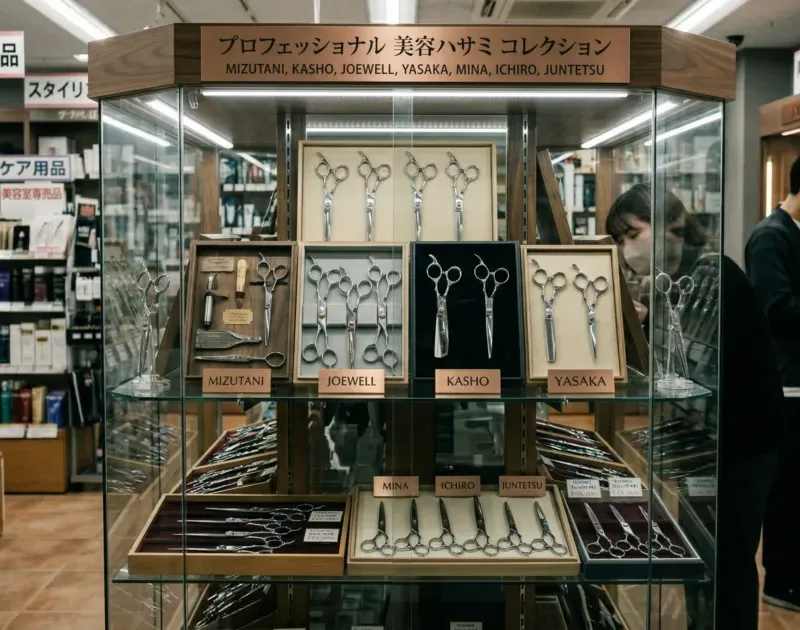
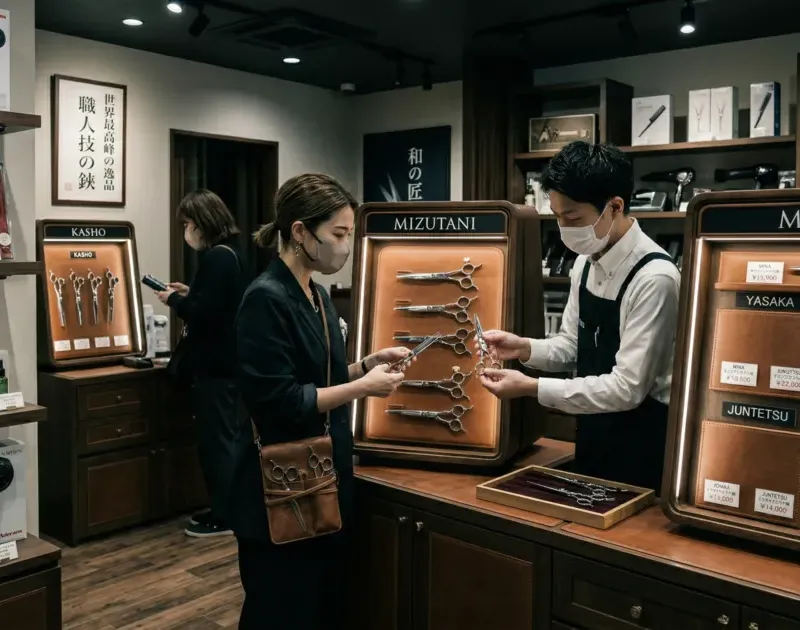
| Factor | Japanese brands (Yasaka, Joewell, Mizutani) | German brands (Jaguar Solingen, Tondeo, Witte) |
|---|---|---|
| Entry tier | Value-focused Japanese lines (Ichiro, Mina) | Value-focused German lines (Jaguar Jay, Pre Style) |
| Professional tier | Mid-spectrum pricing with broad model coverage | Mid-spectrum pricing with classic ergonomics |
| Premium | High-spec alloys and bespoke builds | Flagship hardened steels and limited editions |
| Australian distribution | Strong through specialist retailers | Broad through salon wholesalers |
When to choose Japanese
- You prioritise slide cutting, point precision, or dry detailing.
- Ergonomics and light weight matter for long salon days.
- You have access to a trusted convex sharpener.
- You want to expand into premium craftsmanship (Mizutani, Hikari, Kasho).
When to choose German
- You focus on blunt lines, barbering, or scissor-over-comb with coarser hair.
- You prefer a firm, tactile feel and do not mind extra weight.
- Local sharpening options are limited to bevel specialists.
- You supply teams need durable tools without premium servicing costs.
Hybrid approach
Many pros carry one of each:
- Primary: Japanese convex shear (5.75”) for precision and finishing.
- Secondary: German micro-bevel shear (6.5”-7.0”) for heavy lifting and barbering.
- Backup: Value Japanese set (Mina or Ichiro) for apprentices or travel.
Final perspective
Neither origin is objectively “better.” It is about matching tool characteristics to your clients, technique, and support network. Map your needs, test both styles in hand, and choose the combination that keeps you cutting comfortably and confidently—and if you want a second opinion before you buy, reach out and I’ll weigh in.
Stay sharp — join the list
New product drops, maintenance tips, and member-only deals delivered to your inbox.