Powder Metal in Hair Shears: Read the Maker’s Term
Separate the material, its production and a powder-polished surface.
By JapanShears EditorialUpdated
On this page
Powder metal and powder polish answer different questions
A powder-metal statement concerns the material’s production. A powder-polished finish concerns a surface treatment. Keep the full maker term beside the model: similar wording can describe quite different parts of a shear.
You may encounter “Nano Powder Metal” as a listing label. That wording alone supplies no particle size, alloy grade or finished-tool hardness. Look for the maker’s actual material description before treating it as a more specific claim.
Two genuine powder-material descriptions
Joewell identifies the Supreme SPM as Powder Metal Alloy. Its SPM model reference also specifies the Sword & Flat blade and dry-bearing screw system. Those are separate construction details on a 5.5-inch cutter.
Kasho uses another term for the Millennium Offset 5.5: SG2 sintered steel. Its Millennium reference identifies that material alongside the Disc Operation System. Keep SG2 attached to this series rather than assigning it to every Kasho shear.
Takefu’s material catalogue separates powder steels from its VG10 and VG10W stainless entries. That gives you useful material vocabulary. It does not establish which supplier made a particular shear or replace the model’s own statement.
The finish example that catches people out
The Juntetsu KS is a fixed 6.0-inch cutter described as 440C with a powder-polished finish. Its old web address includes powder-steel, but the actual material and finish fields carry the useful meaning. Do not turn a finish into a powder-production claim.
 Open illustration at full size
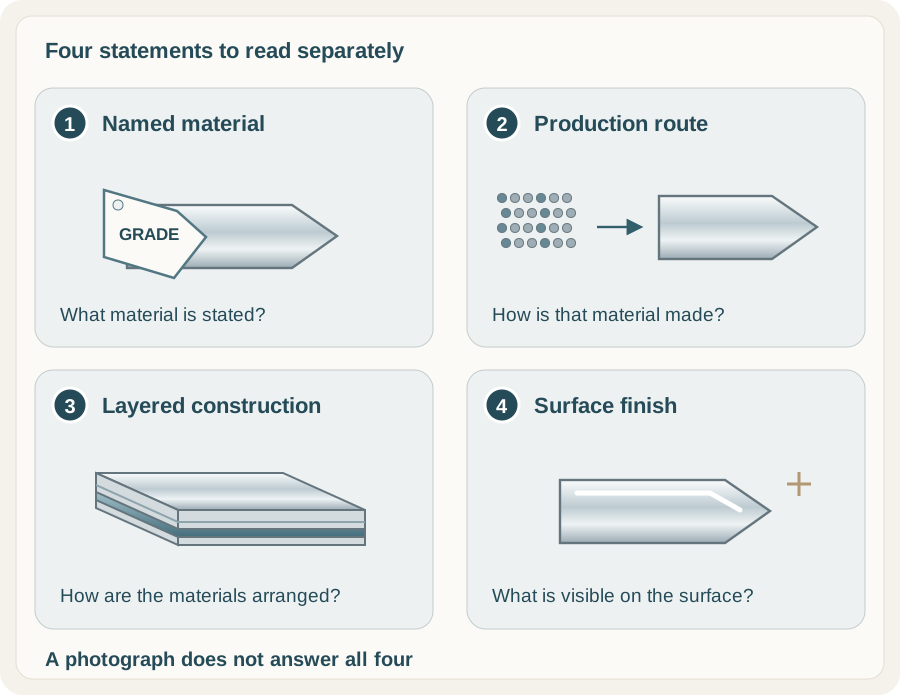
- Named materialThe stated grade or maker alloy name describes the material.
- Production routeA powder or sintered description concerns how the material is produced.
- Layered constructionThe core and surrounding layers describe an arrangement of materials.
- Surface finishPolishing, colour or a visible pattern describes the surface; ask for construction evidence separately.
The 440C guide explains the grade field. The VG10 guide separates that label from VG10W. A surface treatment, named alloy and blade grind can all appear in one specification without becoming interchangeable.
Compare the blade you will work with
Once the material is clear, return to the cutting job. Compare nominal size, separate blade measurements where supplied, cutting hand, blade line and handle. Powder production does not choose those for you.
The layered-versus-sintered comparison puts two complete Kasho models beside each other. The layered blade guide explains a different question: where a patterned structure and core sit relative to the edge. Use the service-led selection guide if you are still defining the cutter’s job.
For a kit, keep the material and role of each tool separate. The component-reading example shows why one impressive label cannot describe every piece in a bundle.
Follow the pivot’s instructions
Protect the edge and keep the tool clean and dry according to its own instructions. Its care requirements come from the whole construction, including the pivot.
For example, Kasho’s care reference excludes Millennium from its general oiling and tension-adjustment directions. That is a model-family instruction, not a powder-steel exemption. Keep the supplied care information with the tool record and use the ownership hub when you need the next step.