Razor Anatomy: Holder, Blade and Guard
Four useful names for comparing a tool and its refill.
By JapanShears EditorialUpdated
On this page
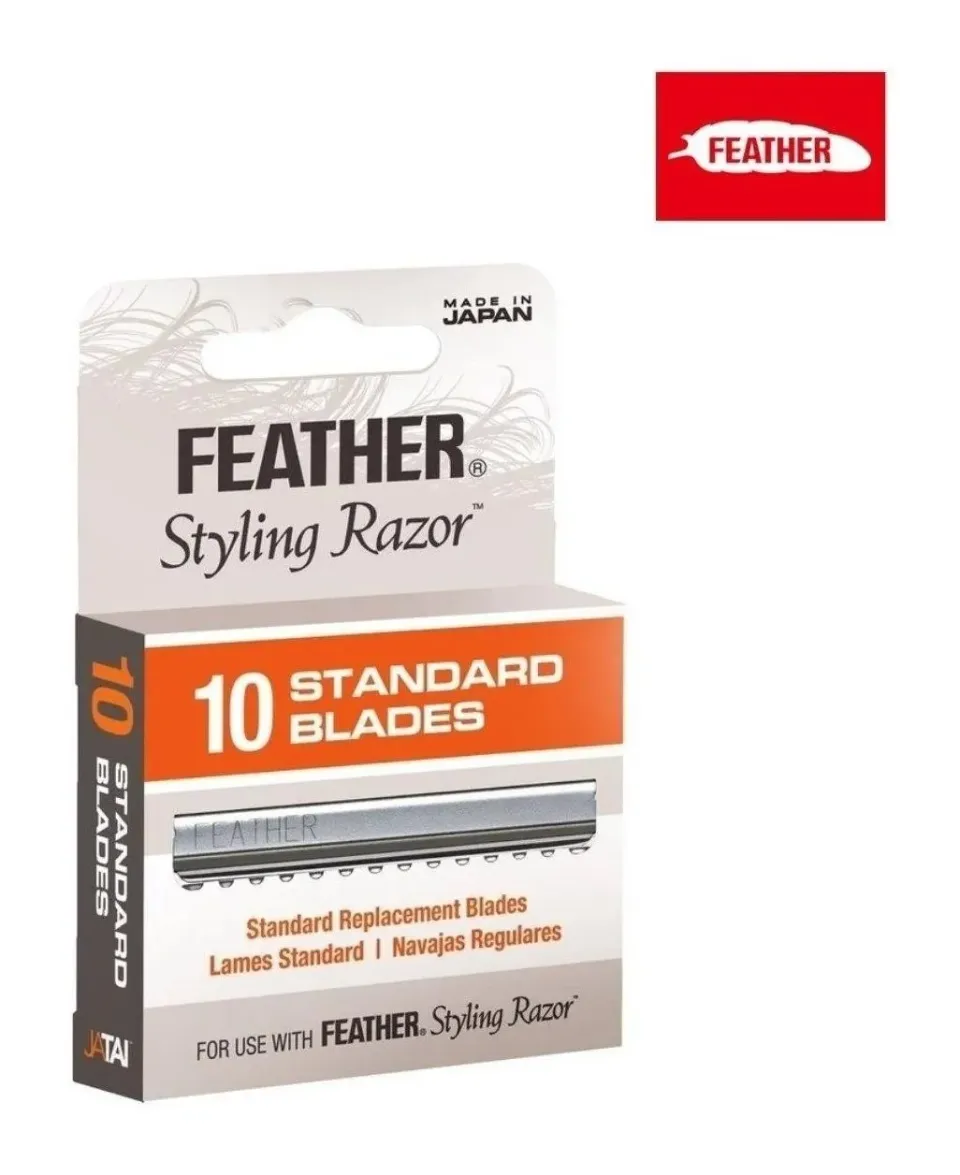
When you say “razor”, you might mean the complete tool or just its replacement blade. Separating those parts makes the next order easier: you keep the handle and holder, then buy the blade family that fits them.
Start with the compatibility map if you need a refill now. The illustration below explains the construction terms behind that choice.
Follow the connected parts
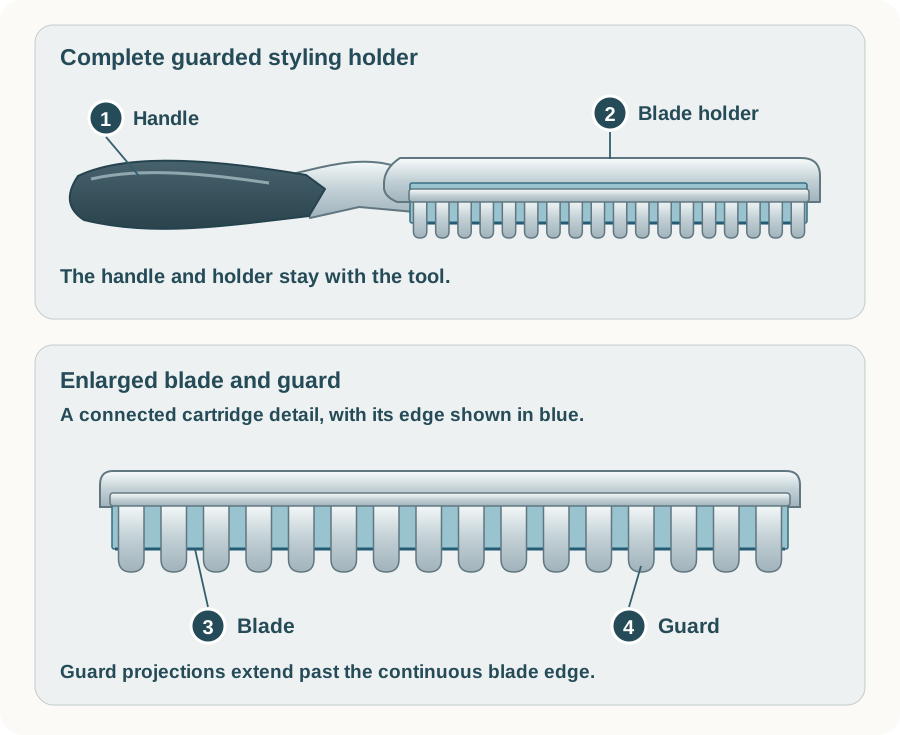
The handle is the part you hold. The blade holder supports the compatible replacement. In this generic guarded Styling example, the replacement combines a continuous blade with a comb guard that projects beyond the cutting edge.
 Open illustration at full size
- HandleThe part held during work. A folding handle is a separate construction choice from blade compatibility.
- Blade holderThe retained part that supports the compatible replacement cartridge. Its model determines which refill family to buy.
- BladeThe replaceable cutting element. The blue line follows its continuous edge through the spaces in the guard.
- GuardProjections extend beyond the edge in this generic comb-guard example. A blade guard differs from a cover used for storage.
Follow the blue blade line through the gaps between guard projections. Those projections are joined to the guard’s continuous backing. The drawing separates the features so you can name them; it does not show how to load a cartridge or identify a particular Feather model from its silhouette.
A blade guard also differs from a cover used for storage. A folding handle that encloses a holder when closed does not, by itself, put a guard along the working edge. The Plier holder, for example, takes its dedicated unguarded PLI-20 blade.
Styling guards have different layouts
The common Feather Styling family offers Standard, Texturising and WG refills. These are supported choices for the Standard and Short holders.
Feather’s Styling reference identifies TG-10 as the thinning blade and WG-10 as a separate guarded design. The official catalogue, printed page 10, shows the Texturising design’s additional guard notches and smaller exposed blade area beside Regular. Read that as a construction difference. It is not a promised percentage of hair removed from your section.
Keep the exact pack in view as well. We have not confirmed that the local Standard ten-pack is the EX generation; the separate fifty-blade carton is explicitly Regular EX. Avoid transferring the current EX measurements to every packet called Standard.
PB and PG belong to another family
The Artist Club SS folding holder uses Feather Professional blades. Its PB Professional option is unguarded. The PG Proguard option has a semicircular blade guard, a different shape from the generic comb guard drawn above.
Feather describes those designs on its Professional page. A single exposure figure cannot describe every mounted combination: the holder is part of that geometry. PB and PG names therefore need to stay attached to their own blade family and exact holder.
Use the terms to make a clear order
Write down the holder name, supported blade family and desired pack quantity. The pack-size guide shows why a maker’s dispenser code and the total selected quantity can differ.
A guard is a construction feature, not permission to skip training or the maker’s instructions. Your educator and workplace process govern actual use, loading, cleaning and disposal. For buying help, those four names—handle, holder, blade and guard—let you ask a much more precise question.