Choose a shear size: whole tool and blade
A 6.0-inch shear does not have a 6.0-inch cutting blade. Read the nominal tool size and the blade measurement separately, then compare both with a shear you know well.
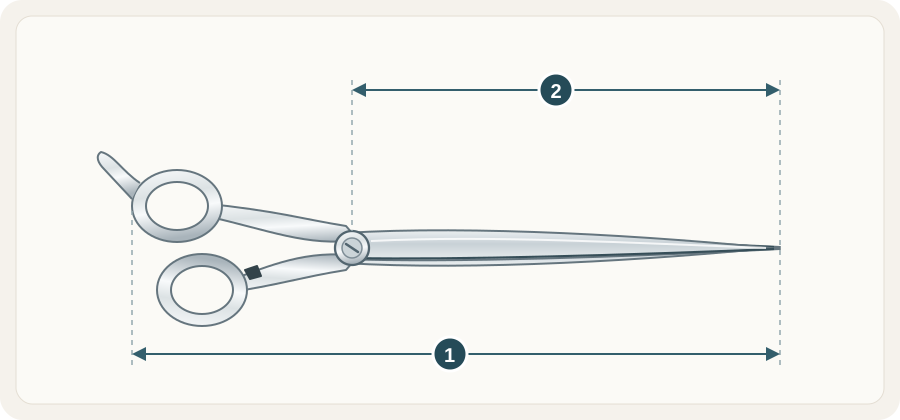 Open illustration at full size
- Overall tool lengthCompare the maker’s stated whole-tool size. Finger-rest treatment can vary.
- Blade lengthA separate blade measurement. Check the model specification rather than converting its nominal inch label.
Read the maker's measuring convention
The inch label is a nominal size used to identify the complete shear. Makers may also publish a full length in millimetres and a separate blade length. Do not calculate a cutting-blade length by converting the nominal inches.
Check how the finger rest is treated. Joewell's specification list says its size excludes a removable finger rest and includes a permanent rest. Use the maker's convention when comparing its figures with a ruler measurement.
A real example: Yasaka SL
Yasaka publishes the following figures for the SL-5.5 and SL-6.0. The nominal model size, full length and blade length are three distinct entries.
On a narrow screen, swipe across the measurement table to see every column. With a keyboard, focus the table area and use the arrow keys.
| Model | Nominal size | Full length | Blade length |
|---|---|---|---|
| SL-5.5 | 5.5 inches | 145 mm | 56 mm |
| SL-6.0 | 6.0 inches | 158 mm | 68 mm |
These are maker specifications, not measurements taken by JapanShears. The SL and FX comparison also shows why equal nominal sizes can have different blade lengths.
Use a familiar tool as your starting point
- Note your current shear's model and nominal size. If you measure it, record the endpoints and whether the finger rest is included.
- Describe the change you want: closer tip placement, more cutting reach or a different ring layout.
- Compare the candidate's blade figure where the maker supplies it. If it is unstated, ask for that measurement rather than substituting the overall size.
- Check hand, handle and edge before choosing the exact size option. Length alone does not establish fit.
A compact cutter can be a useful starting point for close detail; a longer blade can give more reach for sections or comb work. Let your current control and the work you want to change guide that comparison. A palm or finger-length rule cannot account for every handle and blade design.
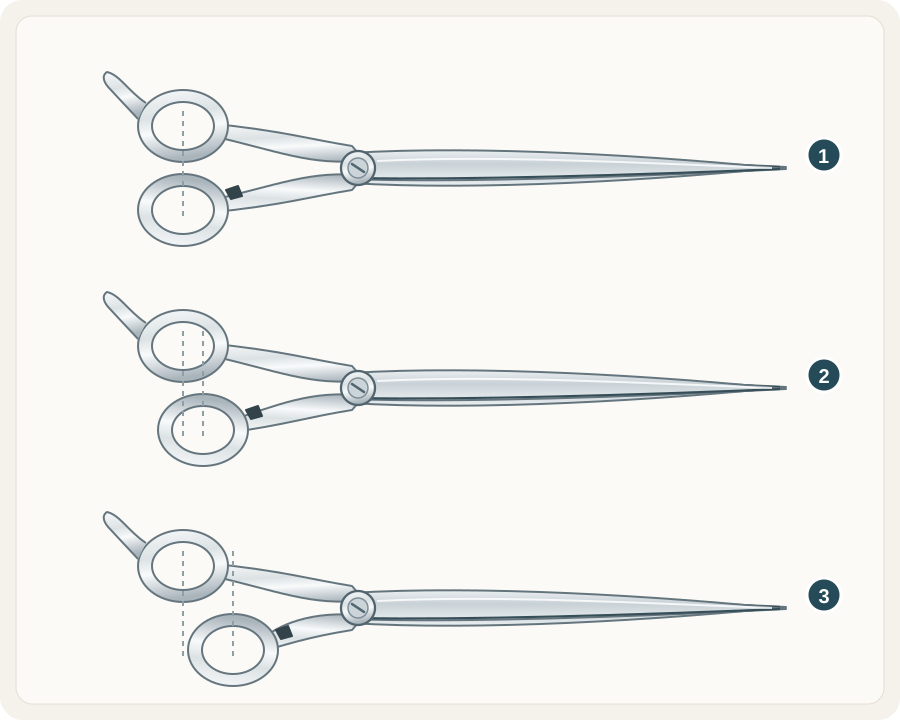 Open illustration at full size
- Straight / in-lineThe rings sit at a similar distance from the pivot.
- Semi-offsetA small difference between the two handle lengths.
- OffsetThe thumb ring sits closer to the pivot. Compare it with your present tool.
Read both sizes in a set
A set option can name the cutter size while keeping the thinner fixed. The Mina Sakura II set offers cutters from 5.0 to 7.0 inches, each paired with a 6.0-inch, 30-tooth thinner. Its 7.0-inch cutter option does not include a 7.0-inch thinner.
Size changes can also change an edge. The edge guide shows the Ichiro Apprentice's 5.5-inch convex slice and 6.0-inch micro-serrated options.
Choose the named option
Use the buyer guide to put size alongside the other construction choices, or use the Shear Finder to apply your hand, length and budget to its selected range. Read the product's complete option name before ordering.
If two size descriptions are hard to reconcile, send us the model names and selected sizes. Include your present shear as a reference so we can see what you want to keep or change.