Forged, Cast, Heat-Treated: What Those Words Mean on a Shear Listing
Process words describe one step in making a shear. They are not quality grades.
By JapanShears EditorialUpdated

On this page
Process words sound like quality words. “Forged” feels better than “cast”, and “cryogenic” sounds better than nothing. In practice each term describes one step in making a shear, and the steps combine in many ways.
Short answer. Forging, casting, stamping and machining shape the blank. Heat treatment, sub-zero treatment and refining change the steel’s condition. None of these words, by itself, tells you that one model is better than another. Ask what the term applies to (blade, handle or both), then look for the maker’s published hardness and care notes.
Key takeaways
- Shaping and treating are different steps. A listing can name one, both or neither.
- The steel grade alone does not specify the finished hardness or toughness.
- A hardness figure measures resistance to indentation, not sharpness or toughness.
- A well-treated stamped blank can outperform a badly treated forged one, so “forged?” is never the only question.
- A claim like “ESR steel” or “cryogenic” is a prompt to ask for details.
How are shear blades shaped?
Four routes are common, and they can be mixed in one shear.
| Word | What it describes | What it leaves open |
|---|---|---|
| Forged | Steel shaped hot by hammer or press, so the grain follows the shape | Whether the handle, the blade or both were forged, and by hand or machine |
| Cast | Liquid steel poured into a mould (often investment casting), which suits complex 3D shapes | The steel, the treatment and whether the blade is cast or just the handle |
| Stamped | A blank punched from plate, then ground | The grade, grind quality and heat treatment |
| Machined from solid | A blank cut and ground from stock, including CNC work | The same list: grade, treatment and finishing |
Japanese listings may also use graded forging terms: true forging (本鍛造), hammered blades (打刃物), machine forging (機械鍛造) and handmade (手作り). Labels vary by maker, so ask which step they mean.
Hybrid builds are established engineering: a maker may cast an ornate handle, make the blade from a different alloy and weld them. Ask whether blade and handle share a process.
What does heat treatment add?
Heat treatment controls the microstructure, and so hardness, dimensional stability and damage tolerance. For hardenable stainless blade steels the usual stages are:
- Annealing: softening or stress relief before or between forming stages.
- Hardening (quenching): heating to the grade’s range, then cooling at a controlled rate.
- Tempering: reheating to balance hardness and toughness.
- Sub-zero treatment: an optional cold step at a defined point.
There is no generic scissor-steel schedule. Mills publish different conditions for different grades, and furnace atmosphere, hold time and section size all matter. A steel name does not tell you what was done to it.
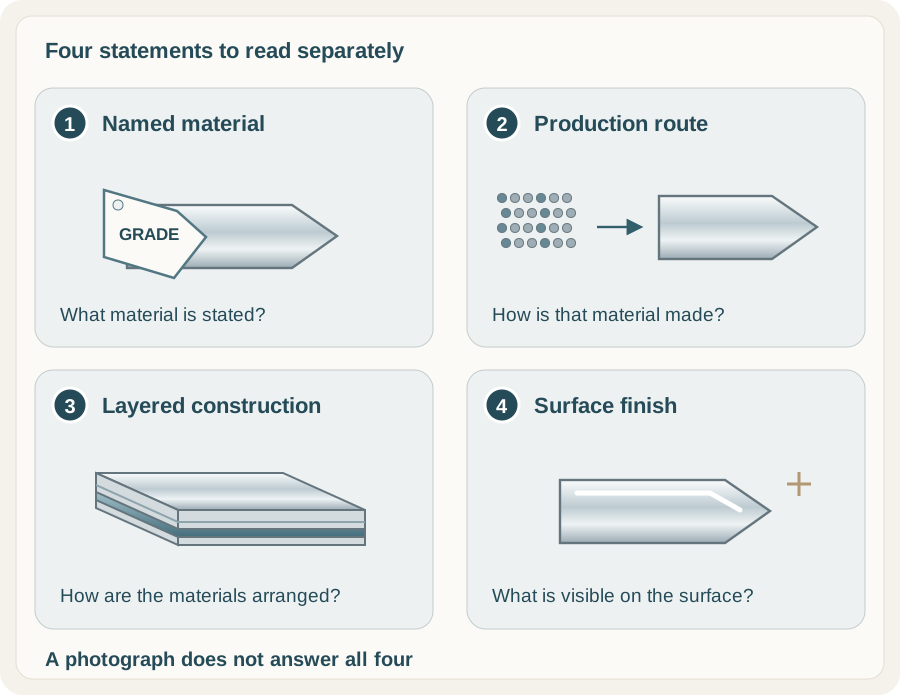 Open illustration at full size
- Named materialThe stated grade or maker alloy name describes the material.
- Production routeA powder or sintered description concerns how the material is produced.
- Layered constructionThe core and surrounding layers describe an arrangement of materials.
- Surface finishPolishing, colour or a visible pattern describes the surface; ask for construction evidence separately.
What does a hardness number tell you?
HRC and HV are indentation scales. A number measures resistance to being dented, not sharpness, toughness, corrosion resistance or edge life. A mill’s published hardening hardness is a response under its own process, while a shear maker’s finished-blade figure includes its chosen temper. The two are different kinds of number, and one cannot be turned into the other.
Conversions between HRC and HV are approximate and alloy-dependent, so avoid them. Our HRC guide explains how to read the figure.
What is cryogenic or sub-zero treatment?
Sub-zero treatment is a controlled low-temperature step inside a heat-treatment cycle. It can transform some retained austenite left after quenching and can improve dimensional stability. Its value depends on the exact steel, timing, soak and later tempering.
It is not required for every steel, and colder is not automatically better. Makers publish different named processes at different temperatures, so one maker’s figure cannot be copied to another model. Sub-zero treatment changes the condition of existing steel. It does not create a new alloy or make up for unsuitable geometry, grinding or care.
What are refining processes like ESR and VAR?
ESR and VAR are secondary remelting steps that clean already-made steel of non-metallic particles and gases. At a fine cutting edge such particles can be weak points. Electroslag remelting (ESR) mainly removes inclusions, and vacuum arc remelting (VAR) mainly removes dissolved gases.
Common scissor grades are not typically sold as remelted steel. If a listing mentions ESR or VAR, ask for the mill datasheet for that steel instead of treating it as a category norm.
What should you ask a seller?
- What does “forged” (or “cast”) apply to?
- Is the blade the same process as the handle?
- Does the maker publish finished-blade hardness, and on which scale?
- Is a sub-zero or refining claim stated by the maker or only by a reseller?
- What care and service does the maker describe for this model?
We sell shears and have not run cutting tests, so we do not rank processes. The buyer’s guide shows where these questions sit among the others.
Common mistakes
- Reading “forged” as a grade. It describes how a blank was shaped.
- Assuming one process word covers the whole shear. Blade and handle can differ.
- Comparing a mill’s hardening figure with a finished-blade figure.
- Copying one maker’s sub-zero temperature to another model.
- Treating a rare process term as a rating.
Questions people ask
Is forged always better than stamped?
No. A well-treated stamped blank can outperform a badly treated forged one. Ask about steel, treatment and inspection.
Does a higher HRC number mean a better shear?
No. Hardness is one measurement, and the balance with toughness depends on the steel and the geometry.
Further reading
- HRC hardness on hair shears explained
- How Japanese shear steel names work
- Beyond the big five: other steel names on a shear listing
- Read a shear spec sheet line by line
- Maker, brand, distributor and seller roles
- The knowledge base and the hair shear glossary.
- Scissorpedia for general scissor reference.
Scissorpedia is a fellow member of the ShearAlliance (see ShearAlliance).