Hair Shear Glossary: Terms Explained
Plain definitions for the parts, edges, handles, steels and techniques you meet on a shear listing.
By JapanShears EditorialUpdated
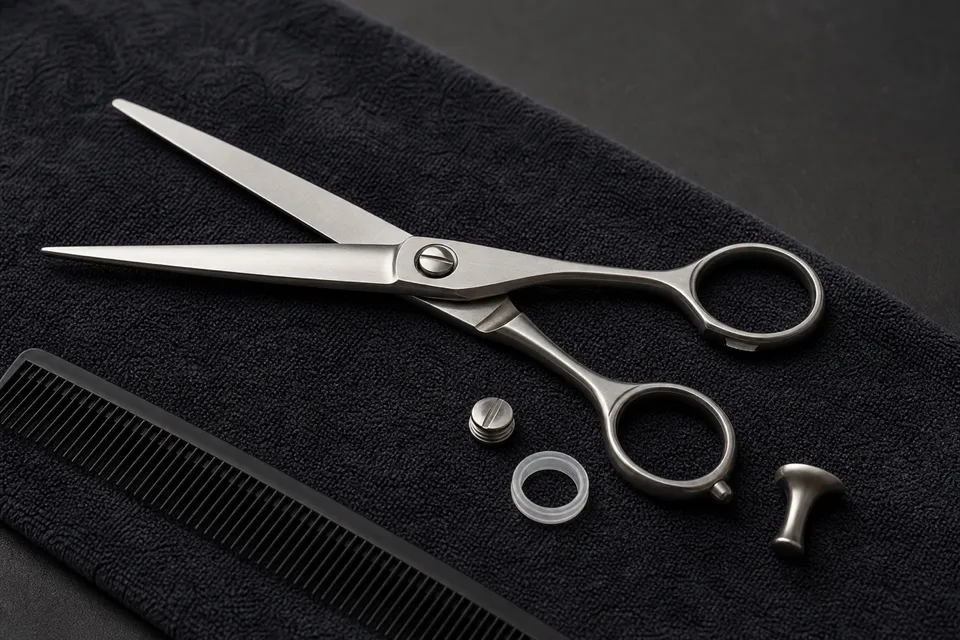
A hair shear glossary is a list of the words a shear listing uses, each with a plain definition. Use it to decode a specification before you compare models: find the term, read the one-sentence definition, then follow the link if you want the longer guide. Hair cutting scissors and professional hair shears are names for the same kind of tool.
Reviewed 4 November 2026. These are working definitions, not a universal manufacturer’s standard: makers use their own wording, so the exact listing and the maker’s model page always come first. For a shorter, illustrated set of twenty terms, see the 20-term scissor glossary. For the wider set of guides, start at the knowledge base.
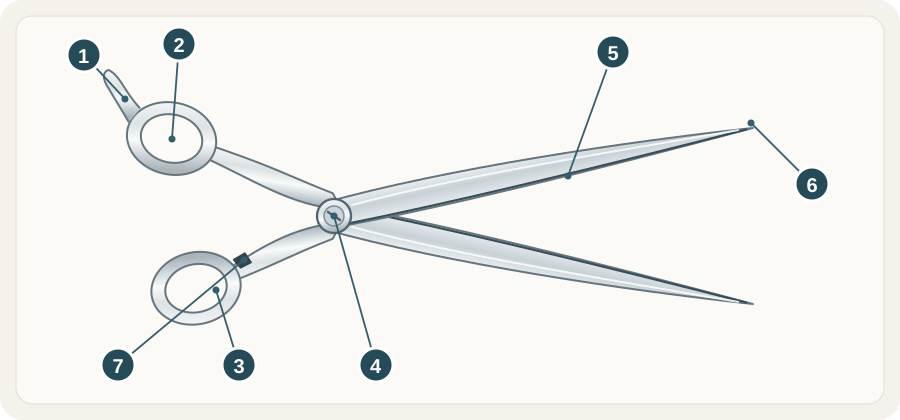 Open illustration at full size
- Finger restAlso called the tang; the small extension beside the finger ring.
- Finger ringThe bow on the handle opposite the thumb ring.
- Thumb ringConnected to the blade moved by your thumb.
- PivotThe joint where the two halves turn; tension hardware varies.
- Cutting edgeThe sharpened inner border where the blades meet.
- TipsThe ends of the blades. Compare their shape on the actual model.
- BumperA small stop between the handles, sometimes called a silencer.
Find a term
Choose a letter or a term. Every term has its own link, so you can share the exact entry.
0-9: 440C
B: Bamboo-leaf blade · Bevelled edge · Blade · Blade holder · Blade length · Blade set · Blender · Blunt cutting · Bumper
C: Chunker · Cleaning · Cobalt · Convex edge · Crane handle · Cut ratio · Cutter · Cutting edge · Cutting hand
D: Damascus · Density · Disinfection · Dry-bearing screw
F: Finger rest · Fixed thumb · Forged and cast · Full length
G: Guard
H: Hair types (1A to 4C) · Hakei (blade section) · Hamaguriba · Hasen (blade line) · Heat treatment · Heel · Hollow grind · HRC
L: Left-handed shear · Lubrication
M: Made in Japan · Micro-serration
P: Pitting · Pivot · Point cutting · Powder metal
R: Ride line · Ring insert
S: Scissor-over-comb · Semi-offset handle · Servicing · Set · Shank · Shrinkage · Slide cutting · Sori · Stainless steel · Steel designation · Strand diameter · Sub-zero treatment · Swivel thumb · Sword blade
T: Tension · Texturiser · Thinner · Tip · Tip groove · Tooth count · Tooth gap · Tooth orientation · Tooth shape · Touch point
U: Urasuki
Z: ZA-18
0-9
440C
440C is a stainless steel designation that some shear listings name as the blade material. It tells you which grade the maker states, not how the finished tool will cut or feel. Read it beside the edge, hand, handle and nominal length, as the 440C guide shows with real models.
A
Alloy
An alloy is a metal made by combining a base metal with other elements, and on a shear listing it names the stated blade material. A named grade needs a maker’s statement for the exact model, because a shiny finish or a country label does not identify the alloy. See the steel library.
ATS-314
ATS-314, also written ATS314, is a steel designation that Yasaka describes as a cobalt stainless cutlery steel. It appears on several Japanese professional shears. Treat it as one field in the specification, not a whole-tool rating; the ATS-314 guide compares two makers’ cutters built around it.
B
Bamboo-leaf blade
A bamboo-leaf blade is a broad, curved blade outline seen from above, used in some designs made for motion cutting. The name describes shape and intended application, not an alloy grade or a tooth pattern. The blade vocabulary guide separates it from edge and profile terms.
Bevelled edge
A bevelled edge is a cutting edge formed with a defined flat bevel approaching the cutting line. Some makers use their own wording, such as a flat single bevel, and keep it separate from their convex designs. Keep the maker’s term with the model. The convex edge guide compares the two.
Blade
The blade is the working part of each shear half, running from the pivot towards the tip. It is not the same as the nominal size of the whole tool, and the two blades of a pair are not always identical in form. Use the size guide to keep the measurements apart.
Blade holder
A blade holder is the part of a styling razor that carries the replaceable blade. Identify the holder first when you reorder, because refills only fit the system they were made for. The Feather compatibility map matches holders to blade families.
Blade length
Blade length is the working span of the cutting blade, often published by the maker in millimetres. It differs from the nominal size of the whole shear, and two cutters with the same inch label can publish different blade lengths. The barber reach guide shows a worked example.
Blade set
Blade set is a designed-in micro-gap that holds the two blades under light spring pressure. It is built in at manufacture and is not adjusted at the tension screw, so a heavy action that survives a clean, oil and tension check is a service question. It is separate from a set of tools. See Japanese scissor words decoded.
Blender
A blender is a toothed shear sold to soften transitions between sections, and the term overlaps with thinner and texturiser. A blender generally has finer teeth than a chunker, but each maker draws the line differently. Compare tooth count, spacing and cut ratio, as the thinner guide explains.
Blunt cutting
Blunt cutting is closing the blades across a section to create or refine a defined line. In this term, blunt describes the result, not a dull shear that needs sharpening. Tool choice depends on the movement you are taught, as the technique-to-tool guide explains.
Bumper
A bumper, or stopper, is a small part that limits how far the blades close and cushions contact between the handles on designs that have one. A missing or damaged bumper is a service issue, not a request for a sharper edge. Mention it in a service enquiry.
C
Chunker
A chunker is a toothed shear that generally has fewer, wider teeth than a blender and removes hair in larger sections. The word is not standardised, so judge the tool by its tooth count, spacing and stated cut ratio instead. Some pairs offer a choice, as the set comparison shows.
Cleaning
Cleaning is removing hair, product residue and other soil from a shear, and it is a different job from disinfection or lubrication. A visually clean shear is not automatically disinfected. Follow the cleaning guide and your workplace procedure, using products compatible with the shear.
Cobalt
Cobalt is an element that makers mention in two different ways: a cobalt stainless steel, or a cobalt-base alloy that is a separate material. The word alone does not rank one shear over another. The cobalt guide separates the two meanings.
Convex edge
A convex edge has a curved outer profile approaching the cutting line, rather than one flat bevel. It is a geometry term, not a material, and makers use variants such as semi-convex. It does not tell you blade length or curve. See the convex edge guide.
Crane handle
A crane handle is a fixed handle with a bent or more angled shank, which changes the handle’s relationship to the blade as well as the ring stagger. The name does not mean the thumb ring moves. Compare actual shapes in the offset and crane guide.
Cut ratio
A cut ratio is a maker’s stated removal figure for a particular thinning model under its own conditions. It is not the share of a whole haircut removed and cannot be worked out from tooth count. See the cut ratio guide for how to read it.
Cutter
A cutter, or cutting scissors, is a shear with two continuous cutting blades used to create or alter a line, length and shape. It does a different job from a thinner. Compare edge, blade line and handle in the cutting shears collection.
Cutting edge
The cutting edge is the sharpened working boundary of a blade, which passes its partner as the shear closes. Use edge when you mean wear, geometry or a nick, and blade when you mean the whole component. The edge guide covers common edge terms.
Cutting hand
The cutting hand is the hand a shear is built for, which determines the blade arrangement as well as the handle. A right-handed shear does not become left-handed when you turn it over. Read the left-versus-right guide and browse the left-handed collection.
D
Damascus
Damascus describes a layered blade construction, and it is a fair description only when the maker confirms the layers. A visible pattern alone cannot establish the core, the surrounding layers or the cutting edge. The powder Damascus guide explains what to check.
Density
Density is how much hair grows in an area of scalp, which is separate from the thickness of each strand. Many fine strands and fewer coarse strands can both be called thick hair, and they behave differently. Use density and strand diameter separately; the fine-hair guide explains why.
Disinfection
Disinfection is a hygiene step done with a specified method and product, and it comes after cleaning. The directions on the product label and your workplace rules decide how, and they must suit the shear’s finish and pivot. Oil does not disinfect. The cleaning guide separates the three jobs.
Dry-bearing screw
A dry-bearing screw is a pivot construction that some makers, such as Joewell, describe as maintenance free. Read the description with the care instructions for that exact model, because the term alone does not settle the procedure. The care routine explains why construction matters.
E
Edge retention
Edge retention is how well cutting performance persists under stated conditions. A general claim means little without those conditions, and no steel name gives a fixed number of haircuts or sharpening interval. Compare the model’s construction and care, using the steel library for material terms.
F
Finger rest
A finger rest, also called a tang, is the projection that supports the little finger on shears that have one. It may be removable or fixed, which can affect how a maker measures size. An extra rest does not make a shear suit both hands. See the size guide.
Fixed thumb
A fixed thumb is a thumb ring joined to its shank so it does not move independently of the blade. A fixed-thumb shear can still have an in-line, offset or crane handle, and its blades still open at the main pivot. Compare it with a swivel in the fixed-versus-swivel guide.
Forged and cast
Forged, cast, stamped and machined describe how a blade blank was shaped. They are process facts, not quality grades, and heat treatment is a separate step. Ask what the word applies to (blade, handle or both). See forged, cast and heat-treated listing words.
Full length
Full length is the maker’s stated overall length of the whole shear, often in millimetres, and some makers publish it beside a nominal size and a blade length. Compare it only with another full-length figure. The size guide shows the three entries side by side for one model.
G
Guard
A guard, on a styling razor blade, is a comb-like part that projects beyond the cutting edge to control how much of the blade meets the hair. It is not the same as a cover used for storage. The razor anatomy guide explains the parts.
H
Hair types (1A to 4C)
The 1A to 4C grid is a visual vocabulary for hair pattern: 1 straight, 2 wavy, 3 curly and 4 coily, with letters for tighter pattern. It does not measure density, strand diameter or condition, and charts draw the boundaries differently. See hair types 1A to 4C and your shears.
Hakei (blade section)
Hakei is the Japanese trade word for the shape of the blade seen end-on, such as clamshell, sword or flat. It is recorded separately from the blade line (hasen), and makers define each section word for their own ranges. See Japanese scissor words decoded.
Hamaguriba
Hamaguriba is Japanese maker vocabulary for a rounded, clamshell-style convex blade section that keeps supporting thickness behind a fine edge. Curvature and inner relief vary by maker, and it is not identical to the English word convex. See Japanese scissor words decoded.
Hasen (blade line)
Hasen is the plan-view line of the cutting edge, running from comparatively straight to strongly curved. It shapes how a maker intends the blade to hold or release hair, though no name maps to a fixed radius. See the blade line section of our Japanese words guide.
Heat treatment
Heat treatment is the controlled heating and cooling of steel, usually annealing, hardening and tempering, with an optional sub-zero step. It sets hardness and toughness. A steel name does not say what treatment a finished shear received, so look for the maker’s published hardness. See forged, cast and heat-treated listing words.
Heel
The heel is the part of the blade nearest the pivot. A problem that appears only at the heel differs from one at the tips, so record where it happens instead of calling the whole shear dull. The changed-cut guide shows how to describe a location.
Hollow grind
A hollow grind is a relief, or slight concavity, on the inner face of the blade in the constructions that use it. It describes the inside surface, not the outside edge profile, so a hollow-ground blade can also have a convex edge. The blade vocabulary guide separates these features.
HRC
HRC is a reading on the Rockwell C hardness scale, and it measures hardness only. It is not a score for sharpness, toughness, comfort or value, and a catalogue figure is not a test of the finished shear. Read it as one field in the steel library.
I
In-line handle
An in-line handle, also called traditional, level or symmetric, places the thumb and finger rings at a similar distance from the pivot. It describes ring position, not cutting hand: an in-line handle can be built for either hand. Compare it with offset layouts in the handle guide.
L
Left-handed shear
A left-handed shear is built with the blade arrangement reversed for the left hand, so it is a construction difference, not a grip preference. Symmetrical rings do not establish it, and turning a right-handed shear over does not create it. See the left-handed shortlist.
Lubrication
Lubrication is applying oil to moving parts where the maker recommends it, and it is not cleaning or disinfection. Use the oil, amount and method the model’s instructions give, and wipe off the excess. Some models are excluded from a maker’s general directions; see the care routine.
M
Made in Japan
Made in Japan is a claim about where a shear was made, and it is separate from a Japanese brand and from Japanese steel. A listing can make one claim without the others, and a business address does not prove a place of manufacture. The brand versus origin guide explains each wording.
Micro-serration
Micro-serration is a fine pattern of small serrations along a cutter’s edge that helps hold hair as the blades close. It is separate from the large teeth of a thinner. Follow the maker’s technique guidance for the model; the convex edge guide compares serrated and smooth options.
N
Nominal length
Nominal length is the size name for the whole shear, usually in inches, such as 5.5 or 6.0. It identifies the model’s size class, not the cutting blade, and conventions vary between makers. Use it as a starting point and read the maker’s blade figure; the size guide explains.
O
Offset handle
An offset handle staggers the rings so the thumb ring sits closer to the pivot than the finger ring, and semi-offset describes a smaller stagger. Makers use their own contours, so look at the actual shape instead of the label. See the offset and crane guide.
P
Pitting
Pitting is small craters of lost metal in a surface. On stainless steel it is most often linked with chlorinated products, residue or damp storage. Polishing may change the look but does not restore the loss, so a pitted shear belongs with the maker or a specialist. See rust spots on shears.
Pivot
The pivot is the main joint that joins the two shear halves so the blades can open and close. It is separate from any thumb connection on a swivel design, and its screws, washers or bearings differ by model. Name the correct joint when you ask about care; see the care routine.
Point cutting
Point cutting is using controlled entries of the blade tips to alter a line or add texture. The name does not set a universal depth or angle, and it is a taught technique, not a tool feature. The technique-to-tool guide connects the movement to blade choice.
Powder metal
Powder metal describes how a material is produced, by forming it from powder, and it is a production term rather than a grade. Makers use their own names for the result, and a powder-polished finish is a different, surface-level claim. The powder metal guide explains the difference.
R
Ride line
The ride line is a narrow working contact region discussed in shear construction and servicing, where the blades meet as they close. It is not a coloured stripe or a polish line, and its condition belongs to the blade geometry and set. A technician should assess it; start with a service enquiry.
Ring insert
A ring insert is a compatible insert fitted inside a finger or thumb opening to make that opening smaller. It does not move the ring, shorten the tool or change the cutting hand. The fit guide separates ring opening from reach and ring position.
S
Scissor-over-comb
Scissor-over-comb is cutting hair held up by a comb, with the comb and shear working together to control length and shape. No single nominal length defines it, and reach and tip control both matter. See the barber reach guide.
Semi-offset handle
A semi-offset handle staggers the rings by a smaller amount than a full offset handle. Contours differ between makers, so the label is a starting point, not a measurement. Compare it with in-line and offset layouts in the offset and crane guide.
Servicing
Servicing is inspection and work that may address the edge, damage, adjustment or components, and sharpening is only one possible part. It does not automatically correct a damaged pivot or a missing bumper. See what to prepare before a service enquiry and the sharpening advice page.
Set
A set is two or more tools sold together, such as a cutter and a thinner, and each component has its own size, edge or teeth. The size you select may apply to only one of them. Read every component, as the set comparison explains.
Shank
The shank is the part of each handle that connects the ring to the blade. Its angle and bend are what distinguish a crane-style handle from a straight one, and they are separate from ring stagger. See the offset and crane guide.
Shrinkage
Shrinkage is the difference between the length of a stretched strand and its settled length, which is most noticeable in curly hair. It is not one fixed percentage for everyone, so judge a finished shape in the state the hair will be worn. The technique hub links to cutting guides.
Slide cutting
Slide cutting is a family of motion-cutting terms, including slice and stroke cutting, in which hair is allowed to move relative to the blades. Teaching varies, and some tools are designed for it. Check the maker’s intended use for the model; the technique-to-tool guide explains.
Sori
Sori is a slight lengthwise bow in each blade, commonly quoted at around 0.03 mm, that makes the blades meet at a single travelling contact point. It is built in at manufacture, which is why a dropped shear can cut differently with no visible damage. Take it to a qualified professional. See Japanese scissor words decoded.
Stainless steel
Stainless steel is steel with roughly 12% chromium or more, which forms a thin chromium-rich surface film that resists corrosion. It is not rust-proof: chlorinated products, residue and damp storage can still mark it. See rust spots on shears.
Steel designation
A steel designation is the stated material grade or maker alloy name, such as 440C, ATS-314 or Supreme Stainless Alloy. It is one construction field and does not predict how long an edge lasts. Use the steel library to read the whole term.
Strand diameter
Strand diameter is the thickness of one hair fibre, which is a separate question from density. Fine and coarse describe strands, while sparse and dense describe how many there are. Keep them apart when you describe a client’s hair or choose a tool; the fine-hair guide uses the distinction.
Sub-zero treatment
Sub-zero, or cryogenic, treatment is an optional low-temperature step inside a heat-treatment cycle. It can transform some retained austenite and improve dimensional stability, but its value depends on the steel and the rest of the process, so one maker’s temperature does not transfer to another model. See forged, cast and heat-treated listing words.
Swivel thumb
A swivel thumb is a thumb assembly with an extra connection that lets the ring move independently of the blades. A decorative pivot screw does not establish one, and its care can differ from the main pivot. The fixed-versus-swivel guide compares real models.
Sword blade
A sword blade is a reinforced blade-body profile, usually with a raised outer ridge, in the ranges that use the term. It does not by itself establish the cutting-edge finish or the steel. See the blade vocabulary guide and the sword-profile collection.
T
Tension
Tension is the operating resistance at the pivot, set through the model’s own adjuster, and it is neither sharpness nor a feel that is correct for every shear. Follow the maker’s method for your model in small steps. The care routine explains why a copied drop-test angle is not a target.
Texturiser
A texturiser is a toothed shear sold for a texture effect, and the word overlaps with thinner, blender and chunker. It is not a fixed tooth-count category, so compare the actual spacing and shape with the job. The thinner guide explains how.
Thinner
A thinner, or thinning shear, is a toothed shear that removes part of a section at each closure, leaving some hair uncut. A common design pairs one toothed blade with one continuous blade. See the thinning shear anatomy and the thinning collection.
Tip
The tip is the far end of each blade, used for placing the shear precisely. A fine-looking tip is not proof of precision or of suitability close to skin, and tip shape is only one part of reach and control. The barber reach guide uses the tip as a landmark.
Tip groove
A tip groove is a small feature at the end of a thinner’s tooth, in the designs that have one. It is separate from tooth count and from the width of the tooth body or gap, so two thinners with the same count can differ. See the thinning shear anatomy guide.
Tooth count
Tooth count is the number of teeth on the toothed blade of a thinner. Keep it with the exact model and option, because a family can offer several counts. It does not tell you how much hair is removed; the same-count comparison shows why.
Tooth gap
A tooth gap is the space between neighbouring teeth on a thinner, and the teeth themselves are called tooth bodies. Gap width, body width and tip form change the result, even at the same tooth count. The thinning shear anatomy guide names each part.
Tooth orientation
Tooth orientation records whether the toothed blade is the static blade (standard) or the moving blade (reverse). It is independent of handedness and cut rate, and makers code it differently, so confirm it on the maker’s diagram. See the thinning shear anatomy guide.
Tooth shape
Tooth shape is the profile at the tip of each thinner tooth, such as V-groove, U-groove, flat or stepped. The names are maker vocabulary and do not set the cut rate. See thinning shear tooth shapes explained.
Touch point
The touch point is the single moving point where the two cutting edges cross as the shear closes, travelling from heel to tip. Its consistency is part of how a cut feels, and it depends on sori and blade set. See Japanese scissor words decoded.
U
Urasuki
Urasuki is the Japanese term for the concave hollow ground into the inner face of each blade, so that only the ride line touches the other blade. Depth is a design choice, and it is separate from the outer edge profile. See also hollow grind and Japanese scissor words decoded.
V
VG-10 and VG-10W
VG-10 and VG-10W are two separately named stainless steels on some shear listings, and the W is part of the stated material. Keep the full name when a model carries it. The VG-10 guide explains what each does and does not establish.
Z
ZA-18
ZA-18 is a steel name that appears in some shear descriptions, and a name on its own cannot identify a tool’s length, edge or role. Ask for the maker and model number so the claim has a shear to belong to. The ZA-18 guide suggests how to ask.
Keep reading
Put the terms to work with the listing walkthrough, then compare real options in the buyer’s guide. Questions about delivery, returns or care have short answers in the FAQ. For background on scissors in general, read Scissorpedia, an information website, or the general overview of scissors on Wikipedia.
Scissorpedia is a fellow member of the ShearAlliance; see ShearAlliance.