VG-10 vs 440C: Choosing a Shear
A worked comparison of two six-inch Juntetsu cutters.
By JapanShears EditorialUpdated
On this page
You can make a useful VG-10-versus-440C comparison without declaring one grade the winner. Choose two cutters for the same job, match a suitable size and handedness, then write down what changes. Here is that exercise with two six-inch Juntetsu models.
Keep the labels in their own columns
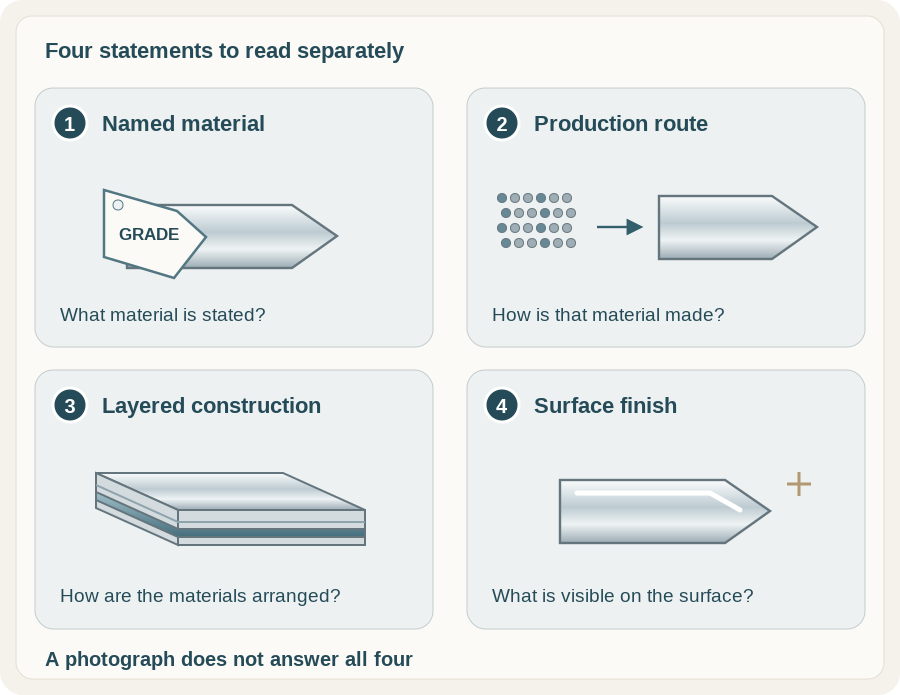
A material name identifies a stated grade. A production statement describes how a material was made. Layered construction describes how parts of a blade are arranged, while a finish describes its surface. One field cannot answer all four questions.
 Open illustration at full size
- Named materialThe stated grade or maker alloy name describes the material.
- Production routeA powder or sintered description concerns how the material is produced.
- Layered constructionThe core and surrounding layers describe an arrangement of materials.
- Surface finishPolishing, colour or a visible pattern describes the surface; ask for construction evidence separately.
For grade context, Böhler identifies N695 with AISI 440C and Takefu publishes a VG10 reference. Their material data is not a finished-shear test. The fuller 440C and VG10 guide explain those boundaries, including the separate VG10W label.
The actual pair
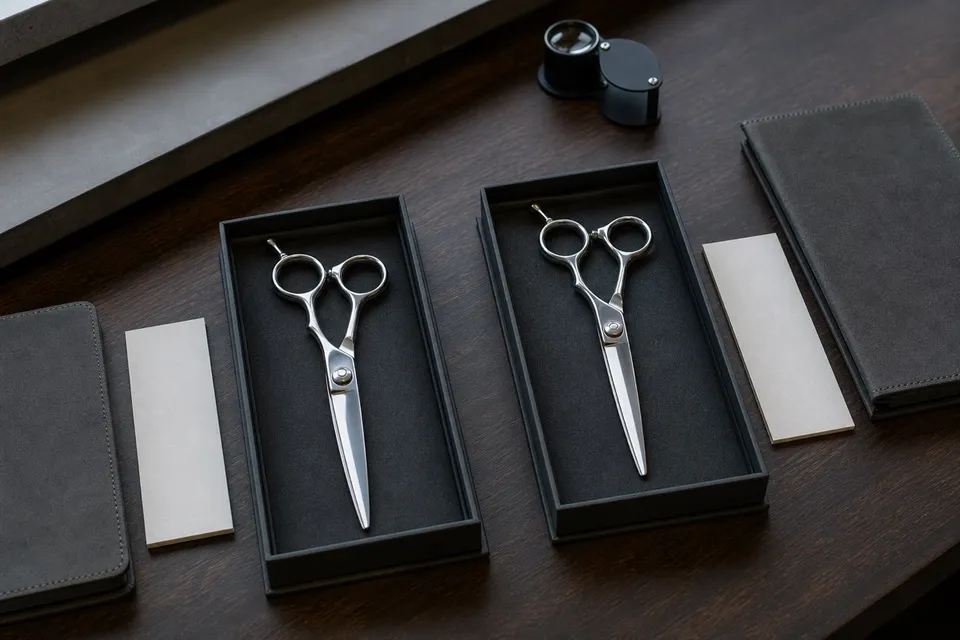
The Juntetsu KS, 6.0 inch lists 440C. The Juntetsu VG10 Offset, 6.0 inch lists VG10.
| Field | Juntetsu KS | Juntetsu VG10 Offset |
|---|---|---|
| Selected nominal size | 6.0 inch | 6.0 inch |
| Hand and role | Right-handed cutter | Right-handed cutter |
| Stated material | 440C | VG10 |
| Edge | Convex | Convex |
| Handle | Offset | 3D offset |
| Finish | Powder-polished | Polished |
| Local size choice | Fixed 6.0-inch model | 4.5, 5.0, 5.5, 6.0 or 7.0 inches |
Matching nominal size and hand makes this a useful shortlist. It does not make it a controlled material test. Handle contours and finish differ; “convex” is also a broad edge description rather than a measurement of every blade surface.
The KS’s powder-polished finish is especially easy to misread. It does not establish that its 440C was made by powder metallurgy. Use the powder-metal explanation if that process is part of your buying brief.
When the steel becomes the deciding field
The material question earns more weight once the other fields match. Narrow the choice to two cutters with the same size, hand, edge and handle family, and the stated grade becomes one of the few remaining differences, alongside finish and price. Even then, write down what you expect it to change. “How the edge responds to my sharpener” is a fair question; a promised number of weeks between services is not.
Both cutters here are Juntetsu, handmade in Japan, so this is a comparison within one maker’s range rather than between makers. Ask your sharpener before you buy whether they regularly service convex edges in VG10 and 440C. Their answer tells you more about living with either shear than a grade chart can. The rest of the range is gathered in the Juntetsu collection.
Turn the comparison into a decision
If you want a six-inch cutter with an offset layout, both options belong in the conversation. Ask which ring and shank shape fits the working grip you already use, and compare the actual blade line with the movement you want to make. The blade guide explains why a shared convex label does not settle that question.
If your main need is a different nominal size, the Offset offers local options beyond six inches. Selecting one changes the comparison: you are then choosing size and construction alongside the material. Start with the size guide and the cutter you know, rather than assuming the same inch label gives every model the same blade length.
Neither grade name supplies a reliable sharpening calendar or proves how either tool will cut in your hand. You have enough supported information here to choose a model for a clear reason: its size choice, stated build and fit in your shortlist. The service guide helps you put that reason into the work the shear will cover.