JapanShears Editorial · Published · Updated
Choosing Patterned Shears for Detail Work
Turn a patterned cutter preference into a practical detail-work buying brief, with real nominal-size and handle examples rather than a claimed salon test.
On this page
Start with the detail job
If you like a patterned cutter, give it a clear buying brief: the hand you cut with, where you need to place the tips, and the movement you want it to cover. The pattern may be part of what you like. It does not make every Damascus model a specialist detail tool.
This is an illustrative brief for choosing a cutter, not a salon test or a reported client result.
A short brief you can discuss
Suppose your familiar 5.5-inch cutter already gives you the reach you want. You are considering another cutter for finishing work around a completed shape. Keep that nominal size and cutting hand fixed initially, then ask:
- Can I see and place the working tips for the section?
- Does the maker describe a blade suited to the movement I practise?
- Which edge, blade line and handle would change from my familiar tool?
- What useful job would the second cutter cover?
For an apprentice, take that brief to the educator supervising the technique. The technique-to-tool guide separates closure, drawing along hair and work at the tips; it does not assign those movements from a steel name.
Two candidates, more than a pattern difference
A right-handed reader using 5.5 inches can examine Kasho Damascus Offset beside Kasho Green Semi-Offset. The handle layout changes as well: offset and semi-offset are separate starting shapes.
Kasho’s Damascus description identifies layered construction. The fit guide helps you compare ring opening and position against the cutter you know. Neither the pattern nor the common nominal size establishes identical blade reach.
Use the pattern and core explanation for the material question. For a broader pair comparison, read Damascus and sintered models.
Caring for a patterned cutter
A Damascus pattern comes from layered construction, and it is cared for like any other shear. Remove hair and moisture after each client, wipe both blades with a soft cloth and dry the pivot area. Store the cutter closed in its own slot.
Avoid abrasive pads on the blade faces. Follow Kasho’s instructions for oil and tension on the specific model, and tell a sharpener the model name and its original edge when you send it for service.
Writing the brief down
A brief that fits on one line is enough:
| Field | Entry |
|---|---|
| Hand and size | Right, 5.5 inches |
| Job | Finishing work around a completed shape |
| Change from current cutter | Handle layout, blade construction |
| Reason | A layout you want to try for detail work |
If the reason column only says “the pattern”, the cutter may still be a fine choice, but it is a preference rather than a kit need.
Decide whether a second cutter earns a place
Finish the brief with a reason: a particular reach, blade design or ring position you intend to use. If your current cutter already covers the job, the patterned finish can remain a personal preference without becoming a necessary kit upgrade.
The service-led selection guide helps keep that decision tied to work. The kit component example then separates a genuinely useful second cutter from the thinner that does another job. Record the selected model and its edge when arranging future care or service.
A closer look at shears
Comparing two models? Send us their names or SKUs and the cutting work you have in mind.
Latest blog posts
Read all blog posts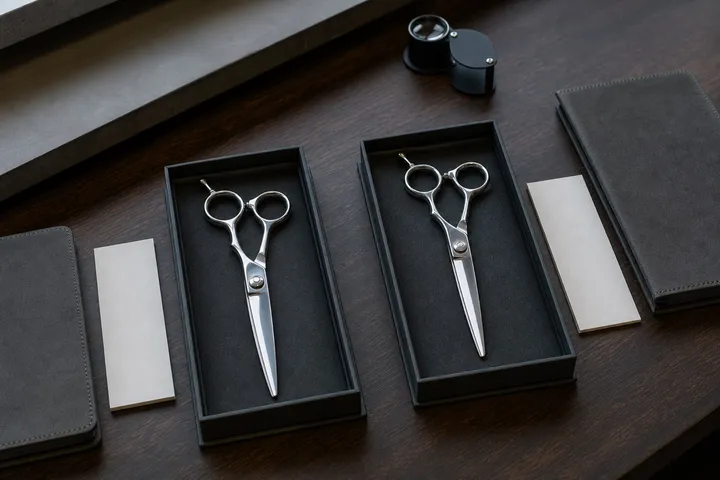
13 places to buy professional hair scissors online
Thirteen websites that sell professional hair scissors, listed A to Z, with a short box of things to check before you buy.
10 Christmas Gift Ideas for Hairdressers and Barbers
Ten gift ideas for a hairdresser, barber or apprentice, by situation: gift card, case, holster, care kit, combs, razor blades and a first-kit contribution.