JapanShears Editorial · Published · Updated
Reading a Patterned Shear Photograph
Read a patterned hair shear gallery alongside its maker’s material and construction statement, without treating surface lines as alloy or process proof.
On this page
A pattern is visible. Its specification needs words.
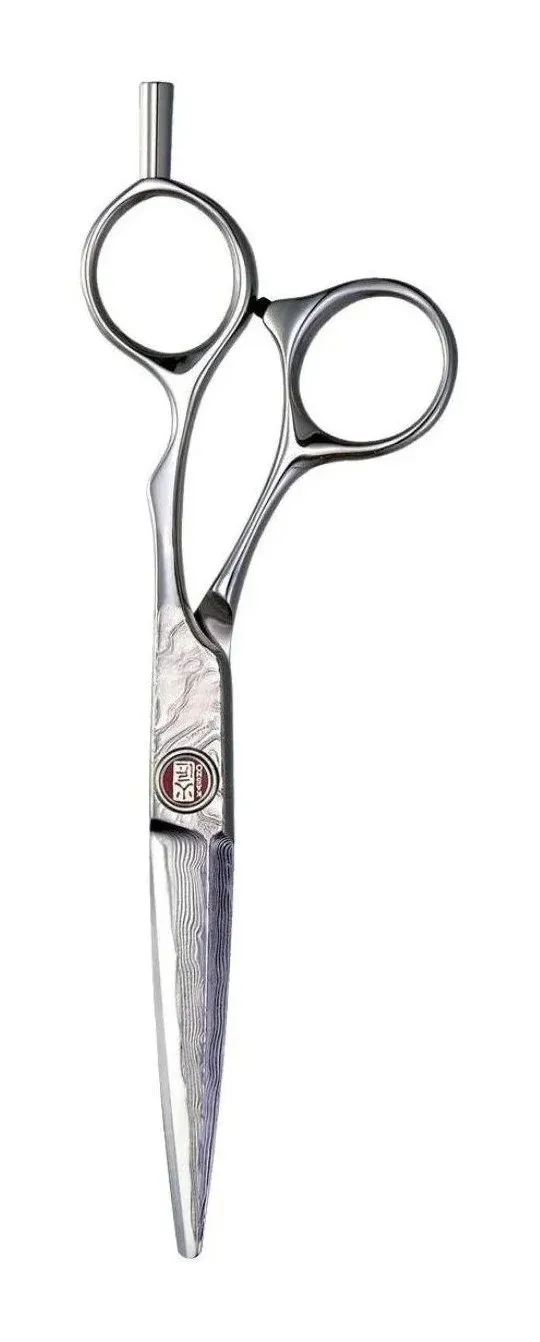
A product gallery can show a layered-looking surface, the blade outline and the ring layout. It cannot identify an alloy or tell you how the material was produced. Read the picture beside the named model’s construction statement.
The Kasho Damascus product gallery is a useful place to practise that distinction. Its genuine listing photographs show the model family. They do not, by themselves, identify which nominal-size option appears in every shot.
Separate the two kinds of evidence
| What to look for in the photograph | What to read in the specification |
|---|---|
| Visible lines or pattern on the blade | The maker’s statement about layered construction and core |
| Whole-tool outline and ring positions | Named handle layout and cutting hand |
| Pivot seen from the outside | Stated screw or bearing system and its instructions |
| Blade shape from the pictured angle | Edge term, nominal size and any separate blade measurement |
KAI Europe’s Damascus reference explicitly describes visible layers combined with a core steel. That statement supplies construction evidence which a surface photo alone cannot. It does not turn every patterned shear into the same structure or prove a powder-production route.
The layered guide gives those terms a generic cross-section. The powder-metal guide explains the separate production question.
Read the gallery with the selected option in view
Choose the nominal size you are comparing, then read the product details with that option visible. Treat a shared family image as a view of that family when its precise variant is not stated. Do not take measurements from a tilted photograph or count visible surface lines as the maker’s layer count.
If material identification or provenance is your concern, the authenticity guide explains the records to gather. Matching a pretty pattern to another photograph is insufficient evidence of the alloy or factory.
Three fields a patterned photograph tends to hide
A patterned blade draws the eye away from details that shape the cut more directly. Before you settle on a layered model, read three fields the picture cannot carry.
- The edge. The listing names the edge construction. A pattern across the blade face says nothing about the grind at the cutting line.
- The pivot. Note the screw or bearing system the maker states, and its care instructions. Two patterned shears can ask for quite different maintenance.
- The size option. One family gallery often serves every length. The Kasho Damascus, for example, is offered at 5.5, 6.0 and 6.5 inches; read the selected option, not the photograph.
Patterned surfaces also respond strongly to studio light. The lines can look bold in one image and faint in the next, which describes the lighting rather than a change in the material. Set the Damascus beside a plain-finish cutter from the 5.5-inch range and the shared fields become easier to compare.
Use the picture to ask a better question
A useful enquiry names the product and selected option, then the missing field: “Which material forms this model’s edge?” or “Does the maker specify powder production for this model?” It does not ask the pattern to answer both.
Once that question is settled, the detail-work brief turns the tool into a practical candidate. The Damascus-versus-sintered comparison shows how to keep material, pivot and fit differences together without inventing a cutting result.
A closer look at shears
Comparing two models? Send us their names or SKUs and the cutting work you have in mind.
Latest blog posts
Read all blog posts
13 places to buy professional hair scissors online
Thirteen websites that sell professional hair scissors, listed A to Z, with a short box of things to check before you buy.
10 Christmas Gift Ideas for Hairdressers and Barbers
Ten gift ideas for a hairdresser, barber or apprentice, by situation: gift card, case, holster, care kit, combs, razor blades and a first-kit contribution.