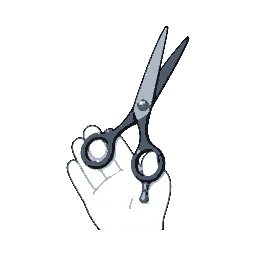
Best Left-Handed Japanese Shears (True Left-Grind)
Why a true left-grind beats a converted right-hander — and what it costs.
Left-handers have been sold short for years
I’m right-handed, but I’ve trained and worked alongside enough left-handed stylists in Sydney and Tokyo to know they get a raw deal. For years “left-handed” shears were just right-handed shears with the finger holes swapped — the blades still ground for a right hand. They look left-handed. They are not. And every left-hander who’s used one knows the feeling: you have to crane your wrist to see the cutting line, and the blades feel like they’re fighting you.
This guide is about the real thing — a true left-grind — and the honest premium that comes with it. Prices are GST-inclusive AUD, everything ships free Australia-wide, and you can browse the dedicated left-handed collection alongside this.
True left-grind vs mirrored/converted
Here’s what actually separates the two, and why it matters every single cut.
A shear cuts because the blades cross with a slight twist that keeps the edges in contact at exactly one point as they close — the “ride.” On a true right-handed shear, that geometry is built so the natural closing force of a right hand pushes the blades together. The blade bevel, the ride, and the screw tension are all ground for that hand.
- A true left-grind reverses all of that. The blades are physically ground and assembled in mirror image, so a left hand’s natural closing motion drives the edges together. The result: a clean, consistent cut, and — just as important — the cutting line sits where a left-hander can see it, on the correct side, without contorting the wrist.
- A mirrored/converted shear only swaps the thumb and finger holes. The blade ride is still set for a right hand. A left-hander closing it tends to push the blades slightly apart, which causes folding, pushing, and that maddening “it bends the hair instead of cutting” feeling. It also blocks your sightline to the cut.
Why does this matter so much for left-handers specifically? Because the cutting line — the edge you watch as you take your guide — is the whole craft. On a converted shear, that line is hidden by the top blade from a left-hander’s viewpoint, so you’re cutting partly blind. On a true left-grind it’s exposed. That single difference is worth more than any spec sheet.
The premium left-handers pay
I’ll be straight with you: true left-grind shears cost more, and there’s less choice. Left-grinds are made in smaller runs, the grinding is specialised, and you won’t find them discounted as often. Expect to pay a noticeable premium over the equivalent right-handed model, and to wait a little longer for some. That’s the reality — but a properly ground left shear that you can actually see your line with is worth every dollar over a converted compromise.
My true left-grind picks
| Shear | Steel/build | Best for | Approx. AUD |
|---|---|---|---|
| Ichiro Rose Lefty | 440C | Best-value true lefty | ~$199 |
| Yasaka Left-Handed | 440C, benchmark grind | All-day reliable workhorse | ~$449 |
| Kasho Design Master Offset LEFTY | VG-10, offset | Ergonomic precision | ~$429 |
| Joewell FX LEFTY | premium build | Top-tier finishing | ~$749 |
- Ichiro Rose Lefty — ~$199. Who it’s for: the left-hander who wants a genuine left-grind without a big spend. A clean 440C blade and the easiest entry into a real lefty. If you’ve only ever used a converted shear, this alone will change your day.
- Yasaka Left-Handed — ~$449. Who it’s for: the working left-handed stylist who wants Yasaka’s benchmark grind in a proper left build. This is the reliable, all-day workhorse I’d point most lefties toward.
- Kasho Design Master Offset LEFTY — ~$429. Who it’s for: the left-hander who cuts long shifts and wants offset ergonomics to protect the thumb, with VG-10 steel that holds its keenness. The ergonomic pick.
- Joewell FX LEFTY — ~$749. Who it’s for: the professional who finishes premium work and wants the smoothest, most refined true left-grind on the list. The top tier — and priced for it.
A note on one outlier: the Ichiro Matte Black (~$219) is built right-handed, but a few left-handed stylists who cut “right-handed by training” ask me about it. If you genuinely learned and cut with a right-handed grip, it’s a fine cobalt-grade 5.0” shear. If you cut left-handed, skip it and buy a true left-grind above — don’t talk yourself into a right-hander.
How I’d choose
If you’re starting out or testing whether a true left-grind is worth it, buy the Ichiro Rose Lefty — it’s the cheapest honest way to feel the difference, and most lefties are stunned by it. If this is your career and your daily tool, the Yasaka Left-Handed or Kasho Design Master Offset LEFTY are the sweet spot of grind quality and comfort. And if you want the best and will keep it for a decade, the Joewell FX LEFTY earns its price.
Whatever you pick, look after it — a left-grind is harder and dearer to replace, so follow my maintenance guide on cleaning, tension and storage. For the bigger picture on steel and sizing, the buyer’s guide and steel library are worth a read, and the full range lives in the left-handed collection.