Disinfectants and Your Shears: What to Check
The tool-care half of disinfection: protecting the metal once you know the method you must use.
By JapanShears EditorialUpdated

On this page
- Which rules come first?
- Why do makers give different instructions?
- What do the chemicals do to stainless steel?
- What should you check before you immerse or wipe?
- What do you do afterwards?
- What should you record?
- What if a shear looks damaged after a soak?
- Common mistakes
- Questions people ask
- Further reading
Disinfecting a shear is a hygiene question and a tool-care question at the same time. This page covers only the tool-care half: what to check so the method you are required to use does as little harm to the shear as possible.
Short answer. Follow your local requirements first, the disinfectant’s label second and the shear maker’s care notes third. A maker’s preference never lowers a hygiene requirement, and a compliant method can still be hard on a finish. If the two cannot both be met, do not quietly shorten the step. Keep the shear out of service and get direction.
Key takeaways
- There is no single correct disinfectant for every shear. Makers give different instructions.
- Chlorinated products have the best-documented pitting risk for stainless steel.
- Quaternary-ammonium products are generally less corrosive, but compatibility still varies.
- After any wet method: rinse where directed, dry fully, then oil. Oil is not a cleaner.
- A short record of what you used makes any later damage far easier to diagnose.
Which rules come first?
Local requirements come first, then the registered label of the product, then the maker’s compatibility notes. Each layer can add detail but none can relax the one above it.
This page does not set out local rules, because they differ and change. Check yours with the relevant authority. For handling chemicals safely at work, Safe Work Australia is the national starting point. What follows is about protecting the metal once you know the method.
Why do makers give different instructions?
Makers differ because their finishes, pivots and alloys differ. One maker recommends wiping with ethanol on a cloth, drying fully and oiling, and warns against soaking, boiling, steam and sodium hypochlorite. Another publishes a compatible immersion procedure: a listed disinfectant at exactly the product maker’s concentration and contact time, then rinse, complete drying and oil.
Both can suit their own models, so a routine from one range should not be carried to another. Read the care notes for your exact model.
What do the chemicals do to stainless steel?
| Class | Documented tool-care risk | What to remember |
|---|---|---|
| Sodium hypochlorite and chlorinated products | Oxidising and chloride-containing. A documented pitting risk, especially with long contact and in crevices | If accidental contact happens, rinse promptly, dry fully, oil as directed and inspect without touching the edge |
| Quaternary ammonium products | Generally less corrosive than hypochlorite | Not universally compatible. Formulation, residue, contact time, coatings and crevices all matter |
| Hair colour, perm products, cleaners, lubricants | Formulations vary too much for a reliable severity table | Remove accidental residue promptly. Do not improvise a neutraliser or use an unlabelled household cleaner |
Do not use abrasives, rust erasers, polish, an ultrasonic bath, boiling, steam or an autoclave on a precision shear unless its maker specifically authorises it.
What should you check before you immerse or wipe?
Run through this checklist.
- Maker’s care notes for the exact model. Do they allow immersion, wiping or neither?
- Label: concentration, contact time, whether a rinse is directed, and how long mixed solution stays usable.
- Dilution: measure it. Do not estimate.
- Pre-clean first, keeping your hands away from the cutting edge.
- Solution age: replace it as the label directs or when it is visibly soiled or diluted.
- Your local requirements: confirm the product and method are ones they accept before you start.
What do you do afterwards?
Finish every wet method the same way.
- Rinse thoroughly with water where the label or maker directs. Do not swap alcohol for a required rinse.
- Dry completely, including around the pivot and screw.
- Oil only after disinfection, rinsing and drying, using the maker’s approved oil and amount. Oil is not a cleaner or disinfectant.
- Store the shear clean and covered, never damp in a closed case. A dirty holster or case can undo a clean tool.
 Open illustration at full size
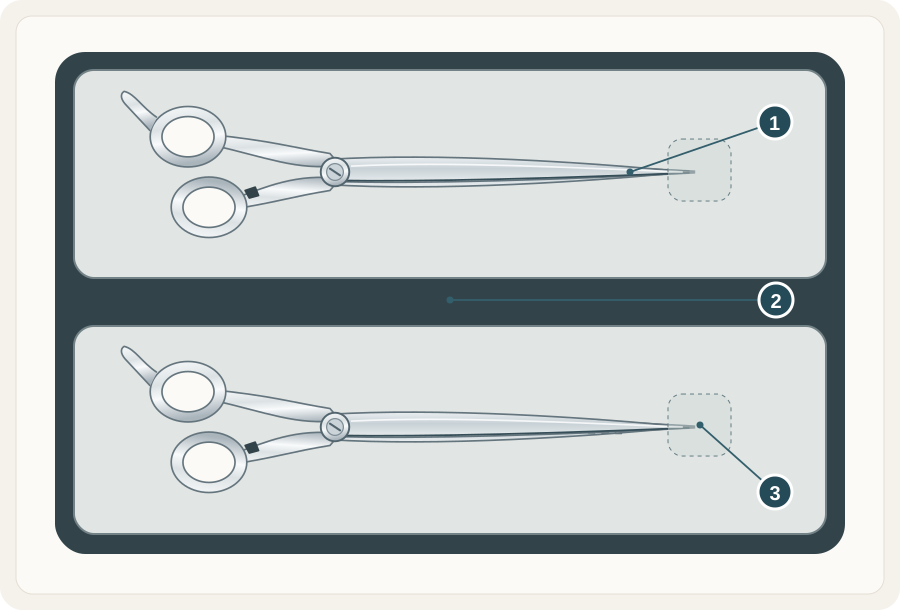
- Close the toolClose gently before carrying or storing it.
- Separate the toolsKeep cutting edges and tooth blades from meeting another shear or loose accessory.
- Protect the tipsPrevent the tool from sliding or being knocked in storage and transit.
Our oils and accessories guide covers the oil side, and the care routine puts the daily steps in order.
What should you record?
Keep a short note: product name and registration number where one applies, concentration, contact time, whether you rinsed and dried, the age of the solution, and the shear model. If staining, craters, gritty action or a changed edge appears later, that note is more useful than the jar alone. It lets a maker or specialist judge what happened. Our maintenance log guide shows a simple way to keep one.
What if a shear looks damaged after a soak?
- Take it out of the solution safely.
- Follow the label’s post-treatment directions.
- Dry and oil only as the maker directs.
- Keep it out of service if there is pitting, roughness, edge marks or altered action.
- Do not test the edge with a fingertip. Look under strong light.
Dark craters are lost metal, not a stain. Our rust spots guide explains how to read what you see.
Common mistakes
- Estimating the dilution instead of measuring it.
- Using alcohol in place of a rinse the label directs.
- Oiling before the shear is dry, or treating oil as the cleaning step.
- Closing a damp shear into a case.
- Carrying one maker’s routine across to a different model.
Questions people ask
Is ten minutes the most a shear can take?
No. A label can state a minimum or a range. The figure belongs to the product, not to every shear.
Can I use alcohol instead of rinsing?
Not where a rinse is directed. Alcohol is not a substitute for it.
Does a higher chromium steel mean bleach is fine?
No. Composition indexes do not make a shear compatible with chlorinated products.
Further reading
- Rust spots on shears: causes and what to do
- How to clean hair shears: blades, teeth and pivot
- Ten care habits for Japanese hair scissors
- Japanese shear care and ownership hub
- The knowledge base and the care answers in the FAQ.
- Scissorpedia for general scissor reference.
Scissorpedia is a fellow member of the ShearAlliance (see ShearAlliance).