Shear Oil, Cases and Accessories
What each care item does, what it does not do and how to choose without overbuying.
By JapanShears EditorialUpdated
On this page
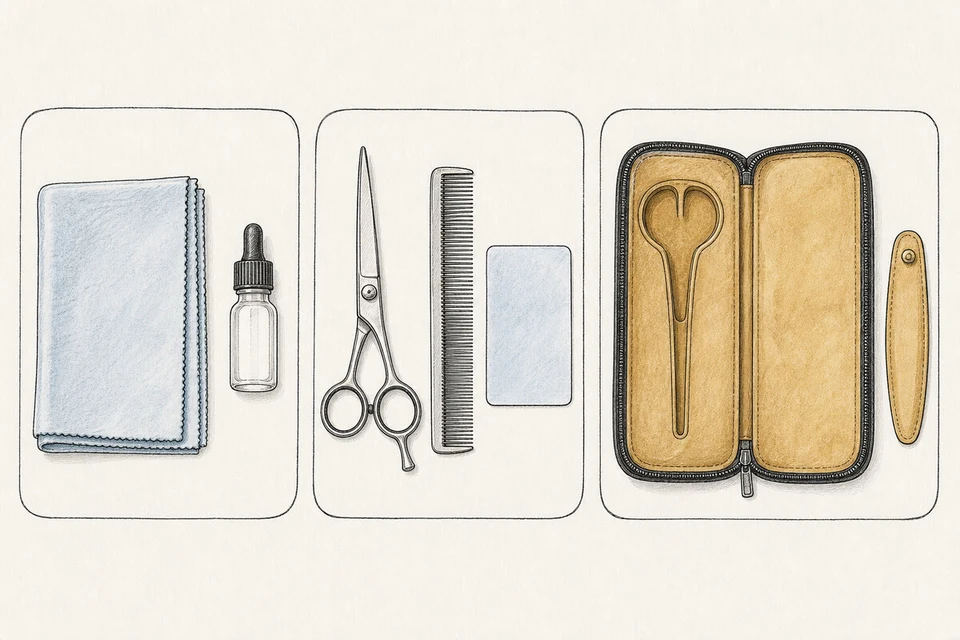
Short answer. A small care kit does four jobs: remove hair and residue (a soft cloth, a brush for thinner teeth), lubricate the pivot (the oil your maker recommends), adjust only as instructed (the adjuster the maker names) and protect the tool in storage (a case or sleeve). None of these is a disinfectant, and none replaces the maker’s instructions for your exact model.
Key takeaways
- Oil lubricates; it does not clean or disinfect, and more is not better.
- A case protects edges and tips; it does not prove hygiene on its own.
- An accessory in a kit still has to suit the tool it is used on.
- Start with a cloth, the maker’s oil guidance and a case, and add only what a real need calls for.
- Keep the maker’s care directions with the shear.
What does each care item do?
Each item has one job, and the table shows what to expect and what not to.
| Item | What it does | What it does not do |
|---|---|---|
| Soft cloth | Removes hair, product and moisture from the blades | Disinfect, or sharpen |
| Small brush | Clears loose hair from teeth and the pivot area | Replace careful handling around a thinner’s teeth |
| Shear oil | Lubricates the pivot where the maker directs | Clean, disinfect or repair an edge |
| Tension key or adjuster | Adjusts the screw system it was made for | Fit every model, or fix a damaged edge |
| Finger insert | Reduces the opening inside a ring | Move a ring or change the hand of the blades |
| Case, sleeve or holster | Protects tips and edges and keeps tools apart | Make a tool hygienic, or protect against a hard drop |
How should you use shear oil?
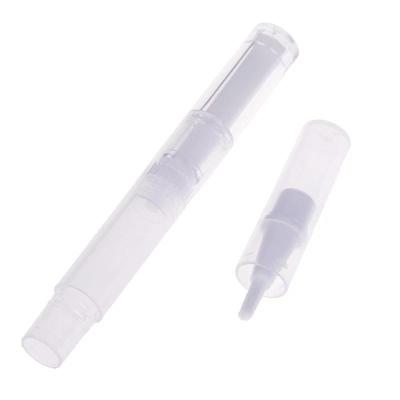
Use the oil your maker recommends, in the place they name, in the quantity they describe. Oil keeps the pivot moving smoothly and helps protect metal surfaces from moisture. It does not clean hair out of a pivot and it does not disinfect. Wipe the blades first, apply a small amount as directed, work the shear gently and wipe away any excess.
A dry cloth and oil maintain a tool; cleaning and disinfection are separate steps that follow your workplace and local requirements and the product label. Our maintenance routine and cleaning guide set out the order.
Which case, sleeve or holster is right?
Choose by how you carry and store your tools. A case or sleeve keeps tips and edges away from combs, clips and other metal. The point is protection in transit and between clients, so choose one that gives each shear its own space.
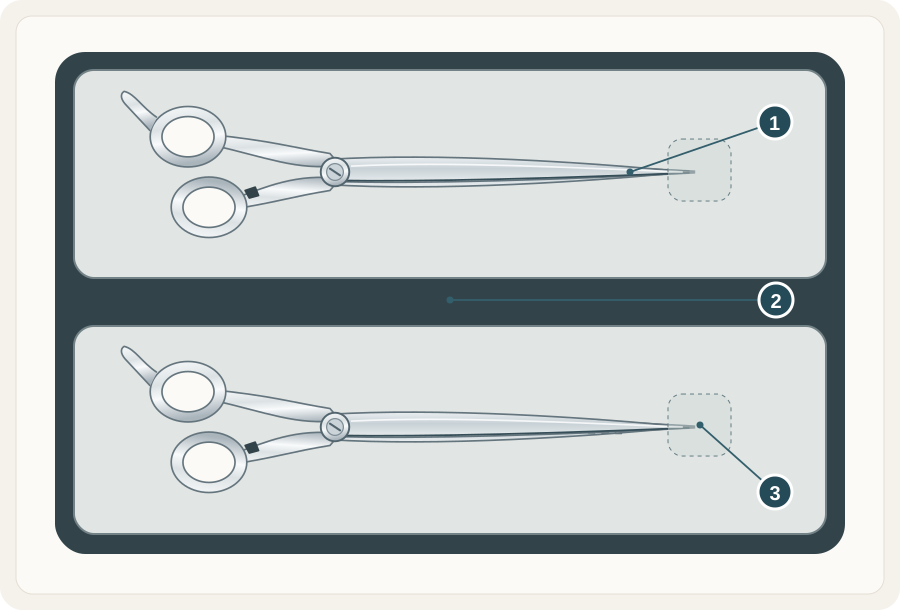 Open illustration at full size
- Close the toolClose gently before carrying or storing it.
- Separate the toolsKeep cutting edges and tooth blades from meeting another shear or loose accessory.
- Protect the tipsPrevent the tool from sliding or being knocked in storage and transit.
| Format | Suits | Watch for |
|---|---|---|
| Padded case or felt sleeve | Storing one or two shears at a station or in a bag | Each tool needs its own slot |
| Wallet or roll | Carrying several tools | Keep edges apart and the lining dry and clean |
| Holster or pouch | Wearing tools at the chair | Check closure so tips are covered |
A case or pouch that cannot be cleaned can recontaminate a tool you have just cleaned, so keep it clean and dry as well. A decorative case is not evidence of hygiene compliance. The cases and holsters comparison lays out the formats, and our accessories collection lists what is available.
What about maintenance kits?
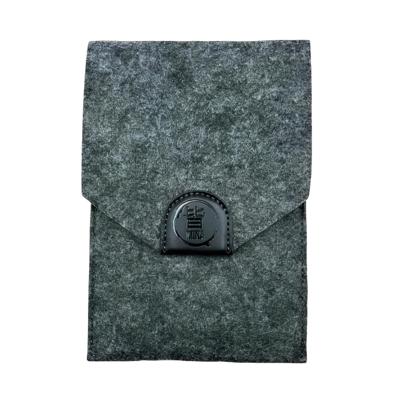
A kit bundles several items, such as a cloth, a brush, oil and an adjuster. It is convenient if you will use most of them, and a poor buy if half is unsuited to your tool. Read the contents line by line, then check each item against your maker’s care instructions: an adjuster must fit your screw, and an oil must be one your maker is content with. A supplied accessory does not create a universal maintenance method.
How do you build a kit without overbuying?
Start small and add on need.
- A soft cloth and somewhere to put it. This is the habit that matters most.
- The oil the maker recommends, in a form you can apply sparingly.
- A case or sleeve that gives each shear its own space.
- A brush, if you own a thinner or a pivot that collects hair.
- The adjuster for your screw system, only if the maker intends you to use it. See screw and tension basics.
- A finger insert, if a ring opening is the problem. See finger rings, inserts and fit.
For tracking, a simple maintenance log is enough.
When not to buy an accessory
Do not buy one because it is in a bundle you will not use, because a listing implies it fixes a cutting problem, or because it promises to sharpen. Oil does not repair an edge, and a polishing cloth does not alter geometry. If hair is folding or catching, the next step is the changed-cut guide, not an accessory.
Common mistakes
- Over-oiling. More oil does not mean more protection. Use the maker’s amount.
- Using oil as a cleaner or disinfectant. It is a lubricant.
- Storing two shears in one slot. Edges and tips can damage each other.
- Putting a damp shear in a case. Dry it first.
- Buying a universal tension key. Use the adjuster for your screw system.
Questions people ask
How often should I oil my shears?
Follow the maker’s instructions for your model. We do not give a universal interval.
Is felt or leather better for a case?
Neither is better in general. Choose one that gives each tool its own space and that you can keep clean and dry.
Do I need a brush for a thinner?
A soft brush can clear loose hair from teeth. Never force a brush or tool between closed teeth.
Can a case protect a dropped shear?
It reduces contact between tools in storage and transit but is not a guarantee against a hard drop. Set a dropped shear aside and have it assessed.
Further reading
- Care habits for Japanese hair scissors, the care guide and the knowledge base.
- Kasho’s care instructions as an example of a maker’s own directions.
- Scissorpedia for general scissor reference.
Scissorpedia is a fellow member of the ShearAlliance (see ShearAlliance).