Rust Spots on Shears: Causes and What to Do
Brown marks, pits or rough patches: work out what you are looking at before you clean anything.
By JapanShears EditorialUpdated
On this page
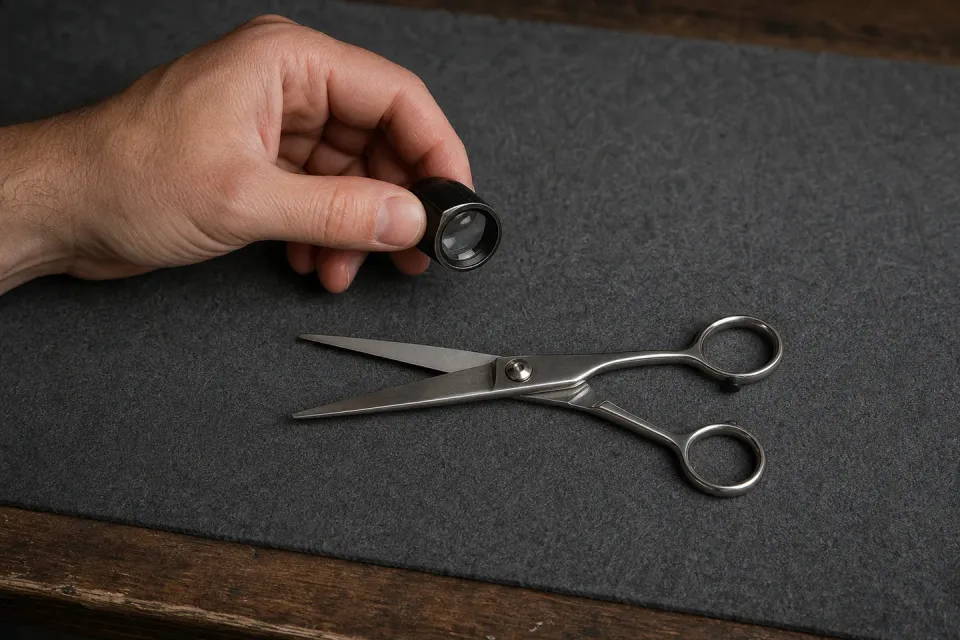
Brown or orange marks on a shear are worth taking seriously, but colour alone does not tell you what they are. The first job is to work out whether you are looking at residue, light surface corrosion or lost metal.
Short answer. Stainless steel resists rust, it does not refuse it. Marks usually trace back to chlorinated products, leftover residue, a wet or contaminated case, or a chemical the maker has not approved. Your safe steps are to wipe, dry and oil as the maker directs. Anything beyond that, including pits and rough action, belongs with a maker or qualified professional.
Key takeaways
- Similar-looking marks can be dried product, transferred stain, surface corrosion, pitting or a finish change.
- Pitting is lost metal. Polishing may change the look, not the loss.
- Never test an edge with a fingertip or nail, and keep a marked shear out of service if the action has changed.
- No abrasive rust erasers, steel wool, household cleaners or powered buffers on a precision edge or coated blade.
- A coating is a barrier that can wear, not a guarantee.
What can a mark on a shear actually be?
A mark can be several things, and appearance alone will not separate them.
| What you see | Possible meaning | First step |
|---|---|---|
| Brown or orange bloom on the blade face | Residue, transferred stain or surface corrosion | Photograph, then wipe with the maker’s approved method |
| Dark pinholes or craters | Pitting, which is permanent metal loss | Stop using it and book an assessment |
| Rough patch near the pivot or screw | Residue or corrosion in a crevice | Do not force the blades. Check how the action feels |
| Dull patch on a coloured finish | Coating wear or a finish change | Compare with the maker’s finish notes |
| Marks plus a gritty or changed action | Possible damage beyond the surface | Out of service until assessed |
Where a mark sits does not prove a cause: a tip mark is not proof of a missed wipe.
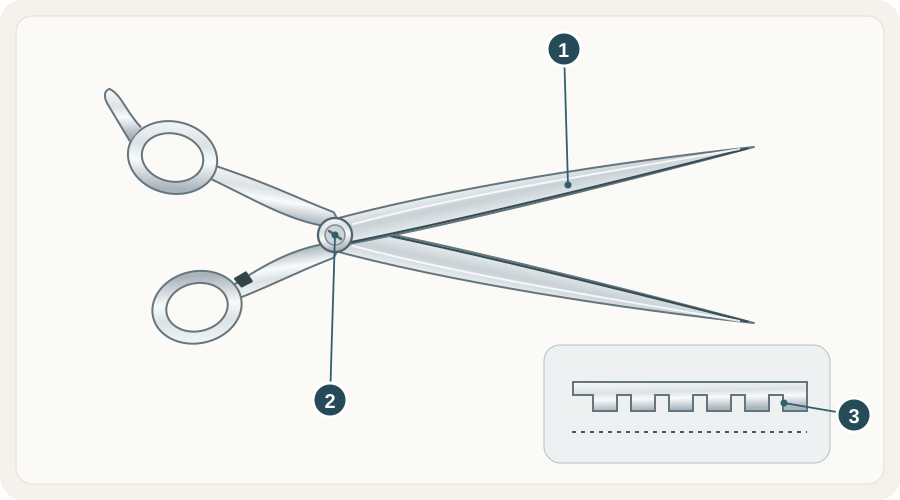 Open illustration at full size
- Blade surfacesLook for loose hair, product residue and moisture without touching the cutting edge.
- PivotCheck the visible joint and how the action feels. Follow the exact model instructions before oiling or adjusting it.
- Thinner teethClear loose hair carefully. Never force a cloth, brush or tool between closed teeth.
Why do stainless shears mark at all?
Stainless steel holds a chromium-rich passive film. Whether that film holds depends on the alloy, the heat treatment, surface condition, crevices, any coating and the chemicals involved. Steels count as stainless at roughly 12% chromium or more, but the chromium that matters is the amount in solution. High carbon locks some of it into carbides, so two steels with the same chromium percentage can behave differently.
A composition index called PREN is used to screen stainless steels. It is not a test of a finished shear, and a higher number does not make a shear compatible with chlorinated products.
Some steels are not stainless at all and need stricter moisture control. If a listing names a non-stainless tool steel, expect wiping and oiling to matter every day. Our steel names guide lists a few.
What are the usual contributors?
- Chlorinated products. Hypochlorite and other chloride-containing oxidisers are a well-documented pitting risk for stainless, especially with long contact and in crevices.
- Immersion problems. Wrong dilution, unnecessary immersion, old solution or retained residue. See disinfectants and your shears.
- Damp storage. A closed case holds water and product against the metal.
- Unknown compatibility. Hair colour, perm products, cleaners, oils and alloys vary too much for a reliable severity ranking.
What should you do first?
Work through these in order.
- Keep fingers and fingernails off the cutting edge. Look in strong light.
- Photograph the marks before cleaning, and note what the shear was exposed to.
- Close the blades gently. If the action is gritty, stop and do not force it.
- After a fresh chemical exposure, rinse as the product or maker directs, dry completely and oil as the maker specifies. Do not swap in alcohol for a required rinse or invent a neutraliser.
- Wipe the blade faces with a clean dry cloth, keeping the cloth from running along the cutting edge.
- If there are pits, rough patches, edge marks or any doubt, take it out of service and see the maker or a qualified shear specialist.
Stop there. Removing residue properly, and any refinishing or regrinding, is professional work. Our note on what to ask before sharpening helps you brief a service.
How do you prevent rust spots?
Prevention is routine. Dry the shear fully after use. Oil the pivot as the maker directs, after any disinfection and rinse, using the oil the maker supplies or approves. Store it closed, clean and covered, and never put a damp tool in a sealed case. Where hygiene steps apply, follow your local requirements. Coatings and polished finishes help, but edges, pivots, pinholes and scratches stay exposed, and coatings can wear; see shear finishes and coatings.
Common mistakes
- Scrubbing with an abrasive to “see what is underneath”.
- Testing the edge with a fingertip or nail.
- Cleaning before photographing, which removes the evidence a specialist needs.
- Treating oil as a rust cleaner.
- Closing a damp shear into a sealed case.
Questions people ask
Can I polish a rust spot off?
Not with abrasives. They can damage an edge or a coating. Ask a professional.
Does a coated shear rust?
It can. A coating separates the steel from the environment only while it is intact.
Is oil a rust cleaner?
No. Oil reduces friction and is applied after cleaning and drying. It does not clean or disinfect.
Further reading
- Disinfectants and your shears: what to check
- Ten care habits for Japanese hair scissors
- Shear oil, cases and accessories
- Shear finishes and coatings explained
- Ten signs your shears need attention
- The knowledge base and the corrosion answer in the FAQ.
- Scissorpedia for general scissor reference.
Scissorpedia is a fellow member of the ShearAlliance (see ShearAlliance).