Hair Types 1A to 4C: What to Look For in Shears
The grid describes pattern. Density, diameter and condition are separate questions, and the shear is checked against the method.
By JapanShears EditorialUpdated
On this page
Every code in the 1A to 4C grid answers one question: what does the pattern look like? It does not say how dense the hair is, how fine each strand is or what the hair has been through. That is why the code is a poor shopping filter and a useful conversation starter.
Short answer. Use the grid to describe pattern and nothing more. Assess density, strand diameter, condition and spring-back on the actual client, choose the cutting method, then check the shear against that method: edge, size, handle and a tension that moves smoothly. A sharp, correctly adjusted tool is the baseline for every type.
Key takeaways
- The grid is a communication aid, not a measurement. Charts draw the boundaries differently.
- 4C was not part of the original system. It was added later, and one head can show several patterns.
- Density, diameter and porosity are separate from curl pattern. Do not read them from the code.
- We know of no published rule that ties a type to a convex edge, a bevel, serration or a tooth count.
- Spring-back is individual, so measure it on the client.
What does the 1A to 4C grid actually say?
The grid sorts hair into four families: 1 straight, 2 wavy, 3 curly, 4 coily. Letters A to C usually mean progressively tighter pattern within a family. The grid comes from a consumer hair book of the 1990s and has been extended by publishers and communities since.
| Family | Visible pattern | What the label leaves open |
|---|---|---|
| 1A to 1C | Straight, from very little bend to the most visible body | Strand diameter and density. Some charts bundle “coarse” into 1C, which mixes two variables |
| 2A to 2C | Loose wave to pronounced wave | The 2C and 3A boundary shifts by chart |
| 3A to 3C | Loose spirals to tight corkscrews | Porosity, fragility and curl-group size |
| 4A to 4C | Small coils to very tight coil or zigzag | Shrinkage amount, density and condition |
Pattern also changes with length, moisture, product, heat and processing. State the chart and the condition you observed.
What should you assess instead of, or beside, the code?
Assess five things separately. Each changes the cut.
- Pattern: natural fall, parting and mixed zones.
- Density: how many strands emerge from the scalp. Straight hair is not automatically sparse, and tight curl is not automatically dense.
- Strand diameter: fine and coarse strands exist in every family.
- Condition: chemical, heat and weathering history. Bleaching changes how a fibre handles water.
- Wet and dry behaviour: water swells the fibre and lets it extend under load, so tension can hide the natural fall.
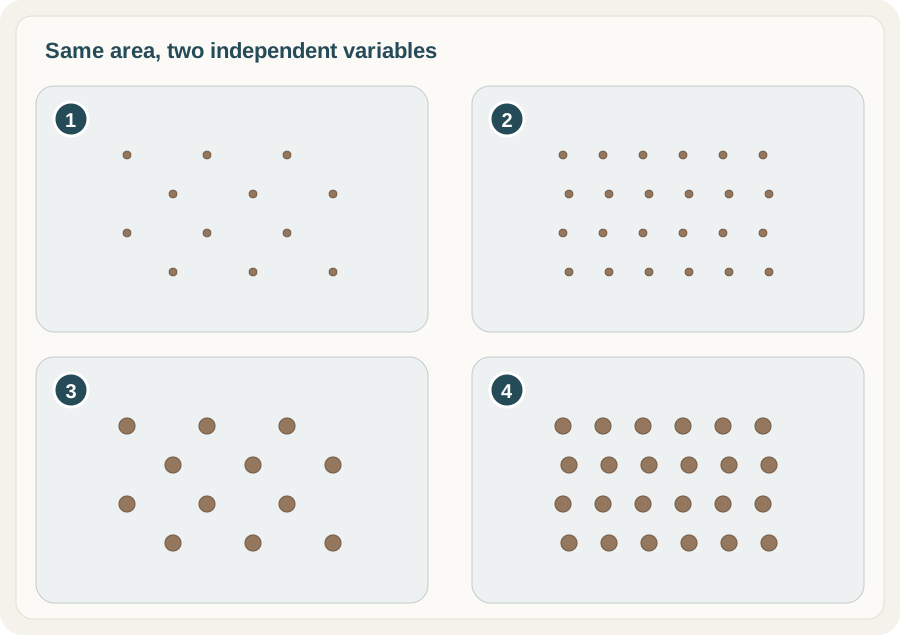 Open illustration at full size
- Thinner strands, fewer strandsStrand diameter and abundance both contribute to the assessment.
- Thinner strands, more strandsFine texture can coexist with greater density.
- Thicker strands, fewer strandsCoarser strands do not automatically mean high density.
- Thicker strands, more strandsAssess both observations alongside growth, movement and the planned shape.
Our wet and dry cutting guide goes further on the last point.
Does hair type decide the blade, tension or tooth count?
No rule we know of says it does. The label does not establish one safe edge grind, one tooth count or one technique, and we know of no controlled study linking a type to convex, bevel, serrated or toothed tools.
What the shear can do is support the method you choose:
- Edge: convex, bevel and micro-serrated edges are options for different techniques. They are not requirements of a type. The edge comparison explains each.
- Tension feel: the shear’s own tension should be set to the maker’s instructions so the action is smooth. Separately, tension on the hair can stretch a fibre, so release a section and check where it falls.
- Toothed shears: use the exact model’s published cut rate. Tooth count does not predict removal across products, and density figures do not convert to a tooth count. See how to read cut ratios.
How does cutting method change what you check?
The method, not the code, drives the tool check.
| Method | What it asks of the shear | What to check |
|---|---|---|
| Dry, curl-by-curl or pattern-led shaping | Clean entry on small groups, a visible line | Tip control, a size you can place accurately |
| Wet structural cutting, then a dry check | A steady line across larger sections | Blade length, edge, smooth closing |
| Staged work (wet, then dry) | Both in one service | Whether one cutter covers it |
| Weight removal with a toothed shear | Controlled, conservative removal | The model’s published cut rate, tooth shape and orientation |
Verify the result in the state the client wears the hair. For weight removal with a toothed shear, read each model’s own specification in the thinning shears collection.
Reach, handle fit, edge and tension feel are the same questions for every pattern, because fine, coarse, sparse and dense hair all appear in every family. For the strand side of that, see choosing scissors for fine hair.
We sell shears and have not run cutting tests, so this page does not recommend a product for a hair type.
Common mistakes
- Reading density or strand diameter from the code.
- Choosing an edge or tooth count because of a type.
- Judging the fall while the section is under tension.
- Quoting a code without saying which chart was used.
Questions people ask
Is 1A fine hair and 1C thick hair?
Not by definition. The code describes pattern. Check diameter and density on the client.
Do coily types need a convex shear?
No published rule we know of says so. Choose the edge for the technique and keep the shear sharp and adjusted.
Further reading
- Wet vs dry cutting and your shears
- Ten checks when choosing scissors for fine hair
- How to read thinning shear cut ratios
- Cutting technique hub
- The knowledge base and the hair shear glossary, which defines density and strand diameter.
- Scissorpedia for general scissor reference.
Scissorpedia is a fellow member of the ShearAlliance (see ShearAlliance).