Convex, Bevel and Hollow Edges Compared
Three words, two surfaces: read the outside profile and the inside face separately.
By JapanShears EditorialUpdated
On this page
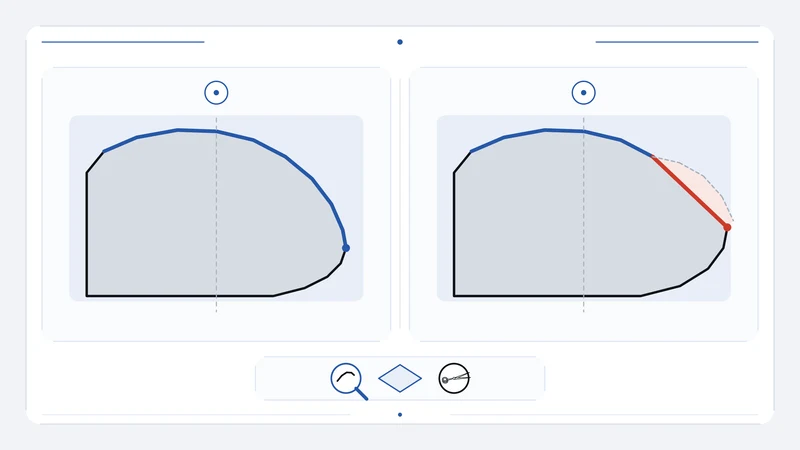
Short answer. On a hair shear, convex and bevel describe the outside of the blade as it approaches the cutting edge, while hollow describes the relieved inside face. They are not three rungs of one ladder, and a single shear can carry a convex outside and a hollow inside at once. Read the maker’s term for each surface, then tell a sharpener the exact model.
Key takeaways
- Convex: a curved outside profile approaching the edge. Bevel: a defined flat bevel approaching the edge.
- Hollow grinding is a feature of the inner blade face, not a competitor to convex.
- Micro-serrated is a fine pattern on the edge and is a separate choice again.
- A maker’s wording is the specification; “convex” on a shop page is shorthand until the maker confirms it.
- The edge a shear leaves the factory with is the edge a sharpener should preserve.
What does each term describe?
A blade has an outside face (the side you see on the outer surface of each half), an inside face (the side that slides past its partner) and a cutting edge where they meet. Edge words attach to different parts of that geometry.
| Term | Surface it describes | In plain terms |
|---|---|---|
| Convex | Outside profile near the edge | The outside curves smoothly into the edge |
| Bevel (flat single bevel) | Outside profile near the edge | A defined flat surface leads to the edge |
| Hollow | Inside face | The inside is relieved so only a narrow band makes working contact |
| Micro-serrated | The edge itself | Fine serrations along the cutting line |
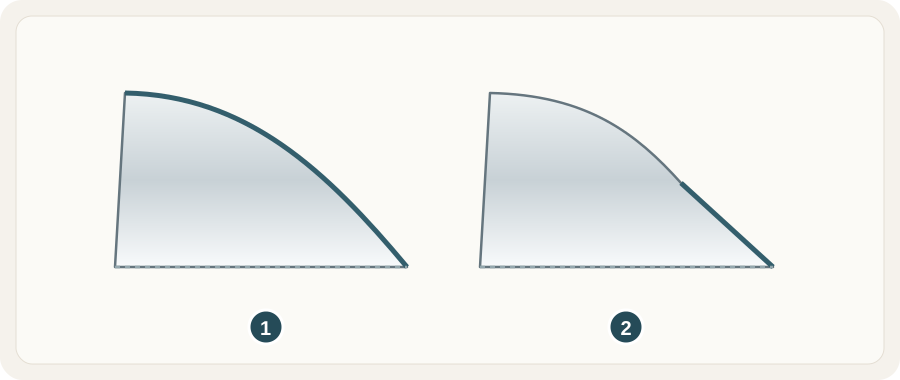 Open illustration at full size
- Convex profileA curved outside approaches the cutting edge.
- Defined bevelA flat bevel approaches the cutting edge. Read the exact maker term.
The drawing shows only the outside-profile pair. Hollow grinding is not visible in that view because it happens on the face that you cannot see when the shear is closed.
How do convex and bevel edges differ?
A convex edge has a curved outside approaching the cutting line; a bevelled edge has a flat, defined bevel. The curve gives the edge a different cross-section from a flat bevel, and that cross-section is what shapes how the blade meets hair.
Maker vocabulary varies. Joewell, for example, separates its standard flat single bevel blade from its convex constructions in its blade reference. Yasaka’s SL cutters are listed with a clam-shaped convex edge. A Japanese maker name therefore does not tell you that every cutter in its range is convex, and “convex” is not a single, standardised profile.
Neither word is a quality grade. A smooth convex edge suits drawing the blade through a section in some techniques; a bevelled edge is a different construction with different handling. Match the construction to the technique you use, using the maker’s own guidance for the model. Our edge guide works through real size and edge variants.
What does hollow grinding mean?
Hollow grinding relieves the inside face so that the blades do not rub across their whole surface. The result is a narrow working contact region, often called the ride line, which works with the pivot to hold the two edges together as they close. The relief is a hidden feature: you will not see it from the outside.
Hollow and convex can therefore describe the same shear. Kasho’s Design Master series, for instance, is described by the maker as having hollow semi-convex blades, which names an inside-face treatment and an outside profile in one phrase. Treat hollow as a construction note, and ask what the maker means before you use it to rule a model in or out.
The care of the inside face is part of servicing. Tension, ride line and blade set belong to a technician who works on that model; a home fix based on an unrelated tool will not preserve them.
Where does micro-serration fit?
Micro-serration is a pattern of fine teeth on the cutting edge, intended on relevant models to help hold hair as the blades close. It is not the large tooth row of a thinner. Because it changes how hair moves, it is a technique decision: read the maker’s guidance before using a serrated cutter for a drawing cut, and note that some ranges offer serrated and smooth edges in different sizes of the same family.
Choosing between them: when each makes sense
| If your work leans on… | Read the listing for… | Then ask |
|---|---|---|
| Drawing the blade through hair | A convex or similarly smooth edge description | Does the maker state the edge for my selected size? |
| Holding a section closed on a line | A bevel, or a micro-serrated option the maker supports | Does this edge suit the technique my educator teaches? |
| A model you already like | The same wording as your current pair | Does the new size carry the same edge? |
When not to choose on edge alone: if hand, handle and nominal size are not settled, or if the listing states no edge at all. An unstated edge is a question for the seller, not a default.
What should you tell a sharpener?
Give the maker, model, selected size and edge wording, then ask whether they service that construction before you send anything. A convex edge, a flat bevel and a toothed blade are not interchangeable jobs. Our guide to preparing for sharpening lists what to prepare, and the sharpening advice page sets out how to start an enquiry. We describe geometry and technique here; we do not run a sharpening workshop.
Common mistakes
- Treating hollow and convex as rivals. They describe different surfaces and can coexist.
- Assuming a Japanese maker makes only convex blades. The wording belongs to the model.
- Changing size and forgetting the edge. One family can offer a smooth edge in one size and a micro-serrated edge in another.
- Testing the edge on improvised materials. Foil, sandpaper and similar tests are not how a maker assesses a shear. Follow the maker’s care guidance.
- Handing over a shear without the edge description. A technician needs the model’s intended grind in order to preserve it.
Questions people ask
Is a convex edge sharper than a bevel?
The words describe shape, not sharpness. Sharpness depends on the edge’s condition, the steel and how it was finished. Compare the maker’s statements for the models you are considering.
Can I tell a hollow grind by looking at the shear?
Not from the outside when the shear is closed. The relief is on the inside faces, so rely on the maker’s description.
Does convex mean it cannot be sharpened?
No. It means the geometry should be preserved by a technician who works on it, rather than flattened into a different profile.
Is micro-serrated the same as a thinner?
No. Micro-serrations are fine teeth on a cutter’s edge. A thinner has a separate toothed blade. See thinners and texturisers in plain English.
Further reading
- Sword, slim and leaf blade profiles for the outline of the blade as seen from above, a third dimension that is separate from edge geometry.
- Japanese shear blades and edges explained and the knowledge base.
- Reading a spec sheet line by line to find the edge field on a listing.
- Scissorpedia for general scissor reference, and the Wikipedia entry on scissors for background.
Scissorpedia is a fellow member of the ShearAlliance (see ShearAlliance).