Wet vs Dry Cutting and Your Shears
What changes for the tool when the hair is wet, damp or dry.
By JapanShears EditorialUpdated
On this page
- What is the difference between wet and dry cutting?
- What does the shear itself have to do?
- Does dry cutting need a different shear?
- Does wet cutting need a different shear?
- How should you care for a shear after each?
- When the cut changes between wet and dry work
- When to choose, and when to ask
- Common mistakes
- Questions people ask
- Further reading
Short answer. Wet and dry describe the condition of the hair, not the grade of a tool. Wet hair offers easy sectioning and a clear guide; dry hair shows how the hair settles and moves. A shear that works for one is not automatically wrong for the other, but the edge, the blade line and the technique should match what you are doing, and the shear should always be wiped clean and dried afterwards.
Key takeaways
- Neither condition is a universal hierarchy. Many professionals work in both, often in the same appointment.
- Dry cutting shows settled movement; wet cutting gives control while sectioning. State the context rather than declaring one “more accurate”.
- The technique matters more than the condition: blunt closures, point cutting, scissor-over-comb and slide work each ask different things of the tool.
- A shear intended for slide work and one intended to hold a line are different tools; check the maker’s stated use.
- Moisture is a care matter: dry the tool, protect the pivot and follow the maker’s oil instructions.
What is the difference between wet and dry cutting?
Wet cutting works on hair that has been dampened, so it is easier to section, comb and see against a guide. Dry cutting works on hair in its settled, styled state, so you see how it falls, how curl shrinks back and where weight sits. Both are working conditions. Neither one makes a tool better; they ask for different things from the person holding it.
| Condition | What it offers | What to watch |
|---|---|---|
| Wet | Organised sectioning, a visible guide | Hair is stretched, so the finished length can change as it dries |
| Damp | A compromise between control and movement | Moisture level changes between sections |
| Dry | The hair’s settled movement and shape | Resistance can feel different against the blades |
Curl shrinkage, product, growth patterns and condition all affect how to read the result. Describe the context instead of promising that one condition is always more accurate.
What does the shear itself have to do?
The tool’s job depends on the technique more than on whether the hair is wet. The same blade can hold a line for a blunt closure and be a poor choice for sliding, or the reverse.
| Technique | What it asks of the shear | Where to read more |
|---|---|---|
| Blunt closure across a section | An edge that cuts cleanly across and a line you can control | Edge geometry |
| Point cutting | Tip entry you can place accurately | Blade length by task |
| Scissor-over-comb | Reach and steady control along a comb | Barber reach |
| Slide or slice | A blade line and edge the maker intends for drawing | Blade profiles |
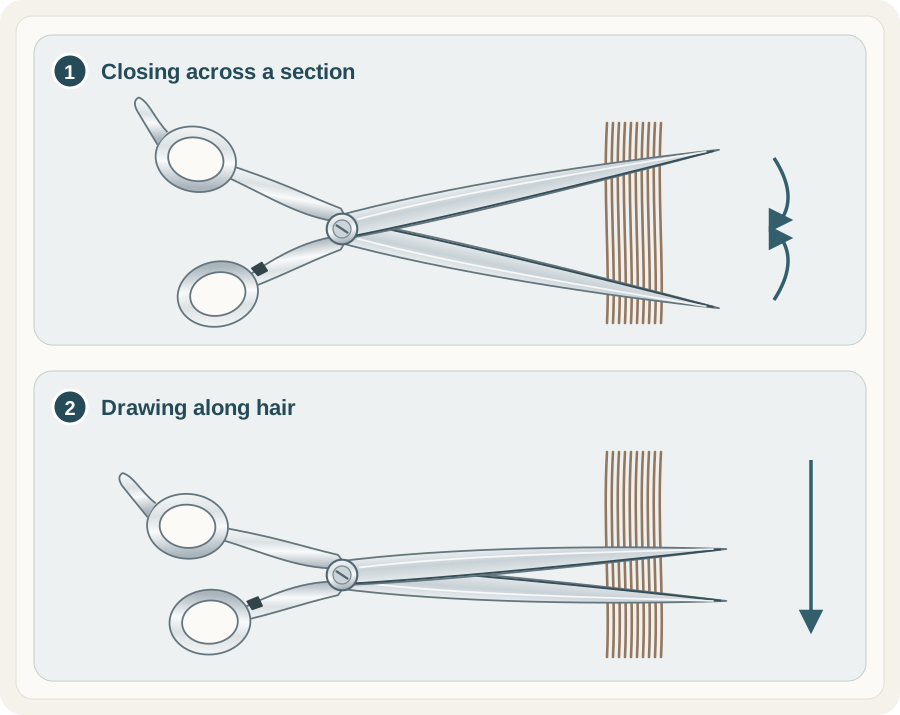 Open illustration at full size
- Closure across a sectionThe blades close across the hair to establish or alter a line.
- Drawing along hairThe tool travels along a section. Blade line, edge condition, intended design and technique all matter.
The drawing is a vocabulary aid, not a lesson. Your educator’s brief, and the maker’s guidance for the exact model, decide how to use the tool. Joewell’s slide-cutting manual is an example of a maker describing a technique for its own models.
Does dry cutting need a different shear?
Not necessarily, and a catalogue cannot tell you that. Some makers and ranges offer dedicated slide or stroke designs, and those names describe an intended technique and blade line. A polished convex edge is not, by itself, a dedicated slide shear. If you work dry and want to slide, check whether the maker states the model for that use, and compare its blade line and edge, not only its steel. The techniques hub and the five-technique guide take the matching further.
Does wet cutting need a different shear?
No tool is wet-only. The practical difference is on the maintenance side, not the cutting side: more water reaches the blades and pivot, so drying matters more. Be careful with thick, dense sections in any condition: take smaller, controlled sections rather than reaching for “stronger steel” or adding force.
How should you care for a shear after each?
The care routine is the same for both, and the aim is to remove moisture and residue promptly.
- Wipe the blades with a soft cloth to clear hair and product.
- Dry the shear fully, including the pivot area and, for a thinner, the teeth, without forcing anything between closed teeth.
- Apply oil only as the maker directs, to the place they name.
- Store the shear closed in its own protected space.
Stainless steels resist corrosion but are not immune, and moisture left at the pivot or between the blades is the usual start of marks. The maintenance routine, the cleaning guide and the oil, case and accessory guide cover the steps. Cleaning is not disinfection; follow the process your workplace and local requirements call for, with products compatible with the shear.
When the cut changes between wet and dry work
If a shear that worked well begins to push or fold hair, do not assume the condition is the cause. Residue, tension, edge wear and the section you take all contribute. Record where on the blade and under what conditions it happens, and read the changed-cut guide. Forcing the blades, or tightening the screw until the problem stops, can add wear; see screw and tension basics. For how pattern, density and condition change what you check on the client, see hair types 1A to 4C and your shears.
When to choose, and when to ask
Choose a shear for the technique and line you use most, not for a wet or dry label. Ask the maker or seller if you plan to slide dry and cannot tell whether the model is intended for it, or if you work in conditions with unusual products or moisture and want to know the maker’s care guidance for that model.
Common mistakes
- Treating wet or dry as a quality ranking. They are conditions.
- Assuming a polished convex edge is a slide shear. Check the maker’s stated use.
- Putting a shear away damp. Dry it before storing.
- Oiling by habit. Follow the maker’s instruction for your model.
- Forcing a thick section. Take a smaller section instead.
Questions people ask
Is dry cutting more accurate than wet cutting?
Each shows something different. Dry shows settled movement; wet gives control while sectioning. Say which you mean rather than ranking them.
Can I use any shear for dry cutting?
You can, but technique and blade suitability matter. If you slide dry, check the maker’s stated use for the model.
Do wet conditions rust stainless shears?
Stainless resists corrosion but is not immune. Drying after use and following the maker’s care directions are the safeguards.
How do I know a shear suits slide work?
Look for the maker’s stated use, the blade line and the edge. Our blade profile guide explains the vocabulary.
Further reading
- Cutting technique hub, five cutting techniques and the knowledge base.
- Joewell’s slide-cutting manual.
- Scissorpedia for general scissor reference.
Scissorpedia is a fellow member of the ShearAlliance (see ShearAlliance).