Handling Shears Safely at the Chair
Carrying, passing, setting down and dropping: habits that protect the person and the edge.
By JapanShears EditorialUpdated
On this page
Short answer. Treat a hair shear as a sharp tool and a precision tool at the same time. Close it when you are not cutting, carry and pass it closed with the handle offered first, set it down on a stable surface rather than a lap or cape, store it in its own protected space, and stop work and inspect it after a drop. These habits protect people first, and the edge second.
Key takeaways
- Close the shear whenever you are not cutting, and point the tips away from yourself and others.
- Pass a shear closed, handle first, and set it down on a stable surface.
- Never try to catch a falling shear. Let it fall, then inspect it.
- Store each shear in its own sleeve or slot so tips and edges are covered.
- A dropped or damaged shear is set aside until it has been assessed.
What are the basic habits?
The habits below take seconds and protect both the person and the tool. They are general workplace practice, not a substitute for your educator’s instructions or your workplace’s own rules.
| Moment | Habit | Why |
|---|---|---|
| Between cuts | Close the shear and keep the tips pointed away | Avoids accidental contact |
| Moving around | Carry it closed, with the tips covered or held down and away | Reduces the chance of contact in a busy space |
| Handing to someone | Pass it closed, handle first, naming that you are doing so | The receiver takes the handle, not the blade |
| Putting it down | Use a stable surface such as a mat or tray, not a lap, cape or chair arm | Stops it slipping or sliding off |
| End of shift | Dry it and put it in a protective sleeve or case | Protects tips, edges and other tools |
How should you pass a shear?
Close the blades, keep the shear closed with the tips pointing down and away from both of you, and present the rings to the other person so they take it by the handle. Tell them what you are doing so they are not surprised. The same applies when passing a thinner: close it and offer the handle first. Do not toss a shear or leave it for someone to pick up from an unstable surface.
Where should you put a shear down?
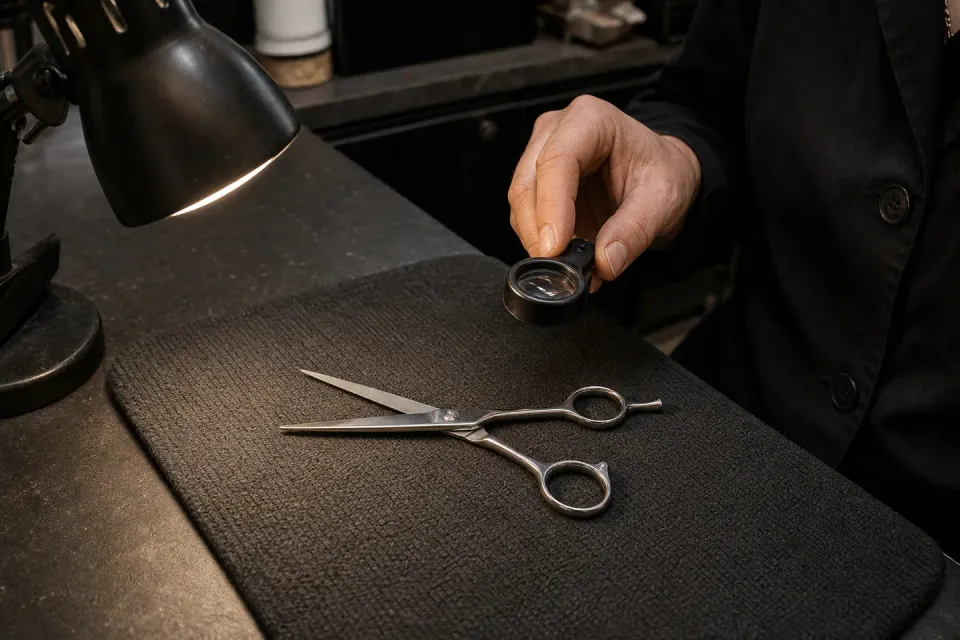
On a stable, dry surface that is not at an edge: a mat, a tray or a dedicated station area. Avoid cape folds, laps, chair arms and open drawers where the shear can shift. Keep a closed shear apart from combs, clips and other metal so the tips and edges do not meet them. See oil, cases and accessories for what suits each storage format.
 Open illustration at full size
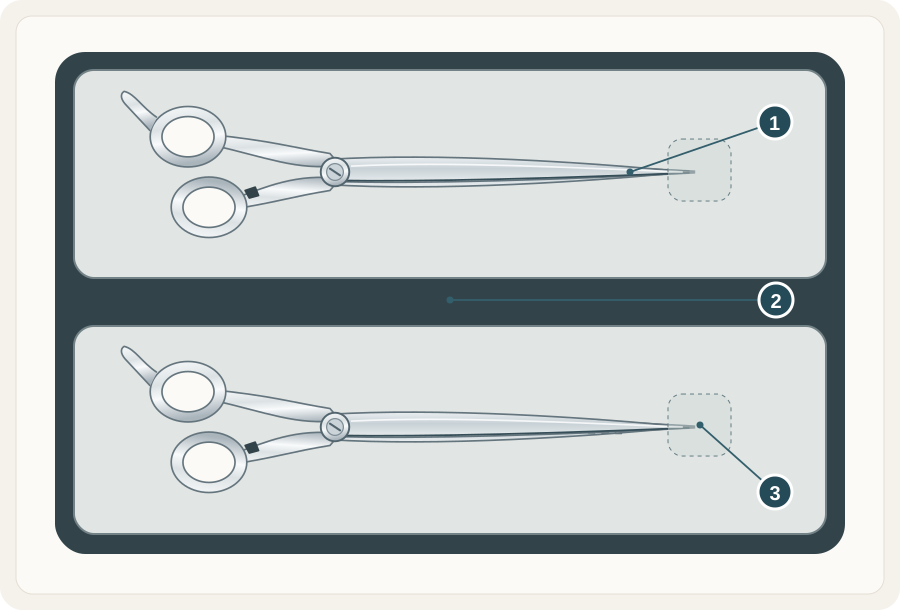
- Close the toolClose gently before carrying or storing it.
- Separate the toolsKeep cutting edges and tooth blades from meeting another shear or loose accessory.
- Protect the tipsPrevent the tool from sliding or being knocked in storage and transit.
What if you drop one?
Do not try to catch a falling shear. Step back, let it fall and then pick it up carefully by the handle. Stop using it for the next client and set it aside, protecting it from contact. Look at it in good light without running a finger along an edge and without forcing the blades closed. Note anything you can see: a bent tip, a chipped edge, a loose screw, a change in how it opens.
A fall changes the starting point, so a cleaning routine is not a repair. Record what happened and when, then arrange an assessment with a technician who works on that model. Our guides on hair pushing, folding or catching and preparing for a service enquiry show what to write down.
How should you handle thinners?
Treat a thinner with the same care as a cutter, with extra attention to the teeth. Close it before moving or passing it, and keep the teeth clear of other tools in storage. When clearing hair, do it gently, and never force a cloth, brush or tool between closed teeth. A bent or damaged tooth is a service question.
What about children, mobile work and clean-and-used separation?
Keep shears out of reach of children and of anyone who may handle them unsupervised. For mobile or home work, carry them in a case or roll that covers the tips and keep clean tools apart from used ones, following the rules that apply to your work. Local workplace and hygiene requirements vary, so check those that apply to you and to your products; for general Australian work health and safety information, see Safe Work Australia. Oil and a dry cloth maintain a tool; neither is a hygiene process.
When to stop and seek help
Stop and set the shear aside after a drop or knock, if you see damage, if the action becomes rough or gritty or if the shear catches unexpectedly. Seek assessment before the next cut. For an injury to a person, follow your workplace’s first-aid arrangements; a guide about shears cannot give medical advice.
Common mistakes
- Leaving a shear open on a lap or cape. It can slip and cut.
- Catching a falling shear. Let it fall.
- Carrying shears loose in an apron pocket. Cover the tips.
- Using the shear after a drop “to see”. Inspect first.
- Storing two shears in one slot. Edges and tips can damage each other.
Questions people ask
Is it safe to pass a shear blade first?
Pass it closed with the handle offered first. That way the receiver takes the handle and the blades face away from them.
Should I keep shears in an apron?
Only if the tips are covered or the shear sits in a holster or sleeve made for the purpose. Loose tips are a hazard to you and to the tool.
What do I do if I drop my shear?
Stop, let it fall, pick it up by the handle, inspect without touching the edge and set it aside until assessed.
Does a case make a shear hygienic?
A case protects tips and edges. Hygiene is a separate process with its own requirements.
Further reading
- Care habits for Japanese hair scissors, how to clean hair shears and the knowledge base.
- Safe Work Australia for general work health and safety information.
- Scissorpedia for general scissor reference.
Scissorpedia is a fellow member of the ShearAlliance (see ShearAlliance).