Thinning Shear Tooth Shapes: V, U, Flat, Mushroom and More
Shape names describe a tooth tip. They do not set the cut rate.
By JapanShears EditorialUpdated
On this page
- What does “tooth shape” actually describe?
- What are V-groove, U-groove and flat teeth?
- What are stepped and prism teeth?
- What about fishbone and mushroom teeth?
- How do double-tooth builds and orientation change things?
- How do you compare two thinning shears?
- Common mistakes
- Questions people ask
- Further reading
A thinning shear listing can carry five or six tooth words at once. Only one is about shape, and it is the least able to predict how much hair a model removes.
Short answer. Tooth shape describes the profile at the tip of each tooth: a V-shaped notch, a rounded channel, a flat landing, a stepped ledge. It sits beside tooth count, cut rate, orientation and single or double comb, and it cannot stand in for any of them. Read the shape name as one clue, then find the maker’s rate and drawing for the exact model.
Key takeaways
- Shape names are maker or trade vocabulary. No shared angle, depth or radius stands behind them.
- The same shape name can sit on models with very different published rates.
- “Fishbone” and “mushroom” are unreliable search words. Ask for a drawing.
- Orientation (which blade carries the teeth) and single or double comb are separate fields.
- Strand-test a new thinner on an inconspicuous section before it goes near a finished cut.
What does “tooth shape” actually describe?
Tooth shape describes the tip of each tooth in profile, not how many teeth there are, how wide the gaps are or how the opposing blade meets them. For the parts themselves, our thinning shear anatomy guide names them.
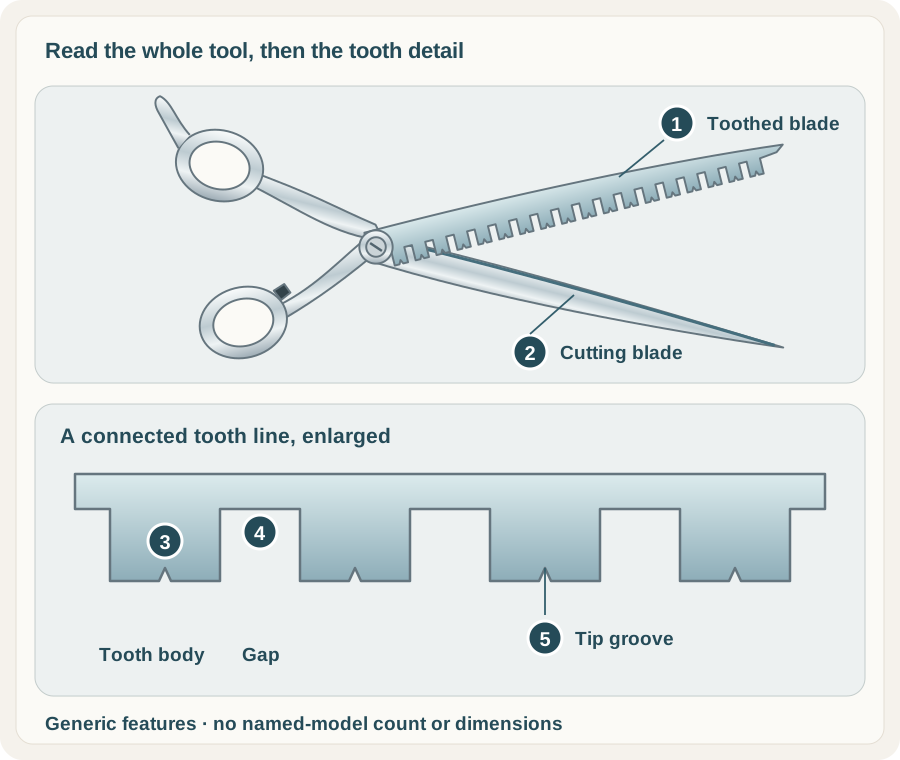 Open illustration at full size
- Toothed bladeThe blade carrying the row of teeth. Look at the complete layout as well as the count.
- Cutting bladeThe opposing continuous blade closes against the toothed construction.
- Tooth bodyThe metal projection joined to the blade’s continuous base. Width and shape are separate from count.
- GapThe space between adjacent tooth bodies. Compare its shape and spacing.
- Tip grooveA feature at this illustrative tooth tip. Other models may use different grooves or a flat tip.
What are V-groove, U-groove and flat teeth?
| Shape | What the name describes | What it leaves open |
|---|---|---|
| V-groove | A V-shaped notch at the tooth tip, intended to retain strands as the blades close | Notch angle, depth, spacing and the model’s rate |
| U-groove | A rounded channel at the tip | Radius, width and depth. Maker diagrams are qualitative |
| Flat or grooveless | A tooth tip without a pronounced capture groove | ”Flat” and “grooveless” overlap but are not always identical |
Makers often contrast V-groove “grip” with freer-release shapes. That is positioning, not a controlled comparison. Line visibility depends on the whole model, the rate, the placement and how often you repeat a pass.
The numbers show why. Within one maker’s grooveless range, published rates run from about 15% to about 80%. In another maker’s V-groove lines, 30-tooth and 40-tooth models publish the same 40% rate. Shape alone cannot supply a figure.
What are stepped and prism teeth?
Stepped is an umbrella term. It can mean ledges or multiple grooves on each tooth, alternating tooth lengths or another terraced profile. A stage count describes the tooth shape, not the number of passes. One maker’s 30-tooth models with two and three grooves publish about 20% and about 30%, but another maker’s stage counts are not on the same scale, so the number of steps cannot be carried from one range to another.
Prism is vocabulary used by several makers. One defines it as a fine V-shaped serration. Another uses it for a comb tip that guides hair into a V-groove. No published drawing proves these are the same cross-section, so keep the maker’s exact term attached to the model.
What about fishbone and mushroom teeth?
Treat both as search leads, not categories.
- Fishbone appears as a product name on at least one human-hair thinning shear, and in pet-grooming listings for different constructions. Another maker uses it for a fishbone-shaped blade back on a cutting shear. None of these defines a shared tooth geometry.
- Mushroom is retailer shorthand for rounded, cap-like tips. It does not trace to a maker’s current drawing or model that we can cite, so it should not be used to identify a tool.
If a listing uses either word, ask the seller for the maker’s profile drawing and published rate.
How do double-tooth builds and orientation change things?
A double-tooth (or double-comb) shear has teeth on both blades. That is a construction fact. It does not by itself prove a rate or a “no lines” finish. Do not assume it always removes less than a single-comb shear.
Orientation records whether the toothed blade is the static one (standard) or the moving one (reverse). Maker codes differ: one maker’s S and B letters mean something different from another’s A, B and AB. Orientation does not set the rate. See same tooth count, different thinning shears for models side by side.
How do you compare two thinning shears?
- Get the maker’s drawing or photograph of the tooth tip, not just the shape word.
- Find the model’s own published cut rate, and any test conditions.
- Note the tooth count and whether it is per blade.
- Record the orientation and single or double comb.
- Test on an inconspicuous section, and remember that repeated passes compound.
- Compare finished models in the thinning shears collection against the task you have in mind.
We sell shears and have not run cutting tests, so this page ranks no shape.
Common mistakes
- Choosing by shape name alone without the model’s published rate.
- Treating “more teeth” as “less removal” across different models.
- Assuming a double-tooth build always removes less.
- Using “fishbone” or “mushroom” as a category when searching.
- Repeating passes without allowing for how they compound.
Questions people ask
Does a V-groove shear leave more lines than a flat one?
Not as a rule. Line visibility depends on the whole model, the rate and the technique.
Do more teeth mean a lower rate?
Not reliably. Published examples go both ways, because tooth width, spacing and profile can override the count.
Further reading
- Thinning shear anatomy
- How to read thinning shear cut ratios
- Same tooth count, different thinning shears
- Thinners and texturisers in plain English
- Texturising scissors: nine tooth lines to compare
- The knowledge base and the thinner answers in the FAQ.
- Scissorpedia for general scissor reference.
Scissorpedia is a fellow member of the ShearAlliance (see ShearAlliance).