Thinners and Texturisers in Plain English
Cut ratio, tooth patterns and why the category names overlap.
By JapanShears EditorialUpdated
On this page
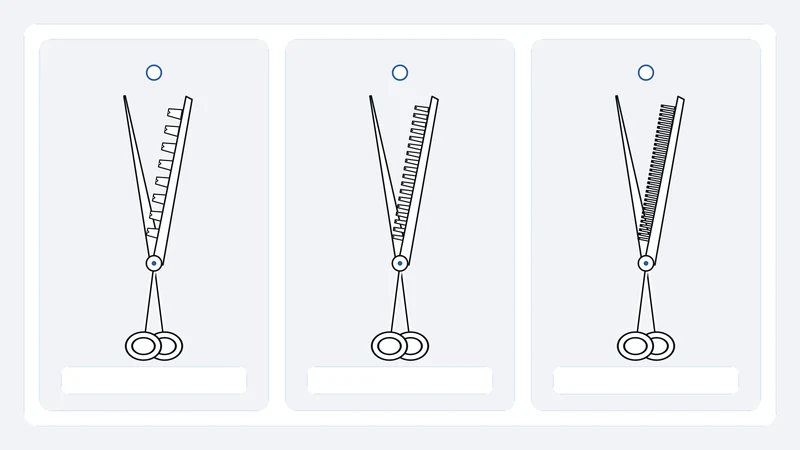
Short answer. A thinner is a shear with a toothed blade paired with a plain cutting blade, so each closure removes some hair and leaves some. Thinner, blender, texturiser and chunker are overlapping labels, not fixed categories; what differs is the tooth pattern and the maker’s stated cut ratio. Compare those two things for the exact model, and treat the label as a hint.
Key takeaways
- A thinner removes part of a section with each closure; a cutter sets the line. Neither replaces the other.
- Tooth count alone does not tell you how much a thinner removes. Tooth width, gaps and shape take part.
- Cut ratio is a maker’s approximate figure under its own conditions, not a percentage of a haircut.
- The same word, such as “texturiser”, can mean different tools in different ranges.
- A thinner is a supporting tool. Learn the role under supervision before adding one.
What does a thinner actually do?
A thinner pairs one toothed blade with one plain cutting blade. When the blades close, hair that lies in a gap between teeth passes through uncut, and hair under a tooth is cut. The result is that part of the section is removed and part stays, which changes weight and texture without shortening the line the way a cutter does.
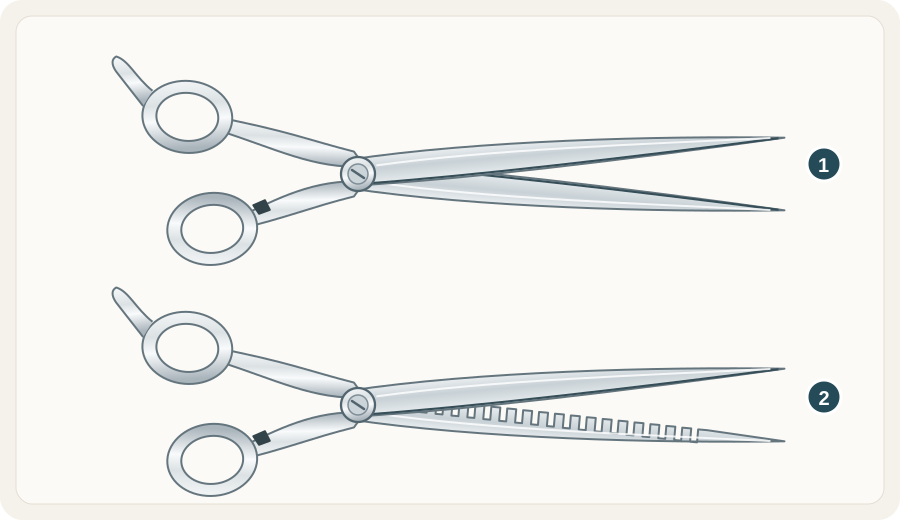 Open illustration at full size
- Cutting shearTwo continuous edges for cutting a line or section.
- Thinning shearA toothed blade paired with a cutting blade. Compare the exact tooth design as well as the count.
That is the mechanism common to the whole family. How much is removed, and what the finish looks like, depends on the teeth. The anatomy guide names the parts: tooth body, gap and tip groove.
Why do the names overlap?
Thinning, blending, texturising and chunking are used by different brands for different tools. Some makers use “texturiser” for an open, wide-toothed tool that removes a lot per closure, others for something quite fine. A word on a listing is therefore a starting point for reading the tooth pattern, not a promise of an effect. Our glossary records the working definitions.
| Label you may meet | Often used for | What to read instead |
|---|---|---|
| Thinner | A general toothed shear | Tooth count and cut ratio |
| Blender | A finer pattern intended to soften transitions | Tooth width and gaps |
| Texturiser | A more open pattern, or sometimes a finer one | The maker’s stated cut ratio |
| Chunker | A wide-toothed, low-count tool | Tooth count and spacing |
How do tooth patterns differ?
Think of a thinner as three independent choices.
- Count. The number of teeth along the blade. More teeth does not always mean less removal, because the teeth can be narrower or wider.
- Width and spacing. Wider teeth with wide gaps leave and remove larger bundles; fine teeth with narrow gaps leave smaller ones.
- Shape and tips. Flat teeth, V-shaped teeth and grooved tips each change how hair enters and exits.
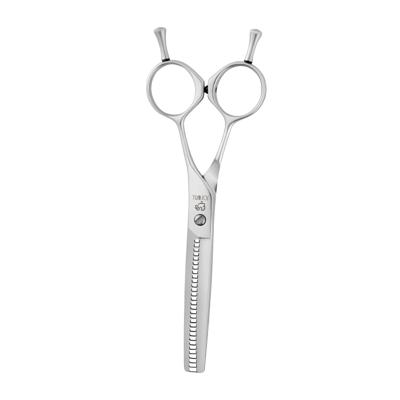
The same-count comparison shows two 30-tooth or 40-tooth models whose stated removal differs, which is why count is a poor stand-alone filter. Joewell, for instance, states 35% for its E-40 and 15% for its E-30, a useful counterexample to “more teeth means less removal”.
What is cut ratio?
Cut ratio is the approximate proportion a maker says one closure removes under its own conditions. It is a model-specific statement. It is not a prediction of what a whole haircut loses, because repeated closures, section thickness, placement and direction all change the cumulative result. Treat the figure like a catalogue number: useful for comparing two models from the same maker, less so across makers whose conditions differ. The cut-ratio guide explains how to read it.
How do you choose between a fine and an open pattern?
Decide what you need the thinner to do, then match the pattern.
| If you need… | Look at | Be careful of |
|---|---|---|
| A soft, subtle transition | Fine teeth, a lower stated cut ratio | Assuming fine means harmless; repeated closures add up |
| Visible texture or reduced bulk in a section | A more open pattern, a higher stated ratio | Higher removal gives less margin for error |
| One tool to learn on | A mid-range pattern the course uses | Buying before your educator names a role |
When not to buy a thinner: when you are still learning to control a cutter, when the problem is a line rather than weight, or when you want a tool for every situation. A thinner is not a safe substitute for a main cutter and it does not make a poor line better.
What about hand, orientation and pairs?
A thinner has its own cutting hand, separate from your cutter’s. Some models have teeth on one side and a reversible orientation; that is a different property from true left-handed construction. For a set, read the cutter and thinner as two tools: a size button can change the cutter and leave the thinner fixed. The left-handed checklist applies to thinners as well.
Hair, curl and technique
Do not choose a thinner by a label such as “thick” or “curly”. Weight removal changes grouping and the perimeter, and placement matters as much as quantity. On curls in particular, over-softening ends is a risk with many blending techniques, so treat any thinning plan as a technique conversation with your educator rather than a purchase decision. See supervised thinner comparison.
Common mistakes
- Comparing tooth counts only. Width, spacing and shape matter.
- Reading a cut ratio as a haircut percentage. It is per closure, under the maker’s conditions.
- Trusting the category word. Compare patterns across brands.
- Using a thinner on a line problem. It removes weight; it does not repair a line.
- Forgetting the thinner’s hand. It needs its own check.
Questions people ask
Is a texturiser the same as a thinner?
Sometimes. The words overlap by brand. Compare the tooth pattern and the maker’s cut ratio rather than the label.
Do more teeth remove less hair?
Not reliably. The tooth width and gaps decide as much as the count. The cut-ratio guide shows counterexamples.
Do I need a thinner as a beginner?
Take the question to your educator. Many courses start with a cutter. See your first Japanese shears.
How do I choose between thinners?
Use the 10-question chooser and the thinning collection.
Further reading
- Thinning shear anatomy, cut ratios and the knowledge base.
- Joewell’s thinning manual for a maker’s own model-specific guidance.
- Scissorpedia for general scissor reference.
Scissorpedia is a fellow member of the ShearAlliance (see ShearAlliance).