JapanShears Editorial · Published
Texturising Scissors: 9 Tooth Lines to Compare
Nine right-handed texturisers from Japanese brands, arranged from 10 teeth to 30, with each maker's own figures and the trade-off of each tooth line.
On this page
A texturiser is a toothed shear that you place for visible separation or weight adjustment, rather than a tool that sets the main line. The nine below run from 10 teeth to 30, and the tooth count is only the start: width, spacing and the maker’s own figure say more about what each one is for.
Short answer. Choose a texturiser by the job you want it to do, then compare the tooth line and any maker figure for that exact model. Fewer teeth mean a more open pattern; more teeth mean a finer one. Neither count nor name tells you how much hair a closure removes.
How this list was chosen
On 4 November 2026 we read the toothed-shear records in the JapanShears range for tools described as texturising, chunking or cut-and-thin, and kept right-handed 6.0-inch-class tools from Japanese brands. We picked nine whose tooth lines or maker figures differ, and we arranged them by tooth count. We did not test any of them. This is a comparison of listings, and the order is not a ranking. Kamisori, a Canadian brand with Japanese-inspired designs, is left out. Where a maker states a cut ratio, it is attributed to that maker and that model. Each card shows its option’s current price.
Terms overlap: thinning, blending and texturising are commercial labels for toothed tools, and the record’s wording is quoted here as listed. JapanShears sells every tool below and links to its own product pages. Juntetsu, Ichiro, Kasho and Joewell are independent brands, not JapanShears brands. JapanShears is a member of the ShearAlliance and is run by the same seller as four other Australian ShearAlliance stores. Our editorial policy explains how we compare products.
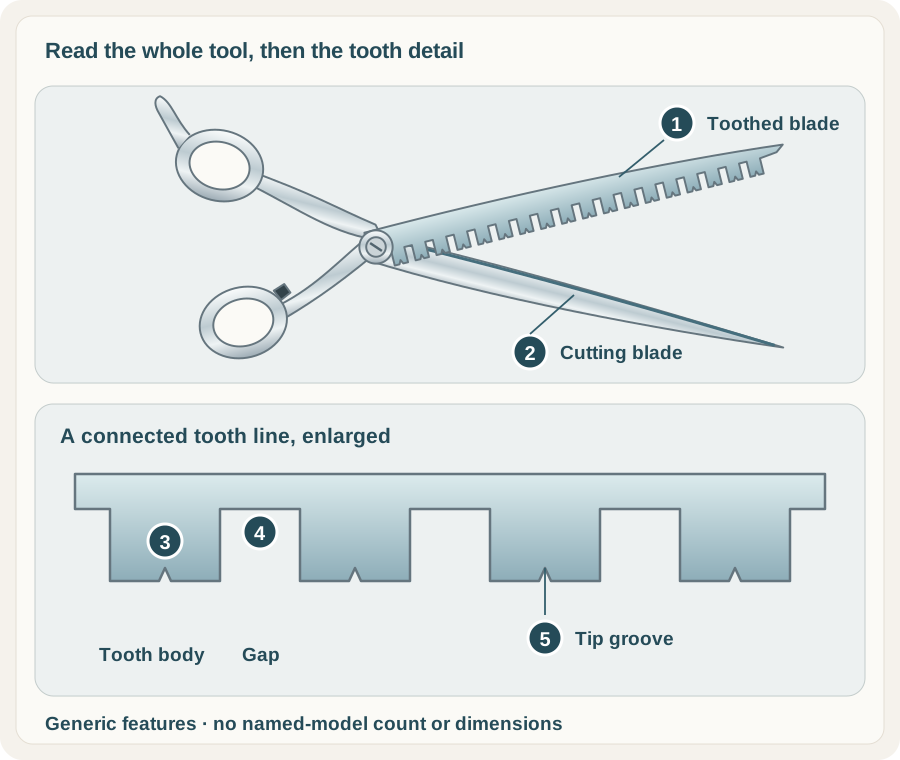 Open illustration at full size
- Toothed bladeThe blade carrying the row of teeth. Look at the complete layout as well as the count.
- Cutting bladeThe opposing continuous blade closes against the toothed construction.
- Tooth bodyThe metal projection joined to the blade’s continuous base. Width and shape are separate from count.
- GapThe space between adjacent tooth bodies. Compare its shape and spacing.
- Tip grooveA feature at this illustrative tooth tip. Other models may use different grooves or a flat tip.
Compare the nine
| Texturiser | Teeth | Maker figure in the record | Hand |
|---|---|---|---|
| Juntetsu Chomper | 10 | None | Right |
| Joewell JGC-12 | 12 | 80% cut ratio | Right |
| Ichiro Kawa | 14 or 30 | None | Right |
| Kasho Design Master | 15 | None | Right |
| Ichiro Taiyo | 15 | None | Right |
| Ichiro 16T | 16 | None | Right |
| Joewell HXG | 17 or 20 | None | 20: right |
| Juntetsu Cobalt | 30 | 15%, 20%, 30% options | Right |
| Ichiro Texture Master | 30 | 10-15%, 20-25%, 30-35% options | Right |
1. Juntetsu Chomper: the most open layout
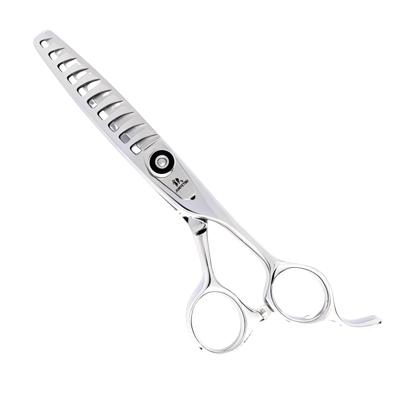
Verdict: the coarsest tooth line in this list. Suits: deliberate separation or weight removal, followed by combing through. Deciding fields: ten V-shaped teeth, VG10 steel, a 3D offset handle and a 6.0-inch length. Trade-off: for a finer line, compare the 16- and 21-tooth Chompers in the same family rather than adding more passes with this one.
2. Joewell JGC-12: a cut-and-thin construction
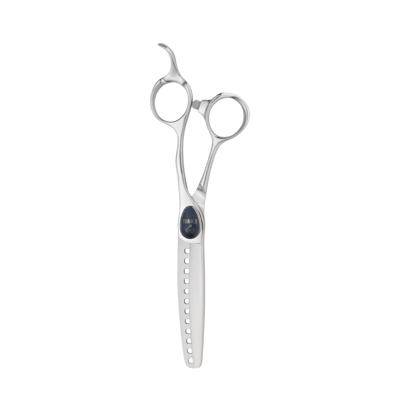
Verdict: a hybrid role, not a fine finishing tool. Suits: a stylist who wants one tool that cuts and texturises in the same movement. Deciding fields: twelve flat teeth, a nominal 6.2 inches, an offset handle, a dry-bearing screw and a permanent finger rest; Joewell states an 80% cut ratio on its model page. Trade-off: that ratio makes the comparison different from a lighter-rate blender, so read the role beside the figure.
3. Ichiro Kawa: choose the chunker or the blender
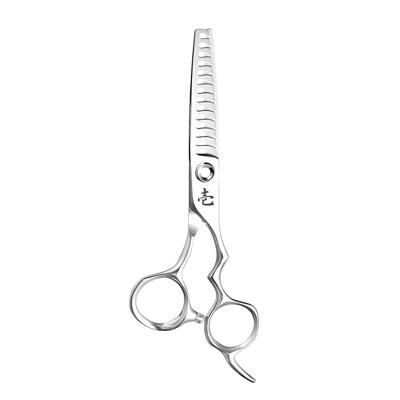
Verdict: two tooth layouts under one listing. Suits: a buyer who wants to pick between a 14-tooth chunker and a 30-tooth blender. Deciding fields: a fixed Z-Balance offset handle, 440C steel and a satin-brushed finish. Trade-off: the option names are layouts, not removal percentages, so record which one you choose.
4. Kasho Design Master 15: one tooth count, one configuration
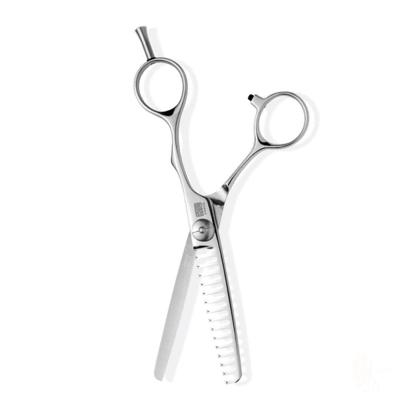
Verdict: a single configuration with no selector. Suits: someone who wants Kasho’s Design Master series with an open tooth pattern. Deciding fields: fifteen teeth, semi-convex blade construction, an offset handle and 6.0 inches. Trade-off: a different tooth count means a different model, and Kasho’s own cut-rate figure for it is not in our record.
5. Ichiro Taiyo: fifteen teeth in a premium-series family
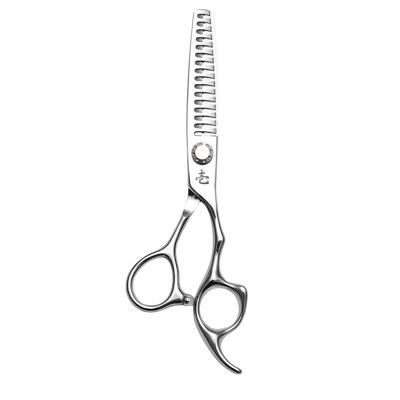
Verdict: the toothed member of a cutter-and-texturiser family. Suits: a stylist who wants to match a texturiser to a Taiyo cutter. Deciding fields: 15 teeth, VG-10 steel listed at 60 to 62 HRC, a polished finish and a Tejina-style tension screw. Trade-off: the record advises a small test cut; tooth count does not fix a percentage.
6. Ichiro 16T: a plain texturiser
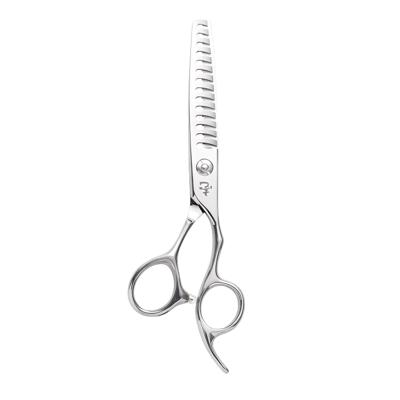
Verdict: a single six-inch shear for a defined texture task. Suits: planned texture or weight adjustment where a solid-blade cutter sets the line. Deciding fields: sixteen V-shaped teeth, a convex edge, 440C steel and an offset handle. Trade-off: it is not a cutter for the main line, and a higher count elsewhere does not by itself prove a smaller change.
7. Joewell HXG: flat teeth and extended gaps
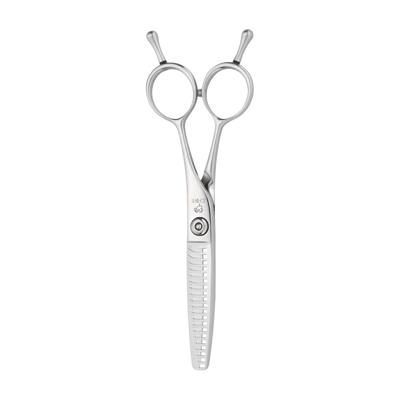
Verdict: open gaps on a classic handle. Suits: a texture adjustment where you want flat teeth with extended gaps. Deciding fields: 17- or 20-tooth options, both a nominal 5.9 inches, Supreme Stainless Alloy and a classic handle. Trade-off: the 20-tooth option is right-handed, but the hand of the 17-tooth option needs confirming with us first.
8. Juntetsu Cobalt Texturising: pick the ratio
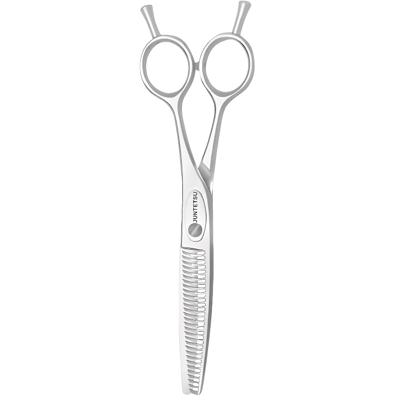
Verdict: one 30-tooth format, three removal choices. Suits: a stylist who wants to choose between Finesse 15%, Blend 20% or Sculpter 30%. Deciding fields: a 6.0-inch tool in Takefu VG10 cobalt, a removable finger rest and a flat-bearing click-lock pivot. Trade-off: the percentages are the record’s option labels, so the result still depends on placement and the hair.
9. Ichiro Texture Master: three styles, one count
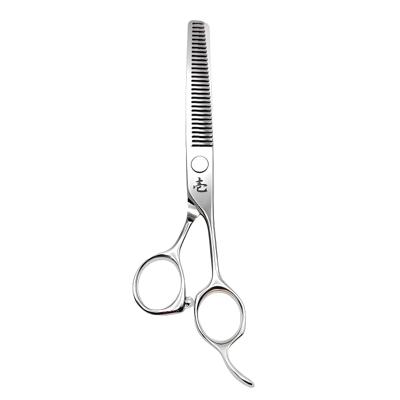
Verdict: a 30-tooth tool in W, V or H styles. Suits: blending that ranges from light to more deliberate. Deciding fields: W lists 10 to 15%, V 20 to 25% and H 30 to 35%, on one offset handle with a flat tension screw. Trade-off: the labels rank the options against each other, not against another brand’s figures.
What did not make the nine
The Juntetsu Chomper also comes in 16- and 21-tooth versions, sold as separate products, and several Kamisori texturisers are excluded to keep this to Japanese brands. Premium thinners from Kasho, Joewell and Yasaka are on the top 10 thinning and texturising list, and lower-priced thinners are on the list under A$300.
What would change this list
A record change, a new tooth line or a maker figure for a model that lacks one would change it. To choose between tooth counts, read same count, different thinners and the cut-ratio guide. For left-handed options, see the left-handed thinning list. Browse all in thinning shears or the knowledge base.
Questions people ask
What is the difference between a texturiser and a thinner? The labels overlap. Compare the tooth design, the count and any maker figure for the exact model rather than the name.
Do fewer teeth always remove more hair? Not necessarily. Tooth width, spacing and the opposing blade matter, so count alone cannot tell you how much a closure removes.
Further reading
- Scissorpedia, an information website on scissors in general.
Scissorpedia is a fellow member of the ShearAlliance; see ShearAlliance.
A closer look at shears
Comparing two models? Send us their names or SKUs and the cutting work you have in mind.
Latest blog posts
Read all blog posts
10 Japanese Shear Myths and What Is Actually True
Ten common beliefs about Japanese shears, from blade length to steel and origin, with a plain correction and a way to check each one.

10 Mistakes to Avoid When Buying Shears Online
Ten online-buying mistakes that cost stylists time and money, from trusting the family photo to skipping the returns terms, with a fix for each.