Choosing Blade Length by Task
Reach against control: match the usable blade to the work, not the label.
By JapanShears EditorialUpdated
On this page
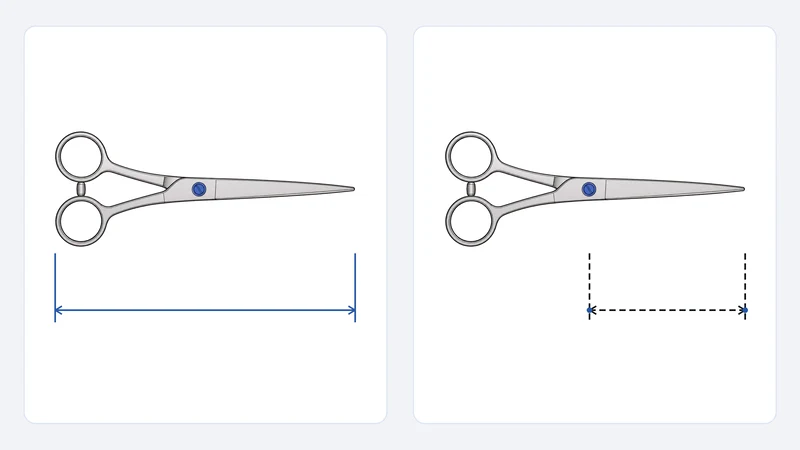
Short answer. Choose the shortest blade that still reaches the work and the longest one you can still place accurately. A compact blade gives tip access for close detail; a longer blade covers more hair per closure for long lines and comb work. The nominal inch label is a model name, not a blade measurement, so compare against a shear you already use.
Key takeaways
- Usable blade length and nominal size are separate numbers; many makers publish both.
- Reach helps long lines and broad sections. Control helps detail. You are trading one for the other.
- Decide by the task you do most, then check how the tool feels at the tip, not only at the heel.
- A second length is an addition for a specific job, not an obligation.
- Do not choose by hair label; choose by the section, the line and the technique.
Why is blade length not the same as the inch size?
The inch figure on a listing is the maker’s nominal size for the whole tool. The blade is only part of it. Two shears with the same label can have different blade lengths because the handle, finger rest and pivot position vary, and conventions for treating a removable finger rest differ by maker. Joewell’s specification list is explicit about this, and the size guide shows Yasaka’s published full-length and blade-length figures side by side.
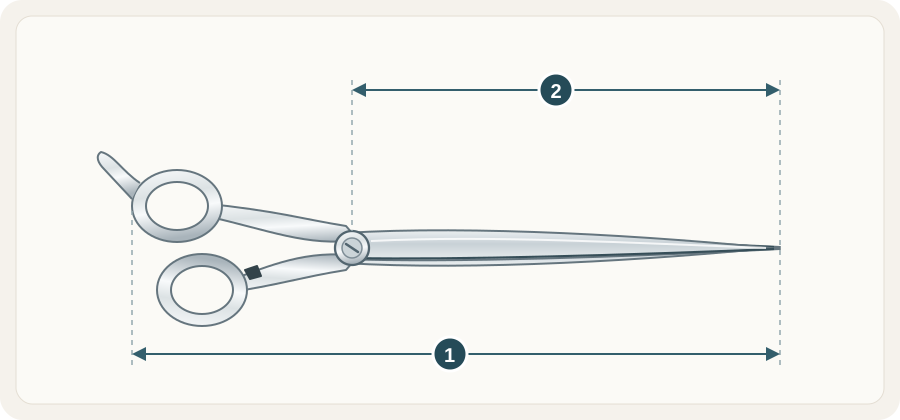 Open illustration at full size
- Overall tool lengthCompare the maker’s stated whole-tool size. Finger-rest treatment can vary.
- Blade lengthA separate blade measurement. Check the model specification rather than converting its nominal inch label.
Where the blade measurement is stated, use it. Where it is not, ask for it rather than converting the label. The barber reach guide takes the same point further for comb work.
Which task suits which length?
The table gives starting hypotheses, not rules. Skilled cutters work with compact tools for long lines and long tools for detail, and the trade-offs below are what they are weighing.
| Task | What you want from the blade | Leans towards | Trade-off |
|---|---|---|---|
| Close detail, fringe and around the ear | Tip access, visibility of the line | A compact blade | Fewer closures cover less hair |
| Perimeter and blunt lines | A clean line in few closures | Mid to long blade | Tip control must hold across the span |
| Point cutting | Accurate tip entry | A blade whose tips you can place consistently | A long blade magnifies small tip movements |
| Slide or slice work | A suitable edge and line for the technique | The maker’s intended slide models, in a length you control | Check the edge as well as the length |
| Scissor-over-comb | Enough reach to travel along the comb | A longer blade, within what you can hold steady | Reach adds weight at the tip |
| Mixed salon work | One controllable main tool | A mid-length cutter | A specialist later, not three tools now |
How do you decide for your own work?
Use a short sequence.
- Name the job that matters most. If it is the job you do daily, size for that.
- Start from a shear you know. Note its nominal size and, if you can, its stated blade length.
- Describe the change you want. “More reach for long lines” or “closer tip access” are decisions; “bigger” is not.
- Compare blade figures, not labels. Where a maker states a blade measurement, set the two side by side.
- Check hand, handle and edge before the exact size. A size cannot fix a layout that does not suit you.
The Shear Finder applies hand, length and budget to the range, and the size collections (5.5-inch, 6.0-inch, 6.5-inch and others) group models by nominal size.
When does a second length make sense?
A second length makes sense when you routinely do two jobs that pull in opposite directions, such as close detail and long comb work, and a single tool compromises one of them. For barbers this is covered in does your kit need two cutter lengths. For salon cutters, it is usually a specialist added after a main tool is settled. It is not a rule that a complete kit has several cutters.
When not to add one: if your current shear does the job and you are drawn by the idea of coverage, or if you have not yet learned the control of the one you have.
What should you check at the tip?
Reach is only useful if you can place the tips. Compare tip shape and visibility on the actual model, not on the family photograph. Note whether the blade closes smoothly to the tip and whether the opening feels controlled at the length you chose. If you are in training, take a named candidate to your educator, and use a tool they are happy for you to try.
Common mistakes
- Buying the biggest nominal size for “more coverage”. The extra length must be controllable at the tip.
- Comparing inches across makers. Conventions differ; compare blade figures where given.
- Choosing by hair label. Section size, line and technique decide the length, not a descriptive word for the hair.
- Forgetting the edge. One family can change edge between sizes. See convex, bevel and hollow edges.
- Treating “compact” as “precise”. A short blade gives access; precision comes from control and technique.
Questions people ask
What blade length do I need for scissor-over-comb?
There is no single figure. Choose enough reach to travel along the comb with a blade you can keep steady, then compare stated blade lengths. Our comb-work guide gives the barber view.
Is a 5.5-inch shear a good all-rounder?
It is a common working length and a sensible reference point, but it is a label. Check the blade measurement and your own control before treating any size as universal.
Does a longer blade cut faster?
It covers more hair per closure, which can mean fewer closures on a long line. Speed is also about control and technique.
Should an apprentice buy a long blade?
Start with the tool and length your course uses, then ask your educator before changing. See your first Japanese shears.
Further reading
- Barber shear reach, the size guide and the knowledge base.
- Reading a spec sheet line by line for the length lines.
- Joewell’s product specification table for a maker’s stated measuring convention.
- Scissorpedia for general scissor reference.
Scissorpedia is a fellow member of the ShearAlliance (see ShearAlliance).