Shear Handle Types: Opposing, Offset, Crane, Swivel
What each ring arrangement changes, and what it leaves for you to judge.
By JapanShears EditorialUpdated
On this page
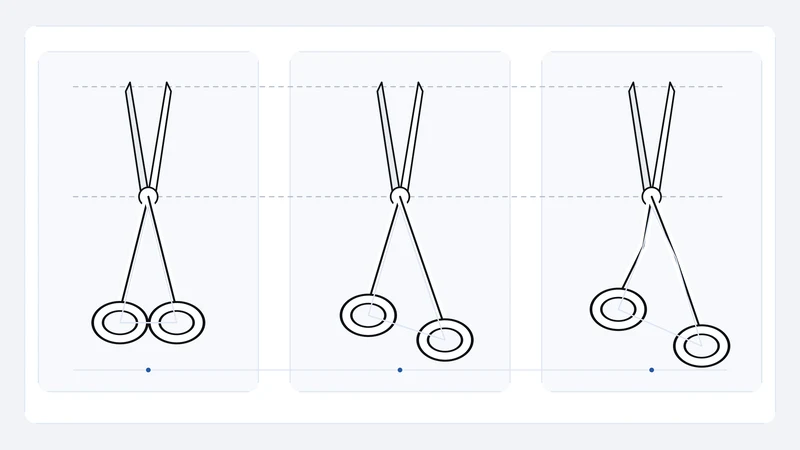
Short answer. A shear handle is the ring arrangement you operate. Opposing (also called classic or traditional) rings sit at similar distances from the pivot; offset staggers them so the thumb ring is closer; crane adds a lowered thumb position and a changed shank angle; swivel adds a thumb ring that rotates. Choose the cutting hand first, then the handle you can describe in your own grip.
Key takeaways
- Handle type changes where your thumb and fingers sit relative to the blades. It does not change which hand the blades are built for.
- Opposing, offset, crane and swivel are families. Ring size, contour and angle still differ model by model.
- A movable thumb is a separate mechanism from the main blade pivot.
- Handles are described by geometry here. We make no claim that any layout prevents or relieves discomfort.
- If you are changing handle family, change one thing at a time and keep the nominal size steady while you compare.
What are the four handle families?
A handle family names a layout, and each layout answers a different question about where your hand rests.
| Family | Ring arrangement | What it changes | Also called |
|---|---|---|---|
| Opposing | Rings at a similar distance from the pivot, broadly symmetrical | A familiar, balanced layout | Classic, traditional, straight, in-line |
| Offset | Rings staggered; thumb ring nearer the pivot | The relationship between thumb and fingers | Semi-offset where the stagger is small |
| Crane | A lowered thumb position and changed shank angle | The posture of the thumb relative to the blade | Crane-style |
| Swivel | Thumb ring that rotates independently | Whether the thumb ring is fixed during operation | Swivel thumb, rotating thumb |
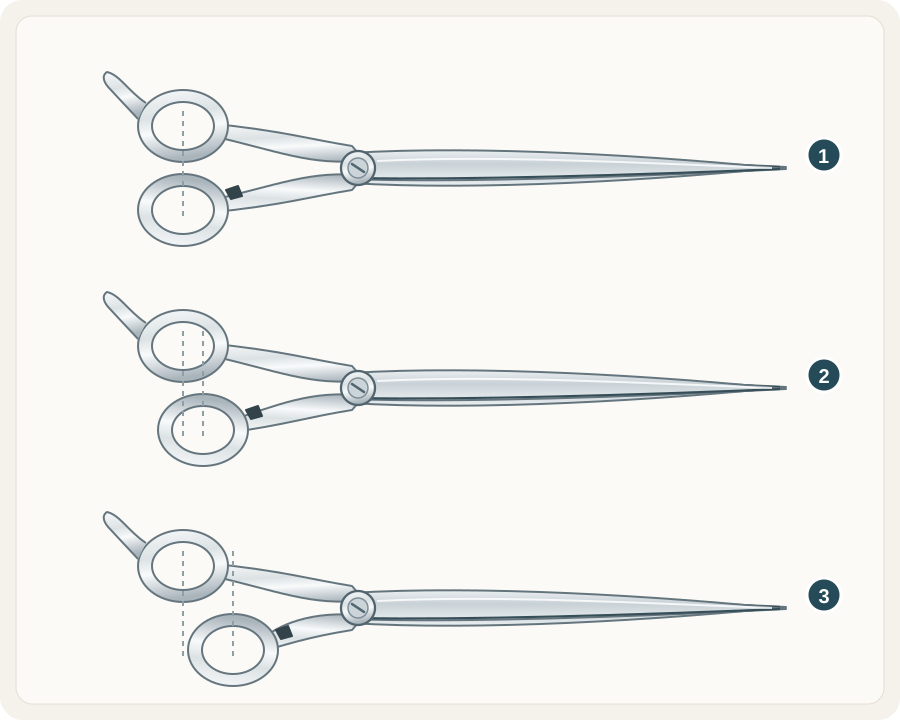 Open illustration at full size
- Straight / in-lineThe rings sit at a similar distance from the pivot.
- Semi-offsetA small difference between the two handle lengths.
- OffsetThe thumb ring sits closer to the pivot. Compare it with your present tool.
What does an opposing handle change?
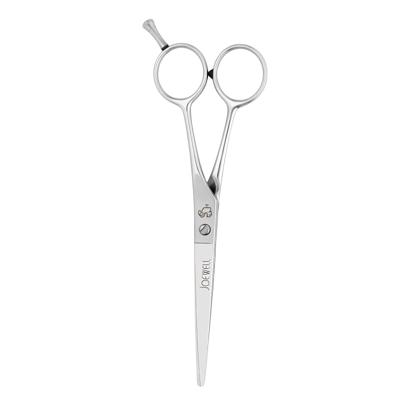
An opposing handle places the rings broadly symmetrically, so neither ring is markedly closer to the pivot. It is the layout many cutters train on, which makes it a natural reference point when you try anything else. Symmetric rings do not make a shear suitable for either hand: the blade construction still has a hand.
Choose it when you want the layout you already use, or when your educator’s brief names it. Do not choose it on the assumption that “classic” means “gentler”; the label describes ring positions, not a result. A concrete example of a traditional layout is the Joewell Classic at 5.5 inches.
What does an offset handle change?
An offset handle staggers the rings so the thumb ring sits closer to the pivot than the finger ring. Describing it plainly: the thumb sits lower than the fingers, which changes the angle at which your wrist and fingers meet the blades. Joewell’s handle reference notes that grip lengths and angles in offset layouts vary, so two offset models are not interchangeable by name.
Choose offset when you want to compare a different thumb position against a familiar tool of the same nominal size. The offset collection groups the family. The offset and crane guide shows the geometry on real models.
What does a crane handle change?
A crane handle changes the shank angle as well as the ring position, lowering the thumb relative to the blade. It is a more pronounced version of the same idea as offset, and makers draw the line between the two differently. Compare the actual shapes in photographs rather than relying on the label.
Choose crane when you have already tried offset and want to compare a more lowered thumb position, ideally with a shear your educator or supplier lets you handle. The crane collection lists models that use the term.
What does a swivel thumb change?
A swivel handle adds a joint so the thumb ring rotates while the blade pivot stays where it is. Two places can then move: the main pivot, where the blades meet, and the thumb assembly further down the handle. Makers describe rotation differently, and a rotating insert inside a ring is a separate construction from an articulated thumb assembly. The swivel guide separates them.
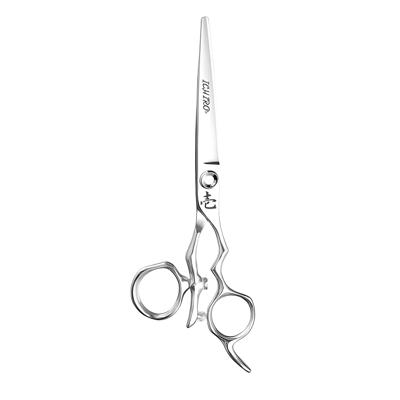
Choose swivel if you want to compare a moving thumb ring with a fixed one at a known length. Skip it if you want the fewest moving parts to look after; each joint has its own care directions.
How should you choose a handle?
Start from what you can describe, not from the label.
- Fix the hand. The cutting hand comes first; see the left-handed checklist.
- Hold the nominal size steady. Comparing handles at the same inch label isolates the ring arrangement.
- Compare one change. Moving from opposing to offset at the same size tells you more than moving handle, size and edge together.
- Note where your thumb sits and how far the shear opens. Use your own words: a ring that feels tight is a ring-opening question, and an insert may address it. See finger rings, inserts and fit.
- Bring a supervisor into the trial. If you are a student, take a named candidate to your educator before changing the layout you were taught.
When not to change handle
If your present layout works, the case for changing is the tool’s other fields (edge, blade length), not curiosity about a handle. If discomfort persists in work, that is a conversation about working conditions and technique with a qualified professional. A handle specification cannot settle it.
Common mistakes
- Treating “ergonomic” as a result. The word on a listing is a design description. We do not state outcomes.
- Reading symmetric rings as ambidextrous. Hand is a blade construction fact.
- Confusing sword with a handle. Sword is a blade profile; see sword, slim and leaf profiles.
- Changing handle and size together. You will not know which change you are reacting to.
- Mixing up an insert with a handle change. An insert reduces a ring opening; it does not move the thumb ring.
Questions people ask
What is a classic handle?
A classic or traditional handle is an opposing, broadly symmetrical ring layout. It is not a statement about quality or about which hand the blades suit.
Is an offset handle better for a longer day?
We do not make outcome claims for any handle. Offset changes the thumb and finger relationship; whether that suits your work is for you to judge in your own grip.
Do swivel handles need extra care?
They add a joint, so follow the maker’s directions for that joint as well as for the main pivot.
Is crane the same as offset?
They overlap. Crane usually also changes the shank angle and lowers the thumb further. Makers define the terms differently, so look at the model photographs.
Further reading
- Offset and crane handles, fixed or swivel thumb and the knowledge base.
- The buyer’s guide and the Shear Finder to apply hand, length and budget.
- Ichiro’s handle education page and Joewell’s handle and screw reference.
- Scissorpedia for general scissor reference.
Scissorpedia is a fellow member of the ShearAlliance (see ShearAlliance).