Offset and Crane Shear Handles: Compare the Geometry
Read ring position, shank angle and thumb movement as separate construction choices.
By JapanShears EditorialUpdated
On this page
Start with the ring positions
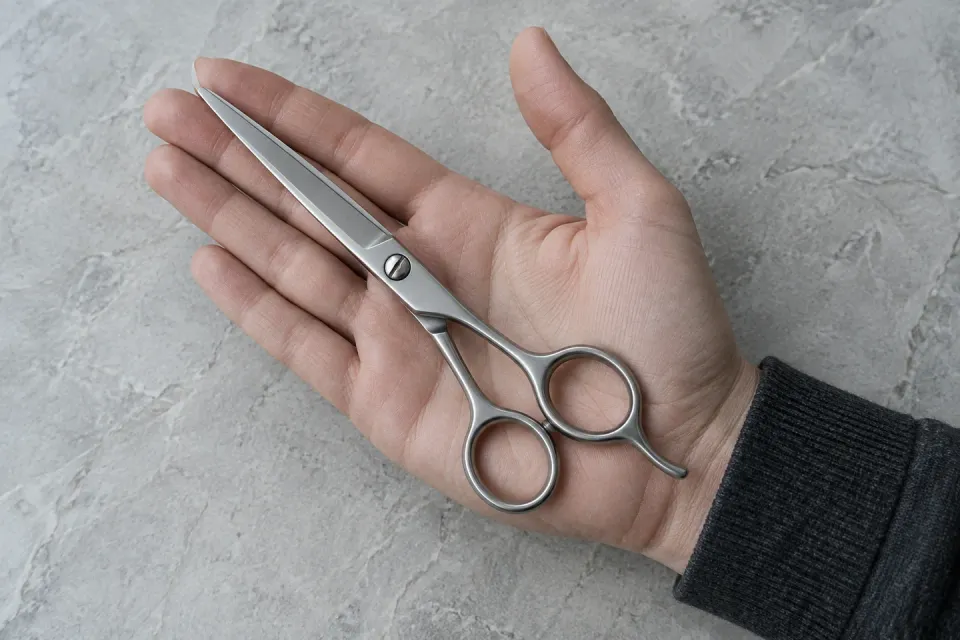
An offset handle staggers the rings, bringing the thumb ring closer to the pivot. A crane-style handle also changes the shank’s angle and places the thumb position lower relative to the blade. Compare the actual shapes: the labels group designs, while the model photograph shows the geometry you are considering.
Choose the correct cutting hand first. Then use a familiar nominal length to compare where the rings sit and how the tool opens in your grip.
Three parts of a fixed handle
| Feature | What changes | What to look at |
|---|---|---|
| Ring stagger | Relative distance of the rings from the pivot | In-line, semi-offset or offset layout |
| Shank angle | The connection between ring and blade | A bent or lowered crane-style shape |
| Ring contour | The shape and angle of the ring itself | A model’s 3D curves, opening and thumb contact |
Joewell’s handle reference describes different grip lengths in an offset layout and notes that designs and angles vary. Jaguar’s mechanical glossary distinguishes offset ring arrangement from the more lowered thumb position of a crane handle.
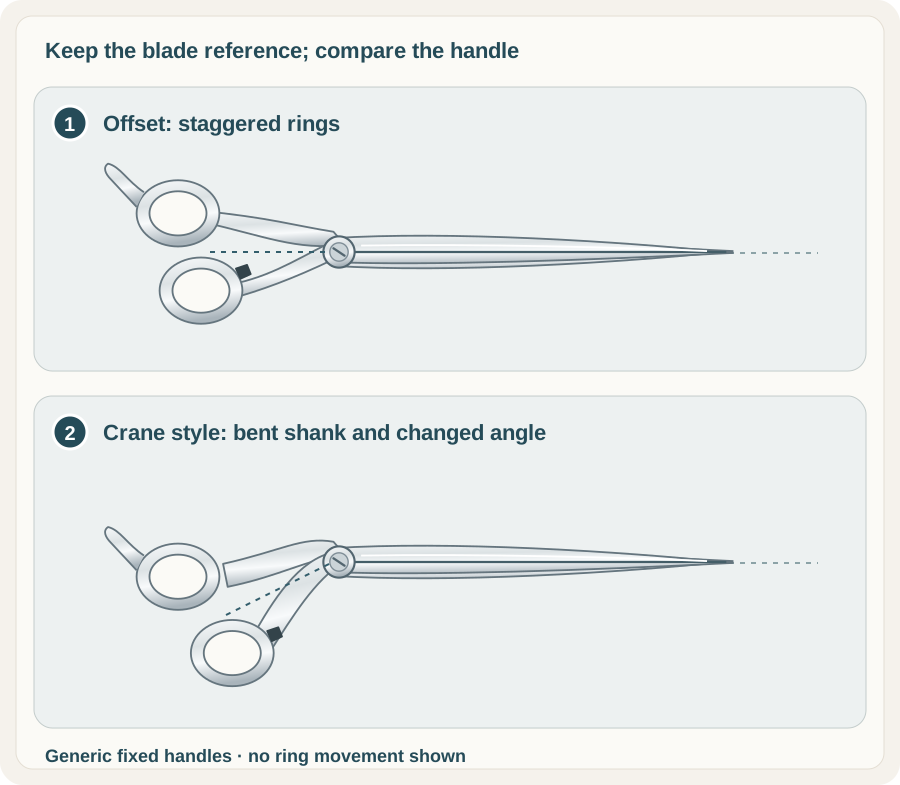 Open illustration at full size
 - Offset arrangementThe thumb ring sits closer to the pivot than the finger ring.
- Crane-style arrangementA bent shank changes the handle angle as well as the ring placement. Compare the exact model’s complete shape.
The drawing holds a blade reference so you can see the handle change. It is a generic geometry comparison. It gives no measured ring spacing, prescribed hand position or comfort result for a named model.
Straight, semi-offset and offset give you a starting vocabulary
Traditional or in-line rings sit at a similar distance from the pivot. Semi-offset introduces a smaller stagger. Offset brings the thumb ring closer. You will still find different ring sizes, contours and angles within each group.
For a useful straight-versus-offset comparison at 5.5 inches, the right-handed Kasho Design Master Straight and Design Master Offset share the listed Design Master blade family. Kasho’s series reference identifies its hollow semi-convex blades, VG-10W steel and ratchet screw construction.
The ring positions are the difference to examine first. Holding the nominal size and blade family steady makes your fit notes easier to interpret; it does not establish identical weight or contours.
A 3D contour is another detail
Three-dimensional ring shaping can angle or sculpt the contact surfaces beyond the basic stagger seen in a flat diagram. Read what the particular maker means by the term and look at more than one model photograph.
The Joewell FX 5.5-inch cutter has a 3D offset grip. The Yasaka SL 5.5-inch cutter has a slim offset handle. Both are right-handed offset cutters, with different stated blade constructions as well. Use the SL-versus-FX comparison when you want to examine the complete tools.
A movable thumb is a separate mechanism
A fixed crane-style shape remains fixed as the blades operate. A rotating thumb design introduces movement at a joint or insert. Its allowed movement and care depend on the model. The glossary above distinguishes a movable thumb from a rotating insert, which is another reason to read the actual mechanism rather than assume every swivel works alike.
If you usually cut with fixed rings, compare a moving grip with a training tool you have permission to use and a clear brief from your educator. Describe what rotates and what remains fixed. This page does not assign a joint count or angle range to a model from its family name.
At six inches, the right-handed fixed Kawa cutter and Kawa Swivel Thumb cutter share listed 440C steel, convex edges and satin-brushed finishes. The swivel model adds a separate thumb mechanism. The fixed-versus-swivel guide identifies that connector apart from the main blade pivot, so the ring movement does not get confused with the fixed offset geometry explained here.
Keep handle and blade profile apart
Sword describes a blade-body profile, rather than the rings’ position. Convex or semi-convex describes construction approaching the edge. A tool can combine one of those blades with several handle layouts.
The blade vocabulary guide separates the edge, profile and cutting-line curve. That lets you ask two clear questions: does the blade construction fit the cutting task, and does the handle layout suit the grip you use for it?
Compare the fit you can describe
With a familiar tool, note the ring opening, where the thumb sits through the opening movement and whether you can place the tips for the task. Use the fit guide for the full observation framework. A compatible insert can reduce the opening inside a ring while keeping the same shank and ring positions.
Browse the offset collection or crane collection after you know which feature you want to compare. For the purchase decision, the premium checklist and budget guide help you connect that difference to a tool you will use.