What Makes a Shear Truly Left-Handed
A five-point check you can run on any listing, thinner or set.
By JapanShears EditorialUpdated

On this page
Short answer. A truly left-handed shear has its whole construction mirrored for the left hand: the blades, the way they cross at the pivot, and the handle arrangement. Symmetrical-looking rings, a reversible finger rest or a flipped photograph do not establish it. Confirm that the selected option names a left-handed build, and check every tool in a set.
Key takeaways
- Handedness is a mechanical property of the blade arrangement, not a feature of the ring shape.
- A right-handed shear held in the left hand is still a right-handed shear.
- Ring symmetry, a movable thumb and a reversible finger rest do not make a shear ambidextrous.
- Thinners have their own handedness; in a set, read each tool.
- Learning a true left-handed tool after a right-handed one takes adjustment. That is normal, not a fault.
What is a true left-handed shear?
A true left-handed shear is built so that, in the left hand, the blades cross and close the way a right-handed shear’s blades do in the right hand. The two halves, the pivot crossing and the grind are all mirrored together. A right-handed tool turned over in the grip keeps its original construction, so it cannot be converted by changing how you hold it.
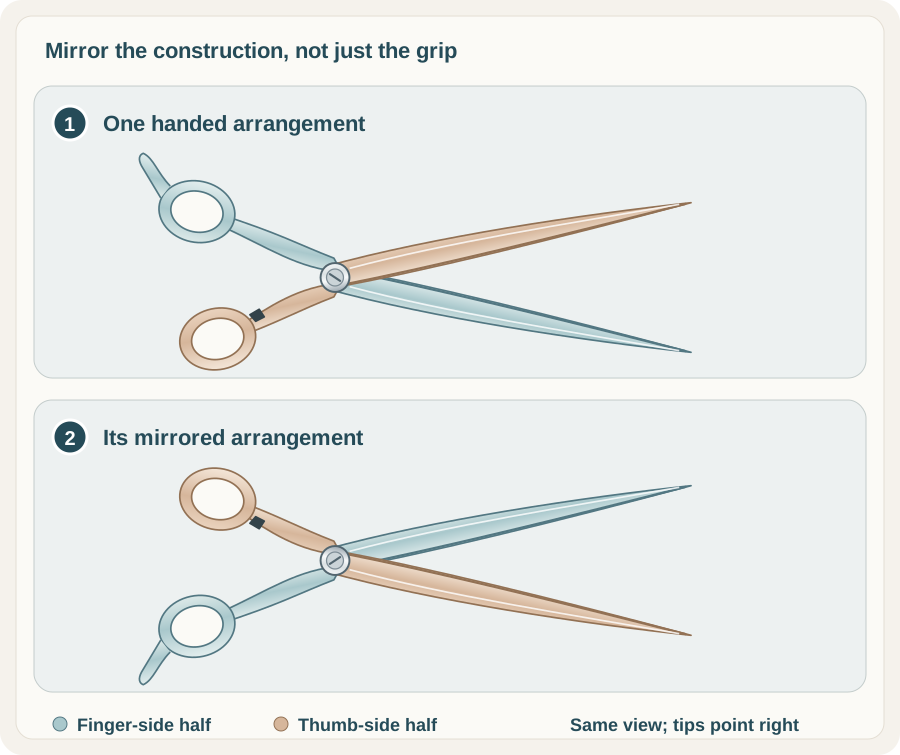 Open illustration at full size
- One handed arrangementFollow each coloured half from its ring through the pivot to its blade.
- Its mirrorThe ring, shank and blade arrangement is mirrored together. Turning the first tool over in your grip does not rebuild it.
The practical reason it matters is how the blades meet. The crossing orientation affects what you can see of the cutting line and how much side pressure it takes to keep the edges working together. The left- and right-handed guide explains the mechanics in more detail.
Five checks before you buy
Run these in order. A “no” at any step is a reason to ask before ordering.
| Check | What to look for | If it fails |
|---|---|---|
| 1. The selected option | The full option name states a left-handed build, with a left SKU | Reselect, or ask the seller with the SKU |
| 2. The maker’s page | The maker lists a left-handed model, such as a “Lefty” or “Left” line | Treat the listing as unconfirmed |
| 3. The photograph | You are not relying on a photo that may be mirrored or taken from the other side | Use the written option, not the picture |
| 4. Each tool in a set | The cutter and the thinner each state their hand | Ask about the tool that does not |
| 5. The handle | The ring arrangement matches what you want, as a separate question | Compare handle families separately |
The first check is the one that matters most. A left option exists for many listings but not all, and the left-handed collection is built from the options that state it.
Which features do not make a shear left-handed?
Four things are often mistaken for it.
- Symmetrical rings. A traditional, in-line handle can have rings that look equal and still be built for one hand.
- A reversible or removable finger rest. It changes where the little finger sits, not the blade arrangement.
- A swivel thumb. A rotating thumb ring is a handle feature, not a handedness feature. See fixed or swivel thumb.
- A reversible tooth side on a thinner. On a thinner, the position of the teeth can sometimes be reversed on some models. That is a different property from a true left-handed build.
A removable ring insert reduces the opening inside a ring and leaves the rest alone; see finger rings, inserts and shear fit.
How do you check thinners and sets?
A thinner has its own cutting hand. In a left-handed set, confirm that both the cutter and the thinner are left-handed, rather than assuming one tool’s hand applies to the other. The Ichiro Rose Lefty thinner is a worked example: the listing names the hand, length and handle for that one tool.
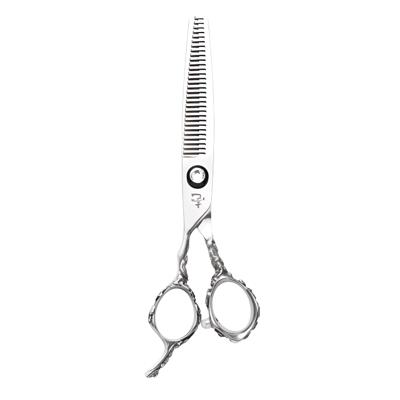
Where a set offers a size choice, confirm the selected option for each component. A size button can change the cutter while the thinner stays fixed.
What if you trained on right-handed tools?
Many left-handed professionals learned on right-handed shears. Moving to a true left-handed build can mean a period of adjustment, because the line of sight and the closing feel are different. That is a practical transition, not a criticism of your skill. Take the question to your educator or a senior colleague, describe the tool you use now, and compare one named candidate rather than switching everything at once. If a pair already in your hand is not cutting as you expect, the left-handed problems and fixes guide matches symptoms to causes.
When to choose a left-handed build, and when to ask first
Choose a true left-handed build when you cut with your left hand and want the blade construction to match. Ask first when the listing does not name a left option for your selected size, when a family offers a left build only in some sizes, or when a photograph is the only evidence. For the wider shortlist, use the left-handed cutter list and the left-handed thinner comparison.
Common mistakes
- Trusting the family photograph. Photos can be mirrored or taken from the other side.
- Assuming a left cutter implies a left thinner. Each tool states its own hand.
- Equating “ambidextrous” with “left-handed”. It is not a blade construction.
- Choosing a left build in a size that is not offered. Check the selected option.
- Changing hand, handle and size all at once. You will not know what you are reacting to.
Questions people ask
Can I use a right-handed shear in my left hand?
You can hold it, but it remains mechanically right-handed. The blade crossing and closing feel are built for the right hand.
Is an offset handle left-handed?
No. Offset describes ring stagger. A model can be offered separately in left and right builds.
Do all families have left-handed versions?
No. Left options exist for some families and sizes. Confirm the selected option, or browse the left-handed collection.
Does a left-handed tool cost more?
Prices come from the product record for the selected option, so check the listing. We do not generalise.
Further reading
- Left- and right-handed hair shears: what changes and the knowledge base.
- The Shear Finder to filter by hand, length and budget.
- Joewell’s left-handed model reference as an example of a maker naming a left-hand line.
- Scissorpedia for general scissor reference.
Scissorpedia is a fellow member of the ShearAlliance (see ShearAlliance).