Sword, Slim and Leaf Blade Profiles Explained
Outline, reinforcement and cutting line are separate from the edge and from the handle.
By JapanShears EditorialUpdated
On this page
- What do the three profile words describe?
- How is the profile different from the edge and the handle?
- Why does the word “sword” confuse people?
- How does the profile relate to technique?
- How do you read a profile on a listing?
- When to choose a particular profile, and when not to
- Common mistakes
- Questions people ask
- Further reading
Short answer. Sword, slim and leaf describe the shape of the blade body: a reinforced outer profile (sword), a slender outline (slim) or a broad curved outline (leaf, sometimes bamboo-leaf). They are not edge grades and not handle types. Read the blade profile, the edge and the handle as three separate lines on a listing, and check how the maker uses each word.
Key takeaways
- Sword is a blade-body profile in this catalogue. It is not a handle, even where a collection is named for it.
- Profile (the outline), edge (the grind approaching the cutting line) and handle (the rings) are independent choices.
- A sword-profile blade can have a convex edge; the two terms describe different things.
- Leaf and bamboo-leaf outlines are used in some designs intended for motion cutting. The name describes shape and intended use, not a steel or tooth pattern.
- Makers use these words differently, so confirm the meaning for the exact model.
What do the three profile words describe?
Each word names a way of describing the blade body. They are loose trade terms, not standardised grades.
| Term | What it describes | What it does not tell you |
|---|---|---|
| Sword | A reinforced outer profile, commonly with a raised outer ridge, in ranges that use the word | The edge finish, the steel or the handle |
| Slim or slender | A narrower blade outline | How the edge is ground, or how long the blade is |
| Leaf or bamboo-leaf | A broad, curved outline used in some motion-cutting designs | A steel grade or a tooth pattern |
A raised ridge or added material can influence rigidity and feel. It does not by itself identify the cutting-edge finish, which is a separate statement. The edge comparison covers convex, bevel and hollow.
How is the profile different from the edge and the handle?
Think of a shear as three questions you can ask independently.
- Outline and reinforcement (profile). What shape is the blade body as seen from above, and is it reinforced?
- Edge. What is the grind approaching the cutting line, and what is the inside-face treatment?
- Handle. Where do the rings sit? See handle types explained. For the Japanese blade-line and blade-section words, see classifying a blade in two axes.
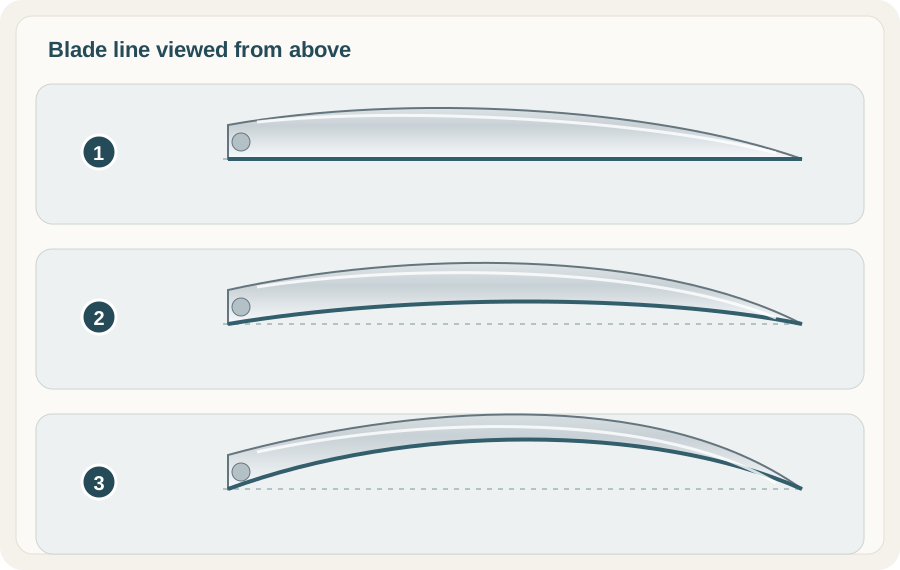 Open illustration at full size
- Straighter lineA cutting line with less curve in this view.
- Moderate curveA different line while keeping the same end-to-end reference.
- More curved lineInvestigate the maker’s intended use for the complete model, including its line and edge.
The diagram shows a fourth, related idea: the curvature of the cutting line itself. An edge label alone does not establish that shape, so look at the blade plan view in the maker’s own photographs. The blade vocabulary article separates edge, profile and cutting-line curve.
Why does the word “sword” confuse people?
Some collections and listings put “sword” next to “handle”, which suggests a ring arrangement. In this catalogue, sword refers to the blade body, and the handle is a separate field. Our Sword-Profile Shears collection groups models by blade profile and says to compare edge, selected length and handle separately. A sword-profile blade can come with several handle layouts, so choose each independently.
How does the profile relate to technique?
A profile suits a technique when the maker intends it to. Some ranges offer dedicated slide or stroke designs with curved or leaf-shaped outlines, selected for drawing the blade through hair; Joewell’s slide-cutting manual is an example of a maker describing technique for its own models. A broad blade is not automatically blunt or unsuitable, and a slim blade is not automatically precise. The effect depends on the full construction and on technique, which is why the wet versus dry guide and the techniques hub matter alongside the profile word.
Do not treat these words as a quality ladder. A profile that holds a line well and one that allows controlled sliding serve different purposes.
How do you read a profile on a listing?
Use a short check.
- Find the profile word in the title, description or specification, and note whether it is the maker’s term.
- Find the edge line separately: convex, bevel, serrated or other.
- Find the handle line separately.
- Look at a plan-view photograph if the maker provides one, rather than relying on the word.
- Ask for the missing line, with the SKU, if one is blank. See how to read a spec sheet.
When to choose a particular profile, and when not to
Choose by the technique and the line you need, using the maker’s intended use for the model. Do not choose by the word alone, by the idea that a broader or slimmer blade must be better, or by a collection name. If you are changing profile and handle at once, you will not know which change you are reacting to.
Common mistakes
- Reading sword as a handle. It is a blade-body profile.
- Treating profile and edge as rivals. A sword blade can be convex.
- Assuming leaf means a specific steel. It describes shape and use.
- Choosing by word. Check the maker’s usage for the model.
- Forgetting the cutting-line curve. It is a separate shape.
Questions people ask
Is a sword blade stronger?
A reinforced profile can influence rigidity and feel, but it is a description of shape, not a strength guarantee. Compare the maker’s statements for the exact model.
What is a bamboo-leaf blade?
A broad, curved outline used in some motion-cutting designs. The name describes shape and intended use.
Can I choose a sword-profile shear with an offset handle?
Often yes. Profile and handle are separate fields; check the selected option.
Is a slim blade better for detail?
A slim outline can give access, but precision comes from control and technique. See choosing blade length by task.
Further reading
- Sword-profile shears collection, blades and edges explained and the knowledge base.
- Ichiro’s blade education page for a maker’s own vocabulary.
- Scissorpedia for general scissor reference.
Scissorpedia is a fellow member of the ShearAlliance (see ShearAlliance).