Finger Rings, Inserts and Shear Fit
Ring opening, finger rest and span: describe the fit before you change anything.
By JapanShears EditorialUpdated
On this page
Short answer. Fit on a hair shear is made of several separate things: how large the ring opening is, where the rings and finger rest sit, how far the shear opens and how the weight feels in your grip. A removable insert reduces a ring opening and nothing else. Describe what you notice in plain terms first; then decide whether the answer is an insert, a different handle or a different size.
Key takeaways
- Ring opening, ring position, finger rest and opening span are four different fit questions.
- An insert changes the space inside a ring. It does not move the ring, change the handle layout or reverse the blades.
- Whether a shear suits your hand is something you judge in your own grip. A specification cannot judge it.
- We describe geometry and do not promise outcomes for comfort, strain or any health condition.
- Persistent discomfort at work is a conversation with a qualified professional, not a product-specification question.
What parts of a shear make up fit?
A shear’s fit comes from its handle, and the handle has more than one feature. It helps to name each so you can say which one is bothering you.
| Part | What it is | The fit question it raises |
|---|---|---|
| Ring opening | The space inside the finger or thumb ring | Is the opening too large or too small for how you hold it? |
| Ring position | Where each ring sits relative to the pivot | Do you want a different thumb and finger relationship? See handle types |
| Finger rest (tang) | The small projection beside the finger ring | Does your little finger want support, and is it fixed or removable? |
| Opening span | How far the blades open | Can you control the tips across the whole opening? |
| Weight and balance | How the mass sits in your hand | See weight and balance |
What does an insert do?
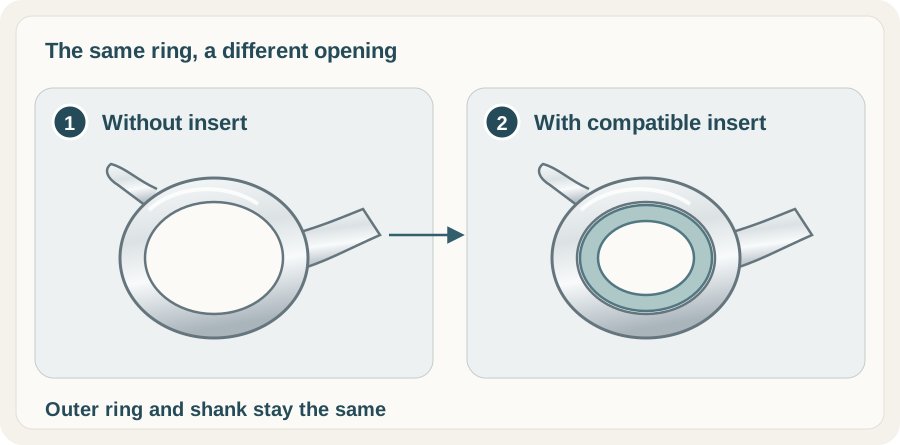
A removable insert sits inside a ring and reduces the visible opening. It is a ring-fit adjustment, and it leaves the rest of the handle as it was.
 Open illustration at full size
- Without an insertThe ring opening is the space within the metal bow.
- With a compatible insertThe insert reduces that opening. It does not move the shank or change the blade arrangement.
That means an insert cannot fix the wrong ring position, the wrong hand or the wrong length. It also needs to be compatible with the tool: makers supply or name inserts for particular models. Joewell’s handle reference is an example of a maker describing its handle parts. If a listing says an insert is included, confirm it fits your selected option.
What should you know about the finger rest?
The finger rest, also called the tang, is the projection that supports the little finger on designs that have one. Some are fixed and some are removable, and makers measure size with or without a removable rest, so two figures for “the same” model may not match. Kasho’s parts guide names the tang and the other parts of a shear. A removable or extra finger rest does not make a shear ambidextrous: handedness belongs to the blades. See what makes a shear truly left-handed.
How do you describe a fit problem?
Use plain words for what you notice, and note which part of the handle it concerns.
- Name the part. Ring opening, ring position, finger rest or span.
- Say when it happens. At full opening, mid-stroke, after a long period of work.
- Compare with a tool you know. Note its model and nominal size.
- Record the change you want. “A smaller ring opening” is a decision; “more comfortable” is not yet.
That record is what you take to a seller or your educator. Our fit guide develops the observation framework, and the size guide explains how nominal size and blade length differ.
How should you try a change?
Change one thing at a time, and keep the others steady.
- If the ring opening is the issue, try a compatible insert before changing the tool.
- If the ring position is the issue, compare handle families at the same nominal size.
- If the span is the issue, compare blade lengths; see choosing blade length by task.
- If you are a student, take a named candidate to your educator and use a tool they are happy for you to try.
Do not combine a new insert, a new handle and a new size in one purchase. You will not know which change you are reacting to.
When is an insert enough, and when is it not?
An insert is enough when the ring position and opening span suit you and only the ring opening is wrong. It is not enough when the thumb sits in the wrong place for how you cut, when the hand is wrong, or when the tool is simply the wrong length. In those cases, compare a different handle or size. If the shear is on a Shear Finder shortlist, compare the exact options as a pair.
What about discomfort during work?
A handle specification cannot treat or prevent discomfort, and we make no claim that any ring layout does. If you experience persistent discomfort, discuss your working conditions, technique and workload with a qualified professional. Describing geometry, as this page does, helps you ask a better question; it does not answer a health one.
Common mistakes
- Expecting an insert to relocate the thumb. It only reduces the opening.
- Assuming any insert fits any shear. Check compatibility.
- Changing handle, size and insert together. One change at a time.
- Reading a removable rest as ambidextrous. Handedness is the blades.
- Reading a spec sheet for fit. Fit is judged in the hand.
Questions people ask
Do all shears come with finger inserts?
No. Some models supply them and some do not. Check the contents line for your selected option.
Can an insert make a loose ring tighter?
It reduces the opening inside the ring. Whether that suits your grip is for you to judge.
Is a bigger ring better?
Neither is better in general. Ring size is a fit decision, and the specification cannot make it for you.
Should I get a different handle or an insert?
If only the opening is wrong, try an insert. If the thumb position is the issue, compare handles. See handle types explained.
Further reading
- How to compare hair shear fit, offset and crane handles and the knowledge base.
- Joewell’s handle and screw reference.
- Scissorpedia for general scissor reference.
Scissorpedia is a fellow member of the ShearAlliance (see ShearAlliance).