Shear Tension Systems Compared: Screw, Dial, Click and Tool-Free
Compare how each system is adjusted, how it holds a setting and what to ask the maker.
By JapanShears EditorialUpdated
On this page
Short answer. A tension system is the hardware that sets and holds the resistance between the two blades. The common types differ in who can adjust them (anyone with a tool, anyone by hand, or only a technician), in how finely they step, and in how well they keep a setting. None is a quality grade. Pick the type whose trade-off matches how you work, then follow the maker’s instructions for your exact model.
Key takeaways
- Systems differ on three practical questions: how you adjust, how fine the steps are and how well the setting holds.
- Tool-free and stepped systems are quick to change. A recessed or fixed system is harder to disturb and harder to change.
- The same word can mean different hardware, and a decorative dial may or may not be the adjuster.
- This page gives no screw direction, turn count or release angle, because those belong to the model.
- A setting that will not hold, or a gritty or catching action, is a reason to stop and ask, not to keep adjusting.
What is a tension system for?
The tension system holds the blades together and sets how firmly they meet as they close. Our screw and tension basics guide explains tension itself and why it is not the same as sharpness. This guide takes the next step: it compares the hardware that does the job, so you can tell what a listing is describing.
The system sits at the pivot, alongside washers and sometimes bearings. It is separate from the edge, the blade line and the handle, which is why two shears with the same blade can have different tension hardware.
How do the common systems compare?
Makers use their own names, so read this as a map of the common families, not a list of standards.
| System | How you adjust it | What it suits | What to watch |
|---|---|---|---|
| Flat or slotted screw | A tool the maker names, often a driver | A user who wants fine control and is willing to use the right tool | The wrong tool can mark the screw. Stop if it is seized |
| Thumb or butterfly screw | By hand, with no tool | Quick adjustment between clients or at a station | A knock can move the setting, so check it after a drop or a rough day in a case |
| Click-lock or click-adjust | A stepped control that registers each position | Repeatable small changes | Step size and feel are model-specific, so read the maker’s description of the steps |
| Ratchet screw | A screw with a stepped, clicking action | Similar to click systems, in a screw form | Follow the maker’s description of the steps |
| Recessed or tamper-resistant screw | A specific key, or a technician | A setting that is hard to disturb | Not meant for casual adjustment. Ask who adjusts it |
| Leaf-spring build | A spring part supplies the pressure. Whether and how it adjusts depends on the model | A tool whose maker describes the spring system and its care | Do not assume a spring build adjusts like a screw. Ask |
| Fixed factory build | No user adjustment | A tool you use as supplied | If the feel changes, the answer is service, not the screw |
Some makers describe their own mix. Kasho, for example, distinguishes its tension systems and notes model exceptions in its care instructions, and Joewell describes its screw types in its handle and screw reference. The point they illustrate is the one that matters here: a routine that suits one range cannot be carried to another.
How does each type hold a setting?
A setting drifts for ordinary reasons. Use, knocks and wear at the washers can all move it. The systems differ in how easily that happens.
- Tool-free controls are the easiest to change and so the easiest to disturb. They suit a user who adjusts often and checks the feel at the start of the day.
- Stepped systems give you a position you can return to, which makes small changes easier to repeat. They still depend on the maker’s step size.
- Recessed and fixed systems resist casual change. The price of that stability is that you cannot fine-tune on the spot.
- Flat screws sit in between. Fine control is available, but only if you use the right tool and a light touch.
If a setting will not hold even with the smallest adjustment the model allows, the cause can be normal drift, a knocked control or worn washers. A service can replace washers, and our service preparation guide helps you brief one. Repeatedly re-tightening does not.
Where does the drop test fit?
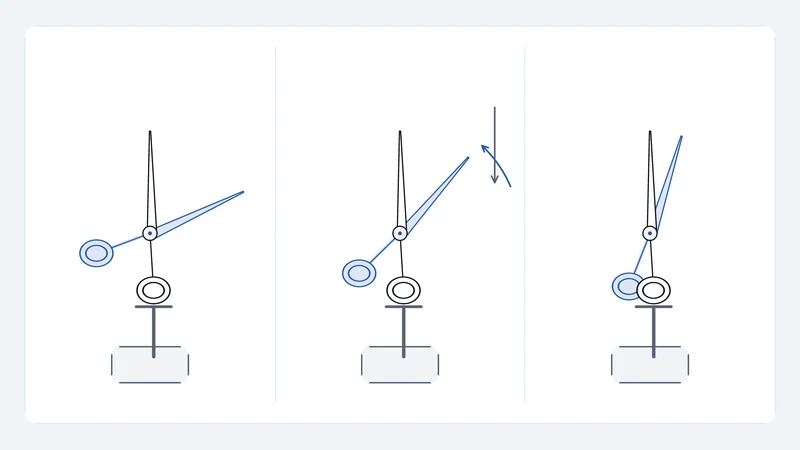
Some sources describe a drop-style check: open the moving blade to a set angle, release it gently and note where it stops. It is one common method, not a standard. Published stopping points differ between makers and trade sources, so the target and method for your own model come from its maker. Treat the result as one clue among several. A complete fall or very little movement is a prompt to check the model’s instructions, not a diagnosis.
How do you choose by the way you work?
Match the trade-off to the job. These are principles, not rules for every user.
| Situation | What helps | What to ask |
|---|---|---|
| Sharing a tool, or a tool that travels in a bag | A system that resists casual knocks | Can the setting move if the case is dropped or squeezed? |
| Frequent small adjustments | A system with stepped or tool-free control | What is the step size, and does the maker publish a method? |
| A tool serviced by a technician | A recessed or fixed build may be fine | Who adjusts it, and is the key or part available? |
| An apprentice learning the feel | A system with clear maker instructions | Does the maker supply the tool and a written procedure? |
Handedness, handle and nominal size still come first. Tension hardware is a useful tiebreaker once those match, which is the order the buyer’s guide uses.
What should you ask before buying?
- Which system does this exact model use, in the maker’s words?
- Can I adjust it myself, and with what?
- Does the maker publish a checking method and a step size?
- What does the maker say to do if the setting will not hold?
- Is there a part or service route if the washers or the adjuster wear?
Common mistakes
- Assuming a dial adjusts. A decorative or faceted control may be cosmetic. Read the maker’s description.
- Borrowing a routine. A flat-screw method does not carry over to a click or recessed system.
- Tightening until the hair stops folding. Folding has several causes, including residue, edge wear, alignment and section size, as the guide to hair pushing, folding or catching sets out. Tension is not a repair for any of them.
- Adjusting without cleaning first. Residue can mimic a tension problem, so clean as the care routine describes.
- Forcing a seized screw. Stop and take it to a qualified professional.
Questions people ask
Is a tool-free tension control better than a screw?
Neither is better in general. Tool-free control is quicker to change and easier to move by accident. A screw is slower but gives you a deliberate, tool-led step.
Which system holds its setting longest?
That depends on the model, how it is used and the condition of the washers, so no system can promise it. Ask the maker how the setting is meant to hold.
Can I tell the system from a photo?
Often you can tell a visible screw head from a dial, but not whether the dial adjusts. The listing or the maker’s page should say.
Does the system change how the shear cuts?
It changes how you set and keep the resistance. The cut still depends on the edge, the alignment, the section and your technique.
We sell shears and have not run cutting tests, so this page compares hardware and ranks none.
Further reading
- Shear screw and tension basics, ball-bearing versus standard pivots and ten care habits.
- The knowledge base, and the cutting shears collection for models you can compare once you know the system you want.
- Scissorpedia for general scissor reference.
Scissorpedia is a fellow member of the ShearAlliance (see ShearAlliance).