Ball-Bearing Pivot vs Standard Pivot: What to Ask
A bearing label names a construction. It does not tell you how a shear feels, wears or should be cared for.
By JapanShears EditorialUpdated
On this page
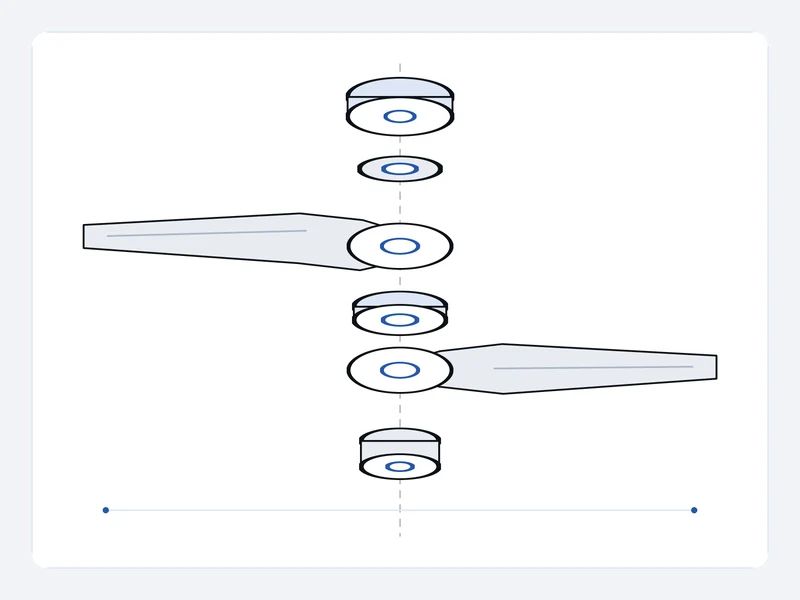
Short answer. A standard pivot joins the blades with a screw, usually with washers or a spacer. A ball-bearing pivot adds bearing parts to that assembly, and a dry-bearing pivot is a maker’s name for its own bearing arrangement. In principle, rolling parts can replace some sliding contact, which is why makers offer them. The label alone does not prove the smoothest action, and it does not set an oiling or adjustment routine. Ask the maker how your exact model is built, adjusted and cared for.
Key takeaways
- “Standard”, “ball-bearing” and “dry-bearing” describe how the pivot is built. They are not quality grades.
- A bearing label does not prove a smoother action, a longer service life or a lighter maintenance routine.
- Some bearing designs have their own lubrication provisions. The maker’s instructions for your model decide what to oil and how.
- Bearing pivots can still be adjusted, and some pair a bearing with a click or screw adjustment. Check how.
- A change in action, a catch or grit is a service question, not a reason to take the pivot apart.
What is at the pivot of a shear?
The pivot is where two separate blades become one tool. The tension screw holds the pair together and sets how firmly they press. Under it sit washers or a spacer and, on some models, bearings. Our screw and tension basics guide shows the parts, and the tension systems comparison covers how each type adjusts.
Keep two things apart. The pivot is the joint. The tension system is the way you set the resistance across it. A bearing pivot can carry a screw, a click control or another adjuster, so “ball-bearing” answers only the first question.
What does a standard pivot mean?
A standard pivot is a screw-and-washer assembly: the blades turn on the screw, with washers or a spacer between the parts. It is the layout many people picture first, and it appears in many price ranges and many makers’ lines.
“Standard” is a comparison word, not a specification. It tells you the pivot is not a bearing design, nothing more. The screw may be a flat screw, a thumb screw or a recessed one, and each has its own instructions.
What do ball-bearing and dry-bearing mean?
A ball-bearing pivot places small rolling parts in the pivot assembly so that part of the turning motion is rolling instead of sliding. That is the principle. How a maker builds it, where the bearing sits, whether it is sealed, and how it is adjusted differ by model.
“Dry-bearing” is a maker’s term for its own bearing arrangement. A maker’s name for a system describes that system. It cannot be assumed to match another maker’s bearing, and the name alone does not settle the care of every part. The same applies to other maker-specific names for pivot systems.
Listings sometimes pair the bearing with the adjuster, for example a bearing with click-lock adjustment or a bearing with a flat adjustable screw. Those are two fields in one phrase. Read them as two questions.
How do the two compare?
| Field | Standard (screw and washers) | Ball-bearing or dry-bearing |
|---|---|---|
| What the label describes | A screw-held pivot | A pivot with bearing parts in the assembly |
| What it does not tell you | How smooth the action is, or how it ages | How smooth the action is, or how it ages |
| Adjustment | By the screw or control the maker supplies | Often still adjustable, by the control the maker names |
| Care | The maker’s cleaning and oiling directions | The maker’s directions, which may differ from a standard pivot’s |
| Service | Washers and screw can usually be inspected by a specialist | Bearing parts may need a specialist who knows that design |
| Treat it as | A construction detail | A construction detail, not a ranking |
The middle row is the point of the table. Neither label predicts smoothness or lifespan. A well-set standard pivot and a poorly set bearing pivot can feel the opposite of what the labels suggest.
What should you ask before you buy?
- What exactly is the pivot? Ask for the maker’s own description of this model, not a general statement about a range.
- Where is the bearing, and what is it called? Use the maker’s term, such as ball-bearing or dry-bearing.
- How is it adjusted? Name the control, and ask what tool, if any, it needs.
- What are the care instructions? Ask whether the pivot is oiled, how often the maker says to look at it, and with what. Some bearing designs have their own lubrication provisions.
- Who services it? Ask whether a qualified sharpener or the maker’s route handles bearing parts and washers, and use the service preparation guide to brief them.
- What happens after a drop? A knock can move alignment first, and the answer is an assessment before use. Our safety at the chair guide covers dropped and damaged shears.
When should the pivot decide, and when not?
Let it count when two shears are matched on hand, handle, nominal size and edge, and you want a particular adjustment style or a pivot the maker describes clearly. A shear with good instructions is easier to keep than a sparsely documented one.
Set it aside when the bearing label is the only difference you can find and the maker publishes nothing about care or adjustment. In that case the label is a prompt to ask, not a reason to pay more attention to one tool. The fair comparison guide shows how to keep one variable moving at a time.
Common mistakes
- Assuming a bearing means no maintenance. The maker’s care routine still applies, and it may differ from a standard pivot’s.
- Flooding the pivot with oil. Oil is applied after cleaning and drying, in the maker’s amount and place. It is not a cleaner. See the oil and cases guide.
- Carrying a routine across. A flat-screw routine does not carry over to a bearing system, or the reverse.
- Dismantling a bearing system. Another brand’s accessible screw is not an invitation to open a design you were not given instructions for.
- Treating a decorative dial as the whole pivot. The visible control may be only part of the assembly.
Questions people ask
Is a ball-bearing pivot smoother than a standard one?
Not as a rule. The label describes construction, and smoothness depends on the whole build, the setting and the condition of the parts.
Does a bearing pivot need oil?
It depends on the design. Some have their own lubrication provisions, so follow the instructions for your model rather than applying a general rule.
Can a bearing pivot be adjusted?
Often yes, but the control varies. Ask what adjusts it and how the maker describes the method.
Is dry-bearing the same as ball-bearing?
Not necessarily. Dry-bearing is a maker’s name for its own system. Read the maker’s description of the exact model.
We sell shears and have not run cutting tests, so this page covers what to ask, not what a given pair will do.
Further reading
- Ten care habits for Japanese hair scissors, shear oil, cases and accessories and the care and ownership hub.
- The knowledge base, and the cutting shears collection.
- Kasho’s care instructions for an example of a maker describing its own adjustment and care.
- Scissorpedia for general scissor reference.
Scissorpedia is a fellow member of the ShearAlliance (see ShearAlliance).