Titanium Shears: What the Word Means on a Listing
A coating, a colour, a model name or a material claim: ask which one it is.
By JapanShears EditorialUpdated
On this page
- What does “titanium” mean on a shear listing?
- How does the word appear on our own listings?
- Does a titanium coating change how a shear cuts?
- What should you ask before you buy?
- How do you compare two listings that both say titanium?
- How should you care for a titanium-coloured shear?
- When is a titanium finish a reasonable thing to choose?
- Common mistakes
- Questions people ask
- Further reading
Short answer. On a hair shear listing, “titanium” most often names a coating or a colour laid over a steel blade, and sometimes it is only part of a model name. On its own it does not tell you what the blade is made of, how the edge is ground, how the shear will cut or how long a surface will last. Ask what the word applies to, then read the steel and the edge as separate lines.
Key takeaways
- Titanium is a metal in its own right, separate from the stainless steels that most hair shear blades are made from. A listing can use the word without the blade being titanium.
- The word turns up in four places: a model name, a finish or coating description, a colour name and, rarely, a statement about the metal itself.
- A coating changes the surface. The steel underneath and the edge geometry are what the blade cuts with.
- We make no durability claims for any coating, and a coating can wear or mark.
- Choose the blade, handle and size first, then the finish.
What does “titanium” mean on a shear listing?
Titanium is a metal element, and titanium alloys are a family of materials distinct from the stainless steels used for most hair shear blades. A shear listing can use the word in four different ways, and each answers a different question.
| Where you see it | What it usually means | What it leaves open |
|---|---|---|
| In a model name, such as “Titanium TR” | A range or model name | The blade steel, the edge and the finish. The name is a label, not a specification |
| In a finish description, such as “rainbow titanium finish” or “titanium film” | A coloured surface layer on the blade or the whole tool | The steel beneath, whether the cutting edge is coated and how the surface wears |
| In a colour name, such as “warm titanium” | A colour and nothing more | Every construction fact |
| In a statement about the metal, such as “titanium blade” or “titanium handle” | A claim about the material of a part | Which alloy, which parts, and the maker’s care notes. It needs the maker’s own statement |
The first three are about appearance and naming. Only the fourth is a claim about what a part is made of, and it deserves a written statement from the maker for that exact model rather than a seller’s summary.
 Open illustration at full size
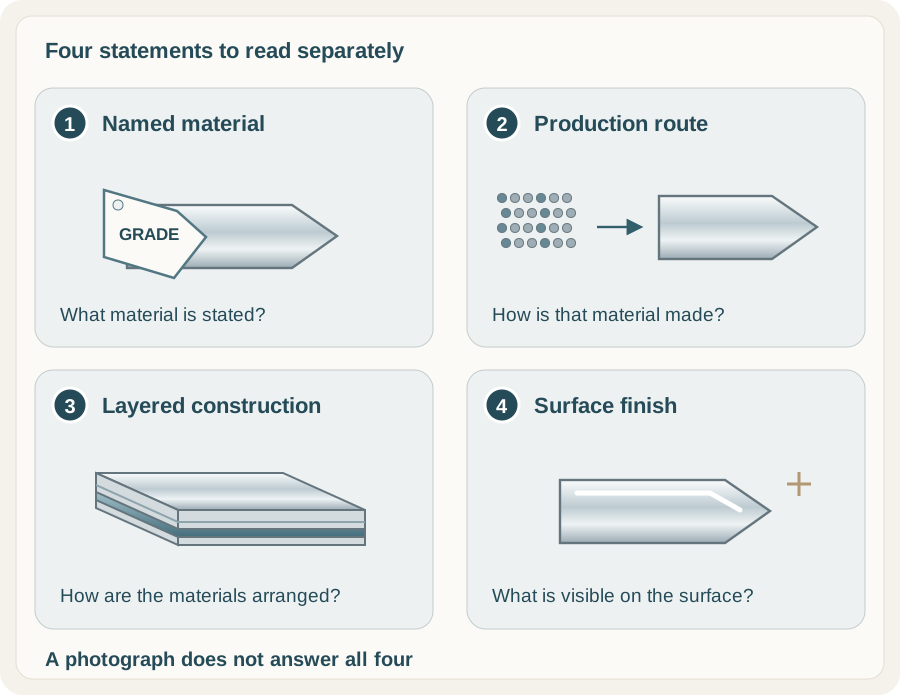
- Named materialThe stated grade or maker alloy name describes the material.
- Production routeA powder or sintered description concerns how the material is produced.
- Layered constructionThe core and surrounding layers describe an arrangement of materials.
- Surface finishPolishing, colour or a visible pattern describes the surface; ask for construction evidence separately.
The diagram keeps material, production route, construction and finish apart. A titanium finish sits in the last group, and it never stands in for the first.
How does the word appear on our own listings?
Our records use it as a finish word. The Joewell Titanium TR carries the word in its name, and its listing describes a convex blade, an offset handle, a blue-black coated finish and Supreme Stainless Alloy. The word names the look. The alloy line names the steel.
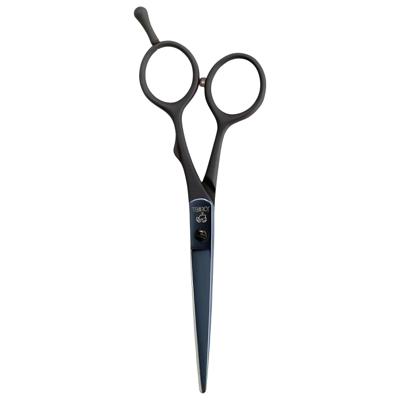
The Juntetsu Hanami cutter is described as having a convex edge, an offset handle and a rainbow titanium finish. Our rose-gold and rainbow collections group tools by colour, and each collection says the same thing: beneath the finish, the models differ in steel, edge and handle, so inspect the selected option for those details.
Does a titanium coating change how a shear cuts?
A coating is a surface layer. The steel, how it was heat treated and the geometry of the edge underneath are what decide how the blade cuts. A finish changes the look and the surface, not the steel. Whether a given maker coats the cutting edge itself, and how a coated face behaves in service, are questions for that maker.
We have not run cutting tests, so we do not rank finishes or claim that one cuts differently. We also make no durability claim for any coating. A coating can wear or mark, and it is a barrier only while it is intact. The finishes and coatings guide covers the general case.
What should you ask before you buy?
Six short questions settle most of it.
- What does the word apply to? A name, a colour, a coating or a material?
- What is the blade steel? Read it as its own line; our steel names guide explains how to interpret one.
- Is the cutting edge coated or only the body? If the listing is silent, ask the maker or seller.
- What does the maker say about care? Cleaning, drying and any products to avoid.
- How does the maker or a qualified technician service a coated shear? Ask before you need it.
- Does the listing state the hand, size and handle separately from the finish? It should.
If you have a sensitivity to particular metals or coatings, ask the maker what the model uses and speak to a qualified professional about your own situation. We make no universal allergy claim for any finish.
How do you compare two listings that both say titanium?
Put the finish aside and compare everything else.
- Write down the steel named on each, as printed.
- Compare the edge line (convex, bevel or the maker’s own term) and the handle family.
- Compare the hand, nominal size and, where published, the blade length. Our spec sheet guide shows how to read each line.
- Only then compare finish, as an appearance preference.
Two shears that share a coating word can differ in every line that decides how they cut, so the word is a reason to read on rather than a reason to treat them alike.
How should you care for a titanium-coloured shear?
Follow the maker’s care directions for the exact model. As general practice, wipe and dry after use, oil as the maker directs, and store the shear closed and protected. Avoid abrasive cloths, polishing compounds and improvised cleaning. If a surface wears or marks, take that to the maker or a qualified technician who works on that model, because polishing at home can change an edge as well as a surface. Our care habits guide covers the routine.
When is a titanium finish a reasonable thing to choose?
It is a fair choice when you have already settled the cutting hand, steel, edge, handle and size, and you like how the finish looks at your station. Colour and low reflection are legitimate preferences. It is a poor basis for choosing on performance unless the maker states something specific about the model and you can read it, because the word alone does not support one.
Common mistakes
- Reading “titanium” as “the blade is titanium”. Check what the word applies to.
- Comparing finishes before comparing steel and edge. The finish is the last line, not the first.
- Assuming a coating cannot wear. We make no such claim for any coating.
- Polishing a mark at home. Ask the maker or a qualified technician instead.
- Treating a seller’s summary as the maker’s specification. Look for the maker’s own statement for the exact model.
Questions people ask
Are titanium shears better than stainless steel shears?
They are not the same kind of comparison. Titanium is a metal; stainless steel is a family of alloys, and most listings name the steel and the finish separately. We do not rank them, and we have not run cutting tests.
Is titanium a type of steel?
No. Titanium is a different metal. If a listing names a stainless steel and also says titanium, the second word is most often the finish.
Does a titanium finish make a shear lighter?
Weight is its own specification, and a finish word does not state it. Check the listed weight or read our guide to weight and balance.
Will a titanium coating last?
A coating can wear or mark, and we make no durability promise. Follow the maker’s care notes and ask how the maker services the finish.
We sell shears and have not run cutting tests, so this page explains vocabulary and ranks no finish. Reviewed 4 November 2026.
Further reading
- The knowledge base and the glossary for the terms used here.
- Yasaka’s material explanation for a maker’s own words on materials.
- Scissorpedia for general scissor reference.
Scissorpedia is a fellow member of the ShearAlliance (see ShearAlliance).