Shear Finishes and Coatings on a Spec Sheet
Polish, satin, matte, black and colour: read the surface without mistaking it for the steel.
By JapanShears EditorialUpdated
On this page
- What is the difference between a finish and a coating?
- What does a finish tell you?
- What does a finish not tell you?
- Does a coating affect allergies?
- How do you care for a finished surface?
- How should you choose between finishes?
- When a finish should decide, and when not
- Common mistakes
- Questions people ask
- Further reading
Short answer. A finish or coating describes the surface of a shear: how it looks, reflects light and shows marks. It does not identify the steel underneath, the edge geometry or how the tool will cut. Read the finish as one line of the spec sheet, ask what part of the shear it covers, and keep the material and edge as separate questions.
Key takeaways
- Finish (polish, satin, matte) is a surface treatment; coating is an applied layer; colour may come from either.
- A black or rose-gold shear can be made of any of several steels. The colour does not name one.
- A finish does not state edge geometry, hardness or durability, and we make no durability claims for any coating.
- A coating is not a guarantee against allergic reaction; ask the maker if it matters to you.
- Choose the blade, handle and size first, then the colour.
What is the difference between a finish and a coating?
A finish is a way of treating the surface of the metal: polished to a mirror, brushed to a satin, or bead-blasted to a matte. A coating is a layer applied on top of the metal to alter its colour or surface. Many listings use the two words loosely, so read what the maker says is actually done, and where.
| Term | Usually means | What the listing may leave out |
|---|---|---|
| Mirror or polished | A high-gloss ground and polished surface | Whether the edge area is treated differently |
| Satin or brushed | A fine linear grain | Which surfaces carry it |
| Matte | A low-reflection surface | Whether it is a finish or a coating |
| Black, rose gold, rainbow, titanium-coloured | A colour, often from a coating or surface treatment | The material underneath |
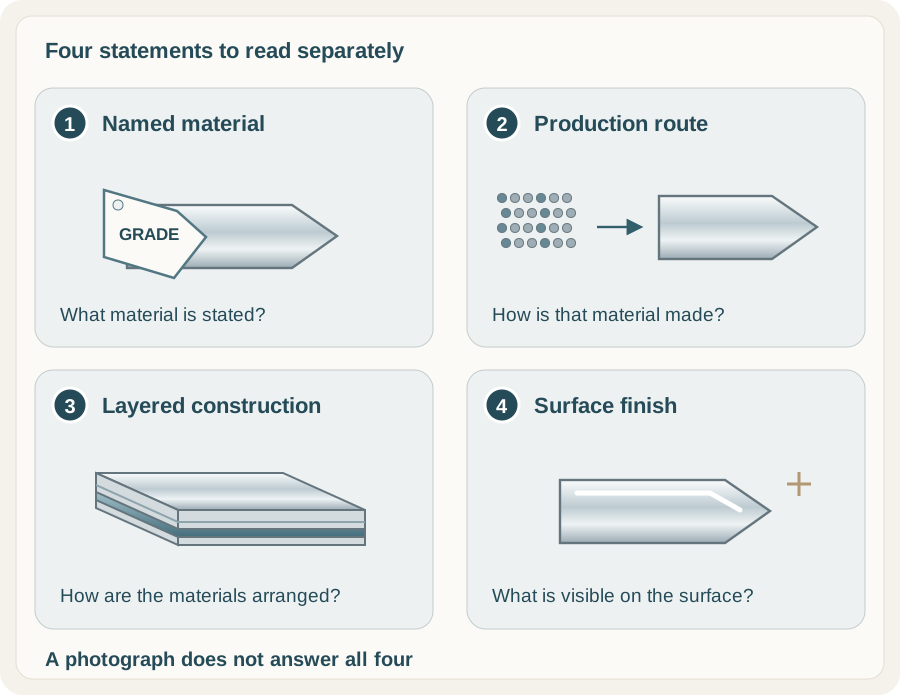 Open illustration at full size
- Named materialThe stated grade or maker alloy name describes the material.
- Production routeA powder or sintered description concerns how the material is produced.
- Layered constructionThe core and surrounding layers describe an arrangement of materials.
- Surface finishPolishing, colour or a visible pattern describes the surface; ask for construction evidence separately.
The diagram separates material, production, construction and finish. A finish word belongs in the last group, and it never stands in for the first.
What does a finish tell you?
It tells you how the shear looks and how light behaves on it. A gloss surface reflects strongly and shows fingerprints and fine marks readily; a matte surface reflects less and may show wear differently. Those are appearance facts. Some people prefer low reflection at the workstation and others a bright surface. Both are preferences, not performance claims.
Colour pages in our range, such as black and matte, rainbow and rose gold, group tools by appearance. Beneath the colour, the models differ in steel, edge and handle, so the collection description itself says to choose the blade and variant first. For one word that recurs across those pages, see what “titanium” means on a shear listing.
What does a finish not tell you?
Four things a finish does not settle.
- The steel. A black coating can sit on different alloys. Use how steel names work for the material line.
- The edge. Whether the cutting edge is coated, and how it is ground, are separate statements. See edge geometry.
- Durability. A listing may describe a coating’s intended properties. We do not say any coating will not wear or mark, and no finish is a promise of a particular lifespan.
- Fit and handling. A surface does not change the handle layout, size or hand.
Does a coating affect allergies?
A manufacturer may describe a coating’s intended properties while declining to guarantee that it is free of any reaction for every person. We use the plain phrase “allergy-neutral” only where a maker states it, and we make no universal promise. If you have a sensitivity to particular metals or coatings, ask the maker or seller what the model uses and speak to a qualified professional about your own situation.
How do you care for a finished surface?
Follow the maker’s care directions for the model. As general practice, wipe and dry after use and store the shear closed. Avoid abrasive cloths, polishing compounds and improvised sharpening or cleaning methods, because they can alter a surface or an edge. If a surface wears or marks, that is a question for the maker or a technician who works on that model, not a cue to polish it at home. Our maintenance routine and the oil, case and accessory guide cover the habit.
How should you choose between finishes?
Settle the shear first, then the surface.
- Hand, nominal size, handle and edge come first; see the spec-sheet guide.
- Material next, read from the maker’s own wording.
- Finish last, as a preference for how the tool looks and feels at your station.
When two shears are otherwise matched, a finish is a fair tiebreaker. When it is the only difference you can see, ask what else differs.
When a finish should decide, and when not
Let it decide when the shears match on every other line and you prefer one look. Do not let it decide when a colour hides a difference in steel, edge or size, or when a listing implies a performance benefit from a coating without a maker statement.
Common mistakes
- Treating colour as a material. Black is not a steel.
- Assuming the edge shares the coating. Ask which surfaces are treated.
- Expecting a coating to last forever. We do not promise it, and neither should a listing.
- Cleaning with abrasives. They can alter a surface.
- Choosing the colour before the size. Fix hand, size and handle first.
Questions people ask
Does a black shear use different steel?
It may or may not. The colour does not tell you. Read the material line for the exact model.
Are coloured shears less sharp?
A finish does not state sharpness. Compare edge and condition, not colour.
Can I recoat a shear?
Ask the maker or a technician who works on that model. We do not recommend home recoating.
Is a mirror finish better than matte?
Neither is better in general. They differ in appearance and in how they show marks.
Further reading
- Steel library, reading a spec sheet and the knowledge base.
- Yasaka’s material explanation for a maker’s own words on materials.
- Scissorpedia for general scissor reference.
Scissorpedia is a fellow member of the ShearAlliance (see ShearAlliance).