Shear Weight and Balance: What the Number Means
A stated weight is one fact; where the mass sits is another.
By JapanShears EditorialUpdated
On this page
Short answer. Weight is how much a shear weighs, where a maker states it. Balance is where that mass sits along the tool: toward the blades, the pivot or the handle. Two shears of equal weight can feel quite different, and neither a light nor a heavy shear is better in general. Compare feel in your own grip, and treat any number as one fact among several.
Key takeaways
- Weight and balance are different things. A figure for the first says little about the second.
- Handle geometry, blade length, ring size and materials all shift where the mass sits.
- Many listings do not state a weight. A blank is a question, not a flaw.
- We make no claim that a light or heavy shear prevents or relieves discomfort or fatigue.
- Judge feel by holding comparable tools, ideally with your educator’s guidance, and change one thing at a time.
What is the difference between weight and balance?
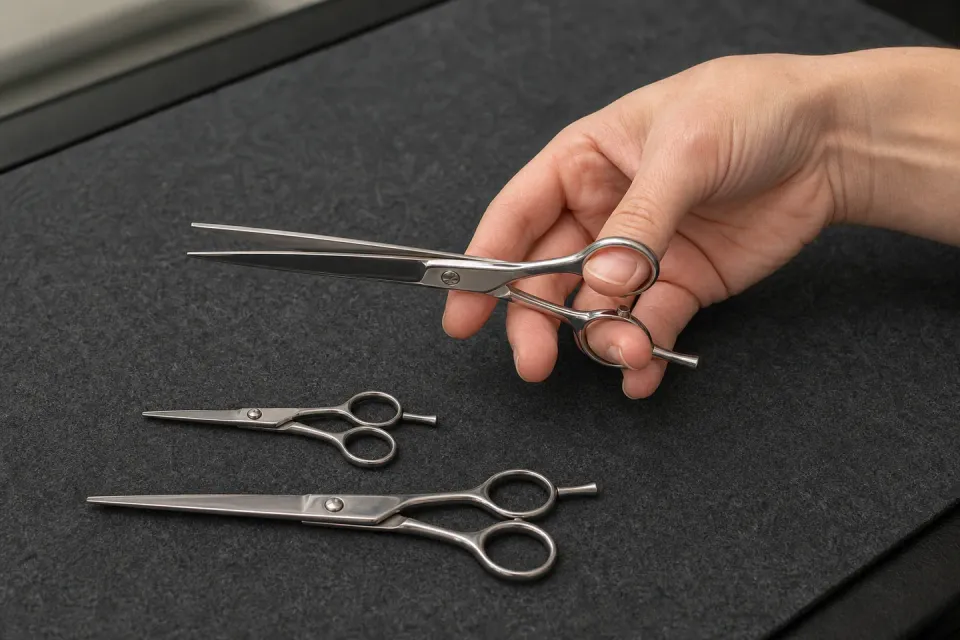
Weight is a single figure for the whole tool. Balance describes how the mass is distributed. A shear with a long blade and light handle puts more mass forward; one with heavy rings and a short blade puts more toward the hand. Two tools can weigh the same and sit very differently when you hold them open and closed.
| Term | What it describes | Where you find it |
|---|---|---|
| Weight | The mass of the whole tool, where stated | A spec line, usually in grams |
| Balance | Where that mass sits along the tool | Not usually stated; felt in the hand |
| Perceived reach | How far the tips feel from your hand | Affected by blade length and handle geometry |
What changes weight and balance?
Several design choices move the mass, and they interact.
- Blade length. A longer blade adds mass beyond the pivot.
- Handle geometry. An offset or crane shank changes the leverage between your hand and the blades. See handle types explained.
- Ring size and material. Larger or heavier rings add mass at the handle.
- Finger rest and fittings. A fixed rest, a thumb joint or an insert changes the distribution slightly.
- Blade construction. A reinforced or broader blade profile can add mass along the blade; see blade profiles.
A drawing in our handle geometry diagram shows why perceived reach changes with the handle even when the cutting job is the same.
Why does a spec weight not settle it?
Because a stated figure averages away the very thing you feel. It is also a maker’s statement, taken under its own convention; where a removable finger rest is involved, conventions differ and the figures may not compare across makers. If a weight is not stated for your selected option, leave the cell blank in your notes. Do not infer it from the nominal size or from a similar model. If it matters, ask the seller with the SKU; see how to read a spec sheet.
How do you compare feel in your own grip?
Use a short sequence, and use words rather than judgements of better or worse.
- Pick a tool you know and note its model and nominal size.
- Hold the candidate at the same nominal size, so blade length is not the variable.
- Describe where the mass seems to sit when the shear is open and when it is closed: toward the tips, centred or toward the hand.
- Note how the tips respond when you open and close slowly: steady, or inclined to drift.
- Change one thing at a time, such as handle family, then size.
- Ask your educator or a colleague what they notice in the same tool, if you are learning.
The fit guide and finger rings, inserts and fit describe the same observation approach for ring opening and span.
Is a lighter shear better for long sessions?
We do not claim that. Weight and balance are properties of the tool; how a working day feels depends on technique, workload, working position and the person. A lighter tool may suit someone and not another, and a heavier tool may give another person the steadiness they want. If persistent discomfort affects your work, speak to a qualified professional about your working conditions rather than trying to solve it with a spec.
When to care about weight, and when not to
Care about it when you have a tool that feels tip-heavy or hand-heavy in a way that affects control, and you want to compare against a stated figure or a different layout. Do not make it the deciding factor when it is not stated, when hand, size and handle are not yet settled, or when the only reason is that someone told you lighter is better.
Common mistakes
- Reading weight as quality. A number is not a ranking.
- Equating weight with balance. They are different.
- Inferring weight from size. Nominal size does not state it.
- Changing several things at once. You will not know what you are reacting to.
- Treating a light tool as a health measure. We make no such claim.
Questions people ask
Do makers publish shear weight?
Some do for some models. Many listings do not. Treat a blank as a question for the seller.
Is a heavier shear steadier?
Some people find so and some do not. Compare in your own grip at the same nominal size.
Does blade length change balance?
Yes: a longer blade moves mass forward. See choosing blade length by task.
Where can I compare feel?
If you are in training, ask your educator whether you may try a named candidate. Otherwise, compare stated figures and ask for the one missing detail.
Further reading
- How to compare hair shear fit, offset and crane handles and the knowledge base.
- Joewell’s product specification table for an example of a maker stating its measuring convention.
- Scissorpedia for general scissor reference.
Scissorpedia is a fellow member of the ShearAlliance (see ShearAlliance).