Blade Line and Blade Section: Classify a Shear in Two Axes
One axis is the line the edge draws along the blade. The other is the shape seen end-on. Record them separately.
By JapanShears EditorialUpdated
On this page
Short answer. A shear blade can be described on two independent axes. The blade line (hasen) is how straight or curved the cutting edge runs along its length. The blade section (hakei) is the shape of the steel seen end-on, behind the edge. Record each as its own field for the exact model, then add the edge grind and the inner face. No shared radius or angle stands behind these words, so the maker’s own diagram outranks any shorthand.
Key takeaways
- Line and section are separate fields. A model can carry a word for each, and the two do not predict each other.
- Japanese blade words are maker-specific vocabulary, not one national standard.
- Edge grind (convex, bevel, hollow) and the inner face are two further fields. They overlap with the section words without matching them.
- A listing that gives only one word has answered half a question. Ask for the other half.
- This page is a classification method. The vocabulary itself is explained in the glossary and the blade and edge guide.
What are the two axes?
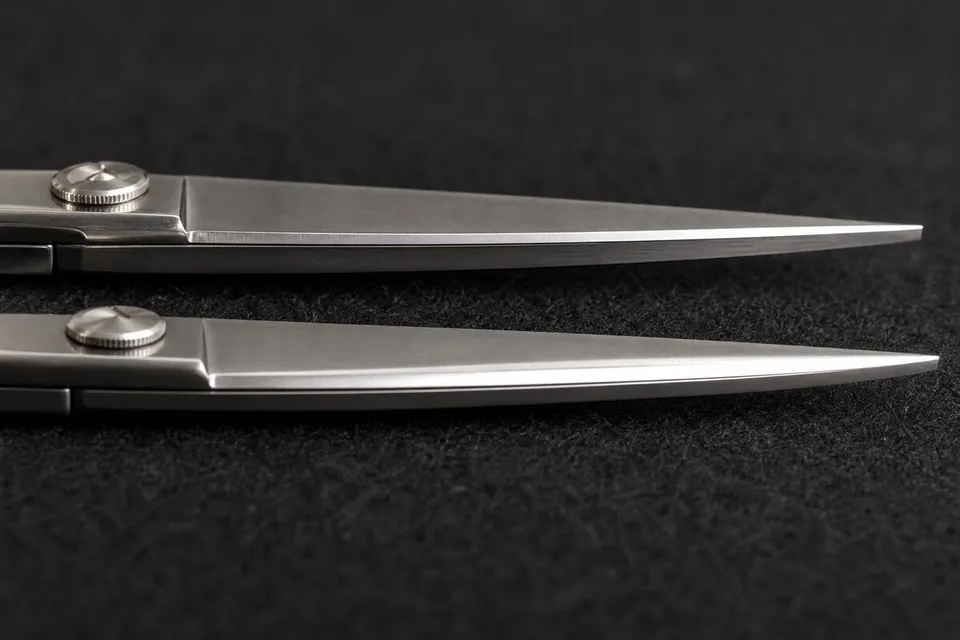
Picture a blade pair from two angles. From above, along the length of the edge, you see a line that is nearly straight or visibly curved. Looking from the tip back toward the pivot, you see the blade end-on: a rounded body, a ridged one, a flat one. These are two different views of the same steel, and each has its own vocabulary.
| Axis | The question it answers | Japanese trade term | Where to look |
|---|---|---|---|
| Blade line | How does the cutting edge run along the length of the blade? | Hasen (刃線) | A drawing or photograph from the side or above |
| Blade section | What shape is the steel behind the edge, seen end-on? | Hakei (刃形) | A cross-section drawing, or the maker’s written description |
The reason to separate them is practical. When a listing says “sword blade” or “bamboo-leaf blade”, it may be answering one axis and silently leaving the other open. Writing the two fields side by side makes the gap visible.
How do the two axes combine?
Freely. A maker can pair a given line with several sections, and a section with several lines. One documented kind of combination is a bamboo-leaf line on a sword-form section. Another is a pair whose two halves differ: a sword-form half against a flat or convex partner. Because the halves can differ, note which blade carries the word when a listing does not say “both”.
You cannot work out one axis from the other. A curved line does not tell you the section is rounded, and a flat section does not tell you the edge runs straight. Treat each cell of the grid as a question for the maker, not a fact you can fill in.
How do you classify a model, step by step?
Use a short worksheet. The aim is a record you can put beside a second model, not a verdict.
- Blade line. Write the maker’s word or phrase for the edge line, and the radius figure if one is given. A figure such as “400R” is incomplete without the blade length and the part of the blade it describes. Some makers give two zones on one blade.
- Blade section. Write the maker’s word for the end-on shape. If the listing says only “convex”, mark the section as unconfirmed, because “convex” is used loosely across several sections.
- Edge grind. Record convex, bevel or hollow as the maker states it. This describes how the outside of the blade approaches the edge, and the edge comparison guide explains the overlap with section words.
- Inner face. Note any hollow ground into the inner face, and any ride line, bow (sori) or blade set the maker mentions. These are built in at manufacture. They are not the tension screw.
- Hand and nominal size. A blade description belongs to one hand and one size of one model.
- Source. Write down where each word came from: the maker’s page, a diagram or a seller’s summary. A seller’s shorthand is weaker evidence than a maker’s drawing.
What does a worked reading look like?
Two invented listing phrases show the method. They are examples of wording, not models we stock.
| Listing phrase | Blade line | Blade section | Edge grind | Inner face |
|---|---|---|---|---|
| ”Bamboo-leaf sword blade” | Bamboo-leaf type, stated | Sword-form, stated | Not stated | Not stated |
| ”Convex willow blade” | Willow type, stated | Unconfirmed, because “convex” may mean the section, the grind or both | Convex, probably | Not stated |
The first phrase fills two axes and leaves two open. The second fills one axis cleanly and hides a question inside a single word. In both cases the next step is the same: ask the seller for the maker’s drawing of that exact model and size.
What does each axis leave open?
Blade line words describe a family of curves, not a radius. Published examples of the willow type run across a wide range of radius figures, so the word alone does not settle how curved the edge is. A bamboo-leaf line is often linked to hair release in slide work, although some makers position it for firmer barber cutting. Read the maker’s stated purpose, not the word.
Blade section words describe how much steel sits behind the edge and in what form. How much curvature a rounded section has, and how much relief the maker cuts into the inner face, are set by each maker. Our profile guide covers the English words (sword, slim, leaf), which overlap with both axes without matching either.
When does the two-axis view matter, and when does it not?
Use it when you are comparing two models that look alike at thumbnail size, when a listing mixes terms, or when you are briefing a service about a particular blade. It is most useful for shears whose makers publish drawings.
Skip it when your decision has already been made by hand, handle and nominal size. A true left-handed build shrinks the field a good deal, and the rest of the comparison is easier once the spec sheet is in order. The spec-sheet guide shows where blade fields sit among the others.
Common mistakes
- Treating one word as the whole blade. “Hamaguri”, “sword” or “leaf” answers one question only.
- Reading a line word as a cutting promise. Terms describe construction. They do not tell you how a shear will cut for you.
- Assuming “convex” fills the section field. It may be the grind, the section or a loose label for both.
- Comparing radius figures across makers. Without a shared method and the blade length, the numbers are not like for like.
- Mixing in the tension screw. Ride line, bow and set are built in. Adjusting the screw does not rebuild them.
Questions people ask
Is hasen the same as edge angle?
No. Hasen is the line of the edge along the blade’s length. The angle at which the edge is ground is a separate matter, and it belongs with the edge grind field.
Does a bamboo-leaf line mean the shear is for slide cutting?
Not by itself. Some makers pair the line with a slide-cutting purpose, and some position it for firmer cutting. The maker’s description of the exact model decides.
Can I read both axes from a photograph?
The line, often. The section, rarely. An end-on shape is hard to judge from a product photo, so ask for a cross-section drawing or a written description.
Do both blades always share the same section?
No. Some pairs deliberately combine different sections, so check which half carries the term.
We sell shears and have not run cutting tests, so this page explains a way of reading a blade. It ranks no shape.
Further reading
- Convex, bevel and hollow edges compared and sword, slim and leaf profiles for the neighbouring fields.
- The knowledge base for the rest of the reference guides, and the cutting shears collection once your fields are settled.
- Joewell’s blade reference as an example of a maker describing its own blade terms.
- Scissorpedia for general scissor reference.
Scissorpedia is a fellow member of the ShearAlliance (see ShearAlliance).