Japanese Scissor Words Decoded
Hamaguriba, kamaba, sori, urasuki and more: what each term describes on a shear and what it leaves open.
By JapanShears EditorialUpdated
On this page
Japanese shear vocabulary answers two questions: what shape is the blade, and how do the two blades touch? Sort a word into the right group and a listing gets easier to read, because no single term describes the whole blade.
Short answer. Blade-line words (chokuba, yanagiba, sasaba, kamaba) describe the curve of the edge. Cross-section words (hamaguriba, iriyamaba, kenba, hiraba) describe the steel behind the edge. Inner-face words (omote, ura, urasuki, ride line, sori, blade set) describe how the blades meet. Read each as the maker’s description of that model, not as a standard.
Key takeaways
- The blade line (hasen) and the blade section (hakei) are separate fields. One model can carry a word from each.
- No shared radius, angle or depth stands behind these words. Makers define them for their own ranges.
- Ride line, sori and blade set are built in at manufacture. They are not the tension screw.
- A term describes construction. It does not tell you how a shear will cut for you.
What do the blade-line words describe?
Blade-line words describe how straight or curved the cutting edge runs along its length. In Japanese trade language this axis is called hasen (刃線).
| Word | Kanji | Plain meaning | Careful note |
|---|---|---|---|
| Chokuba | 直刃 | A straight or comparatively straight line | ”Straight” is relative. There is no cross-industry radius cut-off. |
| Yanagiba | 柳刃 | Willow blade, a line compared with a willow leaf | Not one radius. Makers’ published examples span a wide range. |
| Sasaba | 笹刃 | Bamboo-leaf blade, a rounder, more outward curve | Often linked to hair release in slide work, though some makers position it for firmer barber cutting. |
| Kamaba | 鎌刃 | Sickle blade: fairly straight, then a hook near the tip | Niche and often special-order. Ask whether a sharpener will service it. |
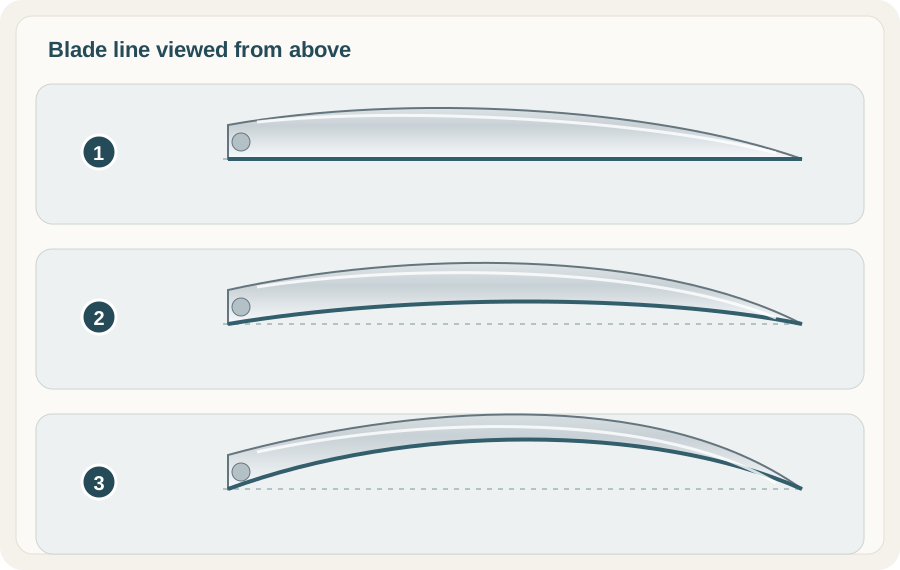 Open illustration at full size
- Straighter lineA cutting line with less curve in this view.
- Moderate curveA different line while keeping the same end-to-end reference.
- More curved lineInvestigate the maker’s intended use for the complete model, including its line and edge.
An “R” figure (a radius) is incomplete without the blade length and the part of the blade it describes. Some makers give two zones on one blade.
What do the cross-section words describe?
Cross-section words describe the blade seen end-on: how much steel sits behind the edge and what shape it takes. This axis is hakei (刃形).
| Word | Kanji | Plain meaning | Careful note |
|---|---|---|---|
| Hamaguriba | 蛤刃 | Clamshell: a rounded, convex section that keeps thickness behind a fine edge | Curvature and inner relief are set by each maker. |
| Iriyamaba | 入山刃 | A midpoint between hamaguri and kenba, with no distinct centre ridge | Named less often. The nearest Japanese anchor for “semi-convex”. |
| Kenba | 剣刃 | Sword-like, with a thicker ridge-shaped section | Makers cite rigidity. Some pair a sword half with a flat or convex partner. |
| Hiraba | 平刃 | Flat blade | Can mean a thin body, a single bevel, one flat half of a pair, or a face meant to sit against a comb. |
Section is not edge grind. Convex, bevel and hollow overlap with these words without matching them one to one; see the convex, bevel and hollow comparison and the sword, slim and leaf profiles guide. A maker can combine the two axes, for example a sasaba line on a sword-form blade.
What are omote, ura and urasuki?
Omote (表) is the outer face of a blade. It carries the edge geometry and the visible finish. Ura (裏) is the inner face, the side that sweeps past the other blade.
Urasuki (裏スキ) is the concave hollow ground into the ura. It removes most of the inner-face contact, so the blades touch along a narrow strip instead of across their full width. A deeper hollow leaves more air between the blades; a shallower one leaves more contact. Some flat-inner builds give the hollow up deliberately, so check it as its own line.
What are the ride line, sori and blade set?
These three are built in at manufacture and work together.
- Ride line (乗り, nori): the narrow working contact strip on the inner face, running from the pivot toward the tip. It is the only part of the inner face that touches the opposing blade, and it is a functional region rather than a coloured stripe or a cosmetic polish line.
- Sori: a lengthwise bow in each blade, commonly quoted at around 0.03 mm, about one hair’s width. It makes the blades meet at a single travelling contact point.
- Blade set: a designed-in micro-gap that puts the blades under light spring pressure.
Sori decides where the blades meet. Set decides how hard they press. The tension screw is the adjustable layer on top, and it cannot repair a damaged set. A dropped shear can look undamaged yet cut differently, because the bow can move first. That is a job for a qualified professional; see what to prepare before a service enquiry.
How do you use these words when comparing?
- Look for the maker’s description of the line and the section as separate facts.
- Note which blade half carries the term when the pair differs.
- For “flat” models, ask about the inner face separately.
- Read any R figure alongside the blade length.
We sell shears and have not run cutting tests, so this page explains vocabulary and ranks no shape.
Common mistakes
- Treating one word as a description of the whole blade.
- Reading hamaguriba as a synonym for “convex” in every case.
- Comparing R figures from different makers without the blade length.
- Expecting the tension screw to fix a changed blade set or bow.
Questions people ask
Is hamaguriba the same as convex?
They overlap but are not identical. Hamaguriba is Japanese maker wording for a rounded section. “Convex” is used loosely in English across several sections.
Is a deeper urasuki always better?
It is a design choice. Depth changes how much of the inner face touches.
Further reading
- Hair shear glossary: terms explained
- Japanese shear blades and edges explained
- Convex, bevel and hollow edges compared
- Sword, slim and leaf blade profiles explained
- Read a shear spec sheet line by line
- The knowledge base.
- Scissorpedia for general scissor reference.
Scissorpedia is a fellow member of the ShearAlliance (see ShearAlliance).