Semi-Offset, 3D and Anatomic Handles: How the Geometry Differs
Three words that sound like one thing. Stagger, ring contour and a general claim are separate fields.
By JapanShears EditorialUpdated
On this page
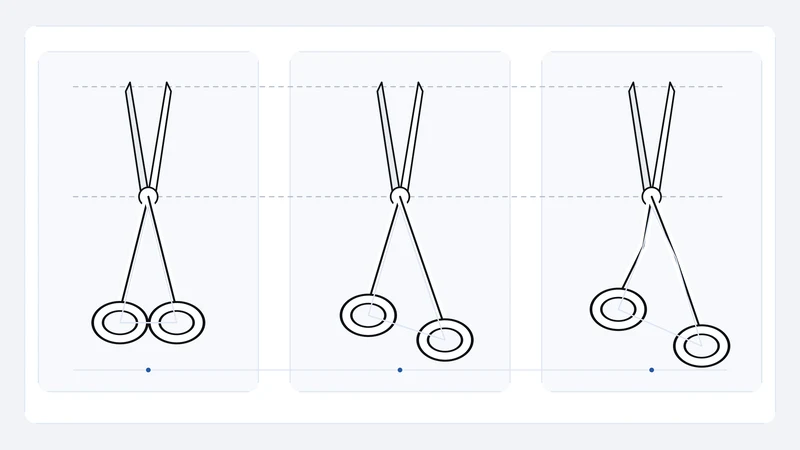
Short answer. Semi-offset, 3D and anatomic answer different questions. Semi-offset describes a small stagger between the thumb ring and the finger ring. 3D describes ring shaping beyond that stagger, and each maker defines it for its own models. Anatomic is a general descriptive label with no shared definition. Record stagger, contour and opening as separate fields for the exact model. Fit is personal, and this page describes geometry, not comfort or any outcome.
Key takeaways
- Stagger (how far the rings sit from the pivot) and contour (the shape and angle of each ring) are two different fields.
- Semi-offset sits between in-line rings and a full offset. Within each group, ring size, contour and angle still differ model by model.
- “3D” appears on handle descriptions and, on some listings, on edge descriptions. Check which part it describes.
- “Anatomic” and similar words have no standard meaning. Ask for the maker’s own description and photographs.
- Handle geometry is not a treatment, and persistent discomfort is not a specification question.
What are the three terms describing?
They describe three different things, which is why they cause confusion when they sit in one product title.
| Term | The field it belongs to | What it describes | What it leaves open |
|---|---|---|---|
| Semi-offset | Ring stagger | A smaller stagger than a full offset: the thumb ring sits nearer the pivot than the finger ring, but by less | The exact distance, ring size and contour |
| 3D | Ring contour | Ring shaping that angles or sculpts the contact surfaces beyond the basic stagger | What the maker means by it, and which surfaces it shapes |
| Anatomic | A general label | A claim that the handle follows the form of the hand | Everything. There is no shared geometry behind the word |
Our offset and crane guide covers the ring-stagger vocabulary and our handle families guide maps opposing, offset, crane and swivel. This page picks up the three words those guides touch only briefly, and adds a way to compare them.
How does semi-offset differ from straight and offset?
An in-line or opposing handle places the rings at a similar distance from the pivot. An offset handle staggers them so the thumb ring is nearer the pivot. Semi-offset introduces a smaller stagger, so it sits between the two. It describes where the rings are relative to each other. It does not describe how the rings are shaped, and it does not describe the blade.
Joewell’s handle reference notes that grip lengths and angles in offset layouts vary, so two models that both carry the word are not interchangeable by name. Read semi-offset as a starting position on a scale, then look at the photograph.
What does “3D” describe?
On a handle, 3D usually refers to ring shaping in more than one plane: the rings are angled or sculpted rather than flat. Where a flat drawing shows only the stagger, a 3D ring adds a contour to the surfaces your thumb and finger meet. Makers define their own versions, and a few use the word elsewhere.
That last point is a trap. On some listings “3D” qualifies the edge rather than the handle, as in a “3D convex edge” description. The same two characters then answer a blade question, not a handle question. When you read the word, ask what noun follows it. The blade line and section guide separates the blade fields so you can keep them apart.
What does “anatomic” mean?
There is no standard answer. Anatomic, ergonomic and similar words are descriptive claims, and no shared dimension, angle or contour stands behind them. A maker may use one to mean a sculpted ring, a particular stagger, a rest shape or simply a general intention. We cannot supply a definition on a maker’s behalf.
Treat it as a prompt to ask for facts you can compare: the stagger, the ring opening, the ring angle, the rest type and a photograph from more than one side. Ergonomics is personal. A word cannot tell you where your thumb will sit or how the tool will feel in your grip.
How do you record and compare handle geometry?
Use a short worksheet and fill the same fields for each model. Hold the nominal size steady while you compare, so only the handle varies.
- Cutting hand. Settle this first. A true left-handed build is a different tool, not a mirrored photograph. See the true left-handed checklist.
- Stagger. In-line, semi-offset or offset, in the maker’s words.
- Ring contour. Flat, or described as 3D or sculpted. Note what the maker says it shapes.
- Ring opening. The size of the opening, and whether an insert can reduce it. The ring and insert guide explains what inserts do and do not fix.
- Finger rest. Fixed, removable or absent.
- Weight and balance. Handle shape can move where the weight sits. See weight and balance.
- Source. Maker’s page, drawing or seller’s summary.
Where you can, try a tool you have permission to use, with a clear brief, and describe what you notice in plain terms: where the thumb rests, whether you can place the tips, how the opening feels. Describe, do not diagnose.
When does this vocabulary matter?
It matters when you are moving from opposing rings to a staggered layout, when two listings sound alike but differ in contour, and when an order has to match across a team. It matters less when you already know the handle you work with and are buying a different size or hand.
Change one thing at a time. If you move from in-line to semi-offset and from flat to 3D rings together, you cannot tell which change you are reacting to. The fair comparison guide shows how to keep the comparison clean.
Common mistakes
- Treating “3D” as a handle word everywhere. It may qualify the edge.
- Reading “anatomic” as a measurement. It has no standard geometry.
- Assuming semi-offset means the same distance across makers. Stagger varies by model.
- Mixing handle and blade fields. A sword or convex blade can sit on several handle layouts.
- Judging fit from a thumbnail. Photographs from more than one angle, and the opening, say more.
Questions people ask
Is semi-offset the same as crane?
No. Crane describes a lowered thumb position and a changed shank angle. Semi-offset describes a smaller ring stagger. The offset and crane guide shows both.
Does a 3D handle fit better?
The word describes ring shaping, not an outcome. Fit depends on your hand and the exact model.
Is an anatomic handle better for a long day?
We make no such claim. The word has no standard geometry, and handle geometry is not a treatment. If discomfort persists, that is not a specification question.
Can I tell the contour from a product photo?
Often partly. Look at several angles and the ring opening, and ask the seller for the maker’s drawing if the contour matters to your decision.
We sell shears and have not run cutting tests, so this page describes geometry and recommends no handle.
Further reading
- Offset and crane handles, fixed versus swivel thumb and the knowledge base.
- The offset handle collection and the crane handle collection, once you know which fields you want to compare.
- Scissorpedia for general scissor reference.
JapanShears is part of the ShearAlliance, working with other trusted scissor websites.