Japanese Shear Steel Library
Understand the material label, then compare the complete shear.
By JapanShears EditorialUpdated
On this page
What a steel label can answer
A named grade helps you identify the material specified for a blade. It is useful when two otherwise relevant shears have different material descriptions. It does not give you a finished tool’s sharpening interval, prove where that tool was made or tell you which handle you will prefer.
Read the material beside the edge, hand, nominal whole-tool length and handle. Those fields describe the option you will actually use. Heat treatment and blade construction also matter; a raw-material data sheet cannot establish the performance of every shear carrying the grade name.
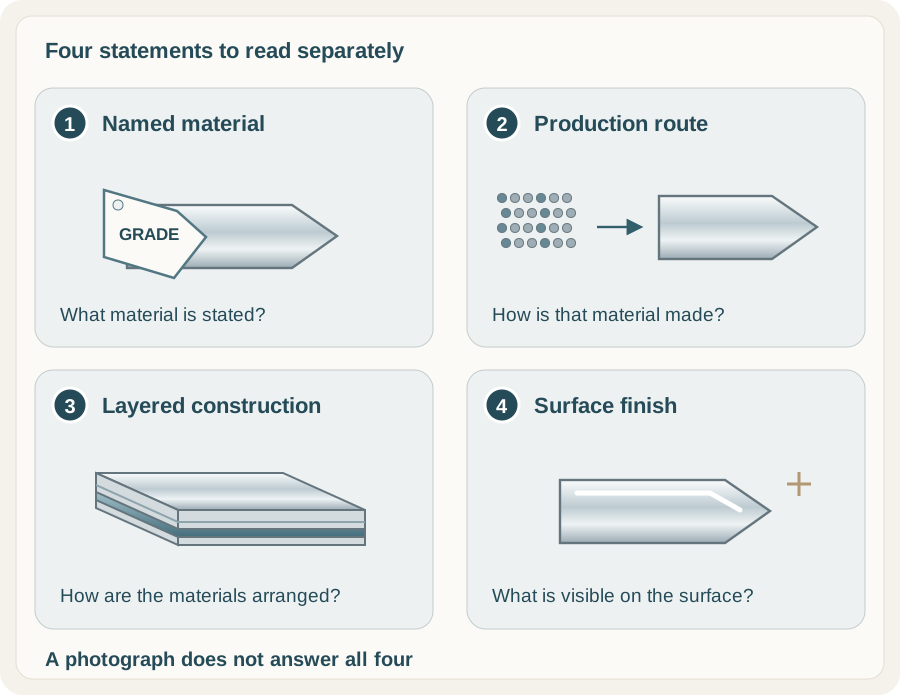 Open illustration at full size
- Named materialThe stated grade or maker alloy name describes the material.
- Production routeA powder or sintered description concerns how the material is produced.
- Layered constructionThe core and surrounding layers describe an arrangement of materials.
- Surface finishPolishing, colour or a visible pattern describes the surface; ask for construction evidence separately.
A small wording change can mean a different claim. Juntetsu KS lists 440C and a powder-polished finish. Joewell SPM in 6.0 inches names Powder Metal Alloy. The first describes a surface; the second names a material. Start there before comparing the handles or blades.
Common labels, with useful boundaries
| Label | What it identifies | The next useful check |
|---|---|---|
| 440C or SUS440C | A stainless steel grade designation | The model’s actual edge and stated material |
| VG-10 / VG-10W | Two separately named stainless blade steels | Retain the complete stated grade; do not drop the W from a VG-10W model |
| ATS314 or ATS-314 | The cobalt stainless cutlery steel named on models such as Yasaka SL | Handle, selected size and edge; the grade is not a whole-tool specification |
| Cobalt alloy | A material description that needs more detail | Whether the maker means cobalt stainless steel or a cobalt-base alloy |
| Supreme Stainless Alloy | Joewell’s material name | The exact Joewell model and blade term |
| Powder or sintered material | A stated production or material description | The maker’s exact term and model construction |
| Damascus / layered blade | A construction description, when the maker confirms layers | Core, surrounding layers and edge; a visible pattern alone cannot establish them |
440C and VG-10
Böhler lists 440C as the market grade for N695 in its N695 material reference. That is useful grade context. It does not establish that Böhler supplied the material for a particular shear, or that the hardness quoted for Böhler’s product form is the finished shear’s hardness.
Takefu publishes representative composition data for VG10, including chromium, molybdenum, vanadium and cobalt, in its VG10 reference. The presence of cobalt does not make “VG-10” interchangeable with every other cobalt alloy label. A product-specific material statement is still needed.
The 440C guide, VG-10 and VG-10W guide and VG-10 versus 440C comparison use real model examples. Takefu’s VG10W reference gives that grade its own entry; the full name matters when reading Kasho Green.
ATS314 and the different uses of “cobalt”
Yasaka identifies ATS314 as a cobalt stainless cutlery steel in its material explanation. The SL model is a concrete example using that description.
Joewell separately describes cobalt-base alloys and Supreme Stainless Alloy in its materials reference. These are distinct terms. Do not replace them all with a generic “cobalt steel” label or assign a universal ranking from the word cobalt alone.
For more on the labels, use the ATS314 guide and cobalt alloy guide. The SL versus FX comparison shows how ATS314 and Supreme Stainless Alloy sit alongside different blade and handle descriptions.
If you are comparing an ATS314 tool with a ZA-18 claim, use the ZA-18 enquiry guide and ATS314 versus ZA-18 comparison brief. They explain what you need from the second model before making the comparison.
Powder and layered descriptions
A layered blade and a powder-production statement describe different things. Kasho’s Millennium reference names SG2 sintered steel. Its Damascus reference describes layered construction. Keep those statements beside the exact model rather than treating both as a premium-steel category.
Choose the next question you need answered:
- What does the production term mean? Read the powder-material guide.
- Where are the core, layers and edge? Use the layered-blade guide.
- How do two actual models differ? Compare Damascus and Millennium at 6.0 inches.
- What can the photograph show? Read the pattern and product-photo walkthrough.
- How would this enter a buying brief? Work through the illustrative detail-work example.
Put the service back into the comparison
The service-first guide starts with your regular cutting work. For a kit, the component-reading example separates the cutter, thinner and included tools. If an existing cutter has started cutting differently, use the changed-cut service brief before treating a new material as the solution.
Use the label to narrow a real choice
Suppose two cutters meet your hand and length requirements. One has the handle layout you want; the other carries a steel name you recognise. First decide whether both still meet your cutting brief. A familiar grade cannot correct an unsuitable hand, tool type or size.
Then compare what each maker actually specifies. Keep an unstated material or hardness field unstated rather than borrowing it from another model. For a thinner, add tooth layout to that comparison; the thinning guide explains why count alone is insufficient.
The buyer guide puts the construction fields in order. The Shear Finder applies type, hand, length and budget to its selected range, while the cutting collection gives you the wider catalogue.