Stiff, Rough or Noisy? What Your Pivot Is Telling You
A symptom, a likely cause, the check to run and the point at which to stop.
By JapanShears EditorialUpdated
On this page
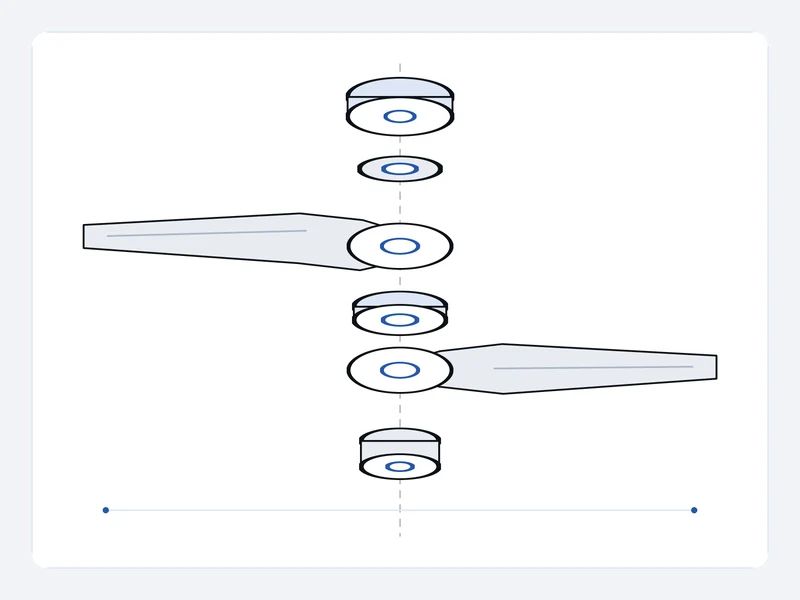
The pivot is where two blades become one tool. It holds the screw, often a washer or spacer, and in some builds a bearing system. When a shear changes how it closes, look here first, and stop early.
Short answer. Stiff, gritty or noisy closing most often comes from a dry or gummed pivot, residue, or tension set too tight. Do the maker-approved clean, dry and oil, then a tension check for your model. If the action does not recover, or the symptom began after a drop, a chemical soak or visible corrosion, stop and send the shear to a qualified professional.
Key takeaways
- Stiff, rough and noisy have different usual causes, so one fix does not fit all three.
- Stop at a hard catch or scrape. Cycling a misaligned pair can worsen edge contact.
- Tension systems differ, so there is no universal turn count or release angle.
- Blade set is a factory parameter. It is not adjusted at the screw.
- Check from history first: drop, chemical soak, service or recent adjustment.
What is actually at the pivot?
The tension screw holds the blades together and sets how firmly they press. Beneath it sit washers or spacers and, on some models, bearings. Tension systems vary: flat screws, thumb or butterfly screws, click dials, leaf springs, recessed tamper-resistant screws, ball-bearing pivots and fixed-factory builds that offer no user adjustment.
A bearing label does not prove the smoothest action or prescribe an oiling routine. Some bearing designs have their own lubrication provisions, so follow the instructions for your model. Our screw and tension basics guide covers the parts in more detail.
Which symptom points to which cause?
| Symptom | Likely cause | Check | Next step |
|---|---|---|---|
| Gritty or scratchy closing | Dry or gummed pivot, or residue around the screw | Look for visible debris, then do a maker-approved clean and dry | Oil as the maker directs and retest gently |
| Squeak | Dry pivot or old oil holding debris | Same as above | If it returns quickly, see a professional |
| Heavy or tight throughout the stroke | Tension too tight | Model-appropriate tension check from the maker | Adjust in the smallest increments the model allows. Stop if the screw is seized |
| Tight, and tension cannot cure it | Blade set (the designed-in spring gap) too great | Note that it persists after clean, oil and tension | Professional adjustment. It is not a screw job |
| Rough after chemical contact or with visible marks | Residue or corrosion at the pivot | Look without touching the edge | See rust spots, then a specialist |
| Rough or noisy after a drop | Alignment knocked | Do not cycle it repeatedly | Assessment before it touches client hair |
| Noise only while cutting | Edge condition rather than pivot | Compare closing with and without hair | Specialist assessment. See when shears push or fold hair |
| Loud closing stroke or hard stop | Worn or missing bumper | Inspect the cushion between the handles | Replace with a matching part. Fit is not universal |
| Gritty, with fine metal specks | Blades magnetised by storage on or near magnets | Check where the shear is kept | Ask a professional |
| Setting will not hold | Normal drift, a knocked thumb screw or worn washers | How fast does it change? | Smallest adjustments. A service can replace washers |
How do you do the checks safely?
Keep fingers and cloth off the cutting edge. Look under strong light. Note any drop, chemical soak, service or adjustment. History narrows the cause faster than feel.
For the clean and oil, use only what the maker specifies. Do not flood the pivot with alcohol or an unlabelled solvent. Oil is applied after cleaning and drying, in the maker’s amount. Our oils guide covers which oil.
What about the drop test?
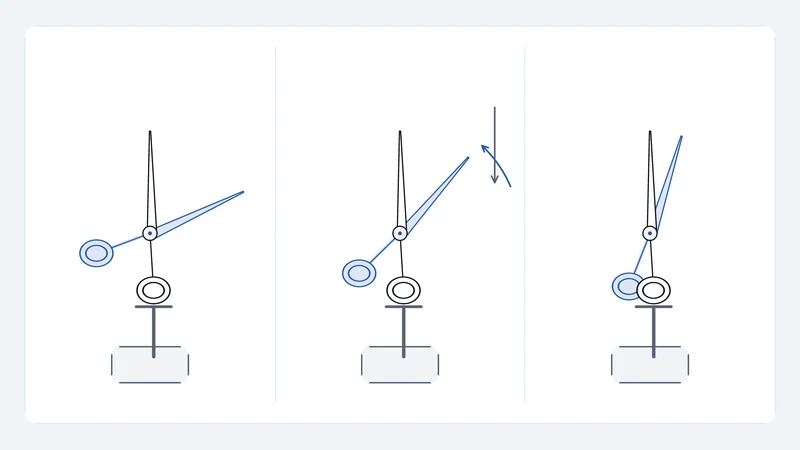
The drop test is a method some sources describe for checking tension. You open the moving blade to about 90 degrees, release it gently and note where it stops. The trouble is that published stop points differ between makers and trade sources. Use the target and method for your model, and treat the result as one clue among several. A complete fall or very little movement is a prompt to check, not a diagnosis.
When should you stop and hand it over?
Stop if any of these apply.
- There is a hard catch, a scrape or a new post-drop symptom.
- The screw is seized, or the mechanism is unfamiliar.
- Movement worsens after cleaning, oiling or adjusting, or roughness survives clean, oil and tension.
- You can see pits or craters.
A qualified service can inspect the pivot, washers and bearings, the set, the edge contact and the alignment. Our note on questions to ask before sharpening helps you brief them.
We sell shears and have not run cutting tests, so this page covers what to check, not what a given pair will do.
Common mistakes
- Cycling the blades repeatedly after a hard catch or a drop.
- Copying a turn count or release angle from another maker’s shear.
- Reaching for the screw first when the cause is residue or a worn bumper.
- Flooding the pivot with oil or solvent.
- Expecting the tension screw to correct blade set.
Questions people ask
Is a squeak always an oil problem?
It is the most common cause, but not the only one. Residue, tension and alignment can all contribute.
Can I just tighten the screw to stop it feeling loose?
Only in the maker’s increments, and a fold or push in the cut can also come from edge or alignment. Tightening is not a repair for those.
Further reading
- Shear screw and tension basics
- Ten signs your shears need attention
- Ten care habits for Japanese hair scissors
- Shear oil, cases and accessories
- Rust spots on shears: causes and what to do
- The knowledge base and the troubleshooting answers in the FAQ.
- Scissorpedia for general scissor reference.
Scissorpedia is a fellow member of the ShearAlliance (see ShearAlliance).