JapanShears Editorial · Published
10 Mistakes to Avoid When Buying Shears Online
Ten online-buying mistakes that cost stylists time and money, from trusting the family photo to skipping the returns terms, with a fix for each.

On this page
- How this list was chosen
- 1. Deciding from the photograph
- 2. Not rereading the cart
- 3. Comparing headline prices
- 4. Buying from a seller you cannot identify
- 5. Ignoring where the seller delivers
- 6. Reading returns and warranty after a problem
- 7. Treating similar names as the same model
- 8. Not keeping a copy of the listing
- 9. Skipping the set contents
- 10. Having no plan for the day it arrives
- A five-line habit
- When to buy somewhere else
- Questions people ask
- Further reading
You cannot hold an online shear before you buy it, so the page has to do the work your hand would have done. Most online mistakes come from reading the page too quickly: the wrong option, the wrong hand, a tool that arrives as half of what you expected. Each of the ten below has a short fix.
Short answer. Decide the exact option before you compare prices, read the cart as carefully as the product page, and keep your own record of what you ordered. Check delivery, returns and warranty terms before you pay, not after the parcel arrives.
How this list was chosen
This list covers the mistakes that online shear buyers make most often, drawn from general ecommerce practice and from how this store’s own listings work. It is not based on survey data or on testing any product. Reviewed 4 November 2026. Mistakes about the shear itself, such as copying another stylist’s size, are in 10 hair scissor buying mistakes you can avoid; this list is about the online transaction.
1. Deciding from the photograph
A product photograph usually shows one example from a family of options. The written selection, not the picture, identifies the hand, size and contents. Fix: read the option name and the specification tab, and treat the image as an illustration of the family.
2. Not rereading the cart
A size button can change the edge, the hand or one component of a set. Fix: open the cart and compare the option name and SKU with the page you chose from. If a line differs from what you intended, change it before paying. Our guide to reading a listing walks through three real examples.
3. Comparing headline prices
A starting price on a collection page is not always the price of the option you want, and a lower price can belong to a different tool. Fix: compare the selected option’s price, then add everything the order needs to be useful: a case, a care product or a second tool if the job calls for one.
4. Buying from a seller you cannot identify
Before you pay, you should be able to find who the seller is and how to reach them. Fix: look for a named business, a contact route and written delivery and returns terms. JapanShears publishes its contact form, a shipping page and an editorial policy explaining how its articles are written.
5. Ignoring where the seller delivers
A store that does not deliver to your address cannot help you, however good the range. JapanShears delivers within Australia. Readers elsewhere will find a regional route on the ShearAlliance page, which lists fellow members by country. The shipping page states current terms.
6. Reading returns and warranty after a problem
Returns conditions, warranty arrangements and your rights under Australian Consumer Law all matter most when something is wrong, which is the worst time to find them. Fix: read the Returns page and Warranty page before ordering, and note what condition the shear must be in for an exchange. The ACCC’s consumer guidance covers the general rights.
7. Treating similar names as the same model
Shear families often share a word, with differences in edge, handle or contents behind it. Fix: match the full model name and the SKU, not the first word. The similar-names guide shows examples, and the authenticity checklist covers what a visual check can and cannot establish.
8. Not keeping a copy of the listing
Pages are edited, options are renamed and products are updated. If a question arises later, your memory of the page is weak evidence. Fix: save the order confirmation, note the selected SKU and keep a screenshot or printout of the specification tab on the day you buy.
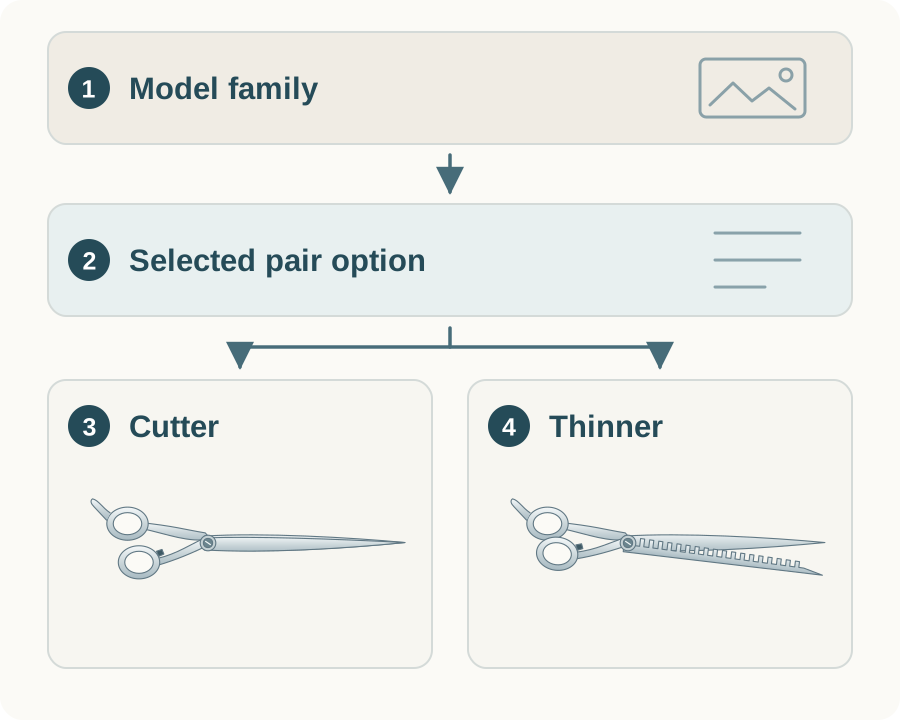 Open illustration at full size
- Model familyUse the title and family photograph to identify the listing. They do not describe every available configuration.
- Selected optionRead the complete chosen label and SKU before its price and specification fields. Changing an option may change more than length.
- Cutter in the optionRead this tool’s own hand, nominal length and edge. Do not copy those fields to the thinner.
- Thinner in the optionRead its own hand, nominal length and tooth description. Keep an unstated field open rather than borrowing it from another listing.
9. Skipping the set contents
A set is two or more tools, each with its own length, hand and teeth. A “set” does not tell you how many tools you will receive, or that the cutter and thinner share a nominal size. Fix: read the contents line and any per-tool details before you compare it with a single shear. The set comparison guide shows how.
10. Having no plan for the day it arrives
Parcels get knocked about, and a mismatch is easier to resolve when you can show the starting condition. Fix: open the parcel in good light, photograph the contents next to your order record and run through the checks in 10 things to check when your hair scissors arrive. If you ship a parcel back or for service, Australia Post lists the packaging and tracking options.
A five-line habit
Before you pay, say these five lines to yourself: which hand, which job, which exact option, what is in the box and what happens if it is wrong. If you cannot answer one, the page is not finished with you. Then keep the order record with a simple maintenance log, which doubles as proof of what you bought.
When to buy somewhere else
Choose a different seller if the listing omits the hand, the contents or the SKU, if the delivery and returns terms are not published or if you cannot find a way to reach a person. For the questions to ask any seller, use 10 questions to ask before buying hair cutting scissors. The knowledge base collects the rest of this site’s buying guidance.
Questions people ask
How do I check a store I have not used before? Look for a named business, a way to contact a person and written delivery, returns and warranty terms. Read them before you pay.
What should I keep after ordering? Keep the confirmation, the selected SKU, a copy of the specification tab and your photographs from the day the parcel arrives.
Further reading
- Scissorpedia, an information website on scissors in general.
- ACCC and Australia Post, for consumer rights and parcel services.
Scissorpedia is a fellow member of the ShearAlliance; see ShearAlliance.
A closer look at shears
Comparing two models? Send us their names or SKUs and the cutting work you have in mind.
Latest blog posts
Read all blog posts
10 Japanese Shear Myths and What Is Actually True
Ten common beliefs about Japanese shears, from blade length to steel and origin, with a plain correction and a way to check each one.
10 Questions to Ask Before Buying Japanese Shears
Ten questions about your hand, your work and the listing that settle most shear purchases before steel, finish or brand come into it.