JapanShears Editorial · Published
10 Questions to Ask Before Buying Japanese Shears
Ten questions about your hand, your work and the listing that settle most shear purchases before steel, finish or brand come into it.
On this page
Answer these ten questions before you open a single product page. Five are about you and your work; five are about what a listing actually states. A shear that fails any one of them is the wrong shear, however good its steel or finish looks.
Short answer. Name your cutting hand, the job the tool will do most often and the tool you already trust. Then check that the listing states the exact blade edge, handle layout and length, and says what is in the box. Brand and material come last.
How this list was chosen
These ten questions come from general trade practice and from how this store’s product listings are written. They are not the result of testing any shear, and no product is ranked here. Reviewed 4 November 2026. Questions about the seller itself (contact details, delivery, returns, records) are covered separately in 10 questions to ask before buying hair cutting scissors.
Questions about you and your work
1. Which hand cuts?
Left-handed shears are built differently from right-handed ones; turning a right-handed pair over does not create a left-handed tool. Decide your cutting hand first, then keep it fixed for every comparison. Where a listing offers both hands in one selector, confirm the selected option before you order. Our left versus right-handed guide shows the construction difference.
2. What job will this shear do most often?
Point cutting, blunt lines, slide cutting, comb work and close detail ask different things of a blade. Pick the job that fills most of your day and buy for that. A second job usually deserves a second tool, not a compromise in the first.
3. Which tool do you already trust, and what does it fail to do?
Your current shear is the most useful reference you have. Write down its nominal length, handle layout and edge, then name the one thing it does not do well. A new purchase should fix that single thing; a purchase with no stated reason tends to repeat the old shear in a new finish.
4. What length can you control?
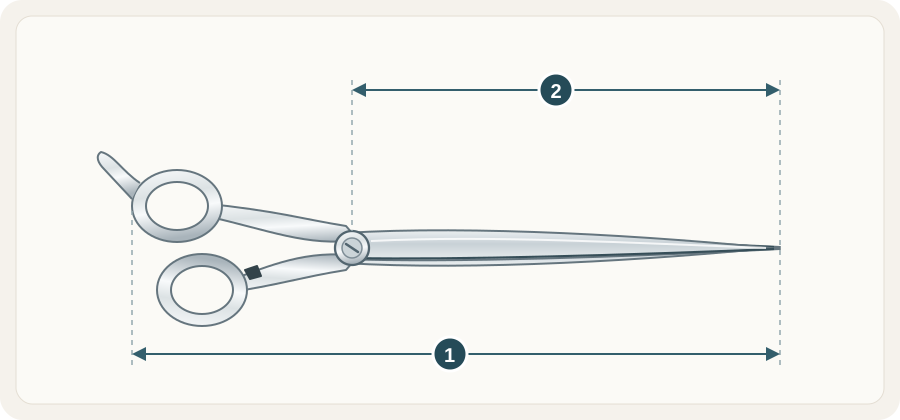
Nominal size, in inches, measures the whole tool. The cutting blade is shorter, and two tools with the same label can have different blade lengths. Choose the reach you can place accurately, and use the size guide and the barber reach guide to separate the two measures.
 Open illustration at full size
- Overall tool lengthCompare the maker’s stated whole-tool size. Finger-rest treatment can vary.
- Blade lengthA separate blade measurement. Check the model specification rather than converting its nominal inch label.
5. Which handle layout is familiar?
Opposing rings, offset, crane and swivel-thumb designs change where the thumb and fingers sit. That is a question of fit and habit, not of which layout is superior. Compare against the handle you already use, and read the handle comparison for the vocabulary.
Questions about the listing
6. What is the blade edge, exactly?
Convex, bevelled and micro-serrated describe the cutting edge. Sword, bamboo-leaf and straight describe the blade line. These are separate fields, and a listing that names only one has left the other open. The blade and edge explainer and the convex edge guide set them out side by side.
7. What does the material line prove?
A named steel tells you what the maker lists. It does not, on its own, tell you how a model cuts or how long its edge lasts, and a hardness figure is one property among several. Treat “Japanese” the same way: a brand’s country and the place a model is made are separate claims. The guide to origin wording explains the difference.
8. Is this one tool or a set?
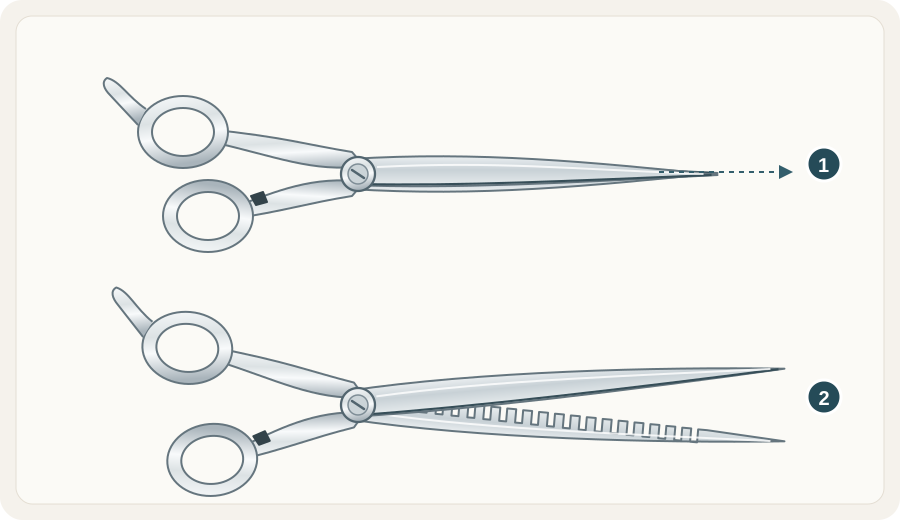
A set contains at least two tools, each with its own length, hand and teeth. A listing for a “5.5-inch set” may pair a 5.5-inch cutter with a thinner of a different length. Read both component records before you compare a set with a single shear.
 Open illustration at full size
- Cutter choiceA set’s size selector may change the cutter only.
- Included thinnerIts length and tooth count may stay the same across those choices.
9. Who can service this design, and how do you care for it?
Convex edges and toothed blades suit a technician who knows that geometry. Look for the care instructions supplied with the model, and decide before you buy how you will clean, dry, adjust and store it. The care guide covers routine care, and ten questions before sharpening covers the service conversation.
10. What happens if it is wrong?
Check the returns and warranty terms before you order, not after the parcel arrives. JapanShears delivers within Australia, and your rights under Australian Consumer Law apply whichever seller you use. Keep the order record and the selected SKU; the Returns page and Warranty page explain this store’s process.
Turn the answers into a shortlist
Take your answers to the shear finder or the cutting shears collection, and filter by hand and length first. Compare two or three exact options on edge, handle and set contents, then use price to choose between them. For a wider route through the topic, the Japanese shear buyer’s guide and the knowledge base go deeper on each field.
Questions people ask
Should I choose a brand before I choose a shear? Choose the job, hand, length and handle first. A brand is a way into a range, and the exact model decides what you receive.
Do I need to know the steel before I buy? It helps, but a named steel is one input. It does not tell you how the model cuts, and fit and edge usually settle the choice sooner.
Further reading
- Scissorpedia, an information website on scissors in general.
- The ACCC’s consumer guidance on shopping rights in Australia.
Scissorpedia is a fellow member of the ShearAlliance; see ShearAlliance.
A closer look at shears
Comparing two models? Send us their names or SKUs and the cutting work you have in mind.
Latest blog posts
Read all blog posts
10 Japanese Shear Myths and What Is Actually True
Ten common beliefs about Japanese shears, from blade length to steel and origin, with a plain correction and a way to check each one.

10 Mistakes to Avoid When Buying Shears Online
Ten online-buying mistakes that cost stylists time and money, from trusting the family photo to skipping the returns terms, with a fix for each.