JapanShears Editorial · Published
10 Japanese Shear Myths and What Is Actually True
Ten common beliefs about Japanese shears, from blade length to steel and origin, with a plain correction and a way to check each one.
On this page
- How this list was chosen
- 1. “A six-inch scissor has a six-inch blade”
- 2. “More teeth always remove less”
- 3. “Japanese steel means made in Japan”
- 4. “Higher hardness means better scissors”
- 5. “Any shear works in the other hand”
- 6. “Convex, hollow-ground, sword and bamboo-leaf are rival grades”
- 7. “If hair folds, the scissors are blunt”
- 8. “A good shear never needs adjustment or service”
- 9. “Oil disinfects scissors”
- 10. “An ergonomic handle suits every hand”
- What the ten have in common
- What to read next
- Questions people ask
- Further reading
Most shear myths are half-truths: a rule that holds for one model, repeated as if it held for all. Correcting them rarely needs more than one distinction, such as nominal size against blade length, or a brand’s home country against where a model is made.
Short answer. Treat every one-line rule about shears as a question to check against the exact model. Size, steel, hardness, tooth count, origin and handedness are each separate facts, and none of them settles a purchase alone.
How this list was chosen
We picked ten beliefs that come up repeatedly when stylists compare shears, and corrected each using general trade knowledge and the way this store’s listings are written. It is not a survey and no product was tested. Reviewed 4 November 2026. Where a model is named elsewhere on this site, its own page is the source for its details.
1. “A six-inch scissor has a six-inch blade”
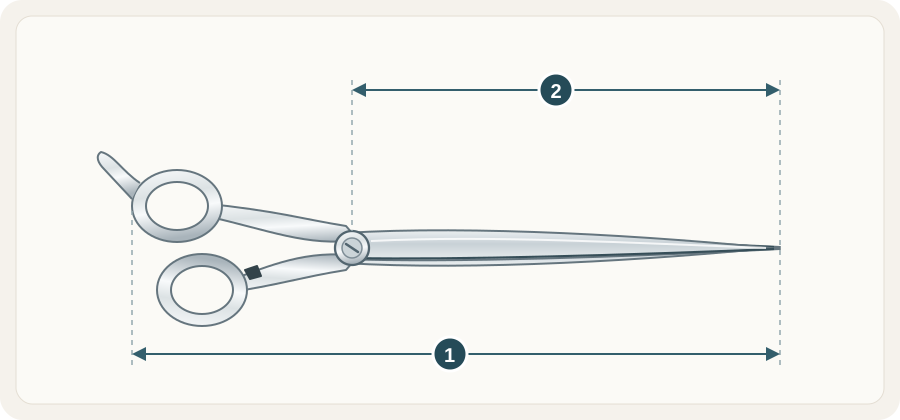
What is true: nominal size is the marketed length of the whole tool, and the cutting blade is shorter. Two tools with the same label can have different published blade lengths. How to check: look for the maker’s blade figure, and read the reach guide for a worked example.
 Open illustration at full size
- Overall tool lengthCompare the maker’s stated whole-tool size. Finger-rest treatment can vary.
- Blade lengthA separate blade measurement. Check the model specification rather than converting its nominal inch label.
2. “More teeth always remove less”
What is true: tooth count is only the number of teeth. Tooth width, spacing and the opposing blade shape the result, so two thinners with the same count can behave differently, and a higher count does not guarantee a lighter cut. How to check: use a maker’s cut ratio for the exact model if one is published; see same count, different thinners.
3. “Japanese steel means made in Japan”
What is true: the steel, the brand’s country and the place a model is made are three separate claims. A listing can support one without the others. How to check: read each claim on its own, and use the guide to origin wording. The same applies to a brand that is Japanese-inspired rather than Japanese.
4. “Higher hardness means better scissors”
What is true: hardness, usually quoted on the Rockwell C scale, is one measured property. It is not a direct score for cutting quality, comfort or value. How to check: ask whether the figure changes your decision. If it does not, leave it as a footnote and compare edge, handle and fit instead.
5. “Any shear works in the other hand”
What is true: a left-handed shear has blade construction and a handle arrangement built for the left hand. Turning a right-handed shear around, or using one marked as reversible, is a different thing, and some people who learned on a flipped tool need time to adjust. How to check: confirm the exact variant, and see the handedness guide.
6. “Convex, hollow-ground, sword and bamboo-leaf are rival grades”
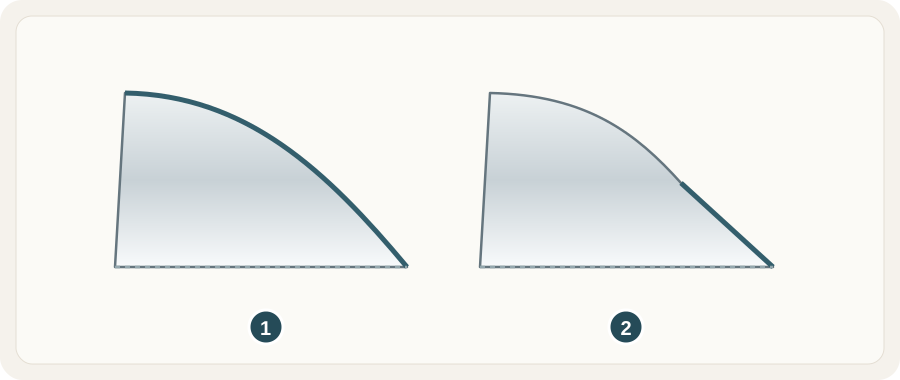
What is true: they describe different aspects of construction. Convex and bevelled describe the edge; sword and bamboo-leaf describe the blade outline; hollow grinding describes the inner face. How to check: compare one dimension at a time, using the blade and edge explainer.
 Open illustration at full size
- Convex profileA curved outside approaches the cutting edge.
- Defined bevelA flat bevel approaches the cutting edge. Read the exact maker term.
7. “If hair folds, the scissors are blunt”
What is true: folding is a symptom with several plausible causes, including trapped hair, tension, edge wear and technique. How to check: clean and dry the shear, note where on the blade it happens, and follow the steps in 10 signs your shears need attention before assuming the edge is the cause.
8. “A good shear never needs adjustment or service”
What is true: ordinary ownership includes the care that suits the model’s mechanism, and damage after a drop is different from gradual change. No material removes the need for care. How to check: read the care instructions for the model and plan a service route before you need one; ten ways to make shears last covers this.
9. “Oil disinfects scissors”
What is true: lubrication and disinfection have different purposes. Oil is for the pivot, as the model’s instructions describe; it is not a hygiene process. How to check: follow your workplace procedure and local requirements for cleaning and disinfection, and keep oiling as a separate step.
10. “An ergonomic handle suits every hand”
What is true: a handle layout puts the thumb and fingers in a particular relationship, and fit is personal. A label such as “ergo” describes geometry, not an outcome. How to check: compare the ring opening, the ring position and the working posture with your current tool; the handle comparison guide lists the vocabulary.
What the ten have in common
Every myth turns a variable into a constant. The correction is the same each time: name the dimension, find the model’s own statement of it and compare like with like. A listing that gives you the field gives you something to compare; a listing that gives you a slogan gives you nothing to check.
What to read next
If you are deciding what to buy, start with ten questions to ask before buying Japanese shears and the spec-sheet lines worth reading. For the wider library, see the knowledge base and the Japanese shear buyer’s guide.
Questions people ask
Are Japanese shears better than other shears? Country is not a construction. Japanese makers sell both flat-bevel and convex blades, and so do makers elsewhere, so compare two exact specifications; see Japanese and German hair shears.
Is a Japanese-inspired brand a Japanese brand? No. Kamisori, for example, is a Canadian brand with Japanese-inspired designs; some models are made in Japan. The brand’s country and the place of manufacture are separate facts.
Further reading
- Scissorpedia, an information website on scissors in general.
- Scissors on Wikipedia, for general background.
Scissorpedia is a fellow member of the ShearAlliance; see ShearAlliance.
A closer look at shears
Comparing two models? Send us their names or SKUs and the cutting work you have in mind.
Latest blog posts
Read all blog posts
10 Mistakes to Avoid When Buying Shears Online
Ten online-buying mistakes that cost stylists time and money, from trusting the family photo to skipping the returns terms, with a fix for each.
10 Questions to Ask Before Buying Japanese Shears
Ten questions about your hand, your work and the listing that settle most shear purchases before steel, finish or brand come into it.