JapanShears Editorial · Published
10 Tips for Your First Week With New Shears
Ten steps for the first week with a new shear: check it, compare it with your old one, practise before clients, keep notes and know your return terms.

On this page
A new shear is a change to something your hands know well, so the first week is partly about the tool and partly about you. Check it, compare it with the one it joins, practise before you use it on a client and write down what you notice. Do all of that before you decide anything.
Short answer. Inspect it on arrival, handle it gently, practise on a familiar exercise before a paying client and keep your old shear to hand as a reference. Record your impressions in writing, and read the returns terms during the first week, not after it.
How this list was chosen
These steps come from general trade practice for introducing a new tool and from the questions customers commonly raise after an order arrives. They are not a testing protocol, and they make no claim about how any model will feel. Reviewed 4 November 2026. For the unboxing checks in detail, use 10 things to check when your hair scissors arrive.
Day one: receive it properly
1. Check it against the order
Compare the maker, model, selected hand, size and set contents with your confirmation and the selected SKU. If anything differs or looks damaged, leave the shear unused and contact the seller with photographs and the order number. The arrival checklist walks through it.
2. Open and close it gently
Hold the shear by its handles and move the blades slowly. You are looking for an even action, not a test of the edge. If it catches or grinds, stop at that point and record what you felt; repeated force makes the report less useful.
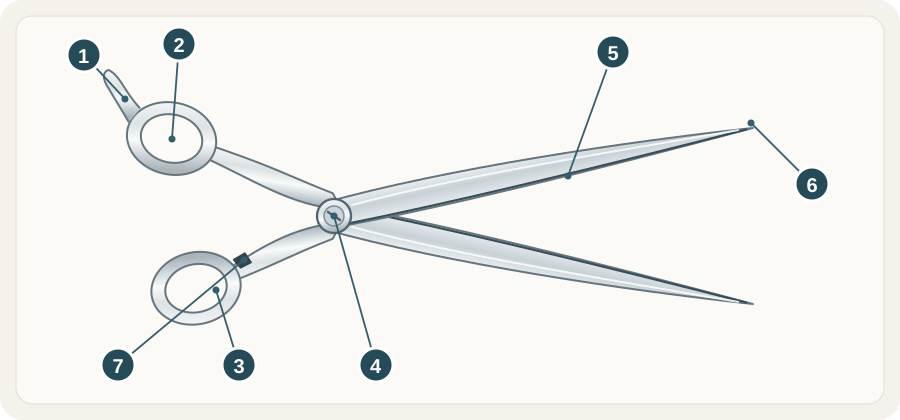 Open illustration at full size
- Finger restAlso called the tang; the small extension beside the finger ring.
- Finger ringThe bow on the handle opposite the thumb ring.
- Thumb ringConnected to the blade moved by your thumb.
- PivotThe joint where the two halves turn; tension hardware varies.
- Cutting edgeThe sharpened inner border where the blades meet.
- TipsThe ends of the blades. Compare their shape on the actual model.
- BumperA small stop between the handles, sometimes called a silencer.
3. Read the care instructions
Find the instructions supplied with the model, or the model’s care notes, before you adjust or oil anything. Pivot systems differ, and the method for one can be wrong for another. If nothing came with the shear, ask the seller.
Days two and three: compare and practise
4. Put it beside the shear you already use
Lay the two side by side and compare handle layout, ring openings, nominal length and the position of the tip. You are noting differences you will feel, such as a lower thumb position or a longer reach. The fit guide gives words for what you see.
5. Practise before a paying client
Run a familiar exercise on a practice head or on hair where a slip does not matter, as your educator or salon would expect. Cut the movement you know best first. Introducing a new tool on a new technique asks two things of you at once.
6. Allow time to adjust
A different handle or length can feel unfamiliar before it feels natural, and that is normal. Judge the shear across several sessions, not several minutes, and keep notes on what specifically feels different. If it never settles, the notes tell you why.
Days four and five: use it, with a reference
7. Keep your old shear within reach
Having the familiar tool beside you gives you a direct comparison when something feels off. It also means a client is never waiting while you decide. Resist retiring the old shear until you are sure the new one covers its work.
8. Start with a cut you know
Use the new shear on a cut whose result you can judge easily, so any difference is visible. Save the unfamiliar or high-stakes cuts for later in the week. A clear result on a known cut teaches you more than a mixed result on a new one.
9. Build the care routine at once
Clear hair, dry the shear and store it covered from the first session. Starting the habit on day one is easier than adding it later, and it protects the tool while you are still deciding about it. Ten care habits for every working day sets them out by time.
Day six and seven: decide
10. Write down what you noticed, and read the returns terms
Write a few lines: where the tip lands, how the ring opening feels, whether the reach suits your work and what you would change. Then read the Returns page and the Warranty page while the shear is still in the condition they describe. If you are keeping it, start a maintenance log with those notes.
If it is not right
Contact the seller with your order number, the selected SKU and your notes, and wait for the next step before returning anything. Your rights under Australian Consumer Law apply as well as the store’s terms. If the issue is a change in the cut rather than a fit question, read ten signs your shears need attention.
What to read next
If the new shear fits but you are thinking about a second one, ten questions before adding a second shear is the next step. The knowledge base collects the rest of the buying and care guidance.
Questions people ask
How long until a new shear feels natural? It varies with the handle, the length and your habits. Judge across several sessions and keep notes on what is different.
Can I return a shear I have already used? Eligibility and condition rules are on the Returns page. Read them in the first week, before regular use.
Further reading
- Scissorpedia, an information website on scissors in general.
- ACCC, for consumer rights in Australia.
Scissorpedia is a fellow member of the ShearAlliance; see ShearAlliance.
A closer look at shears
Comparing two models? Send us their names or SKUs and the cutting work you have in mind.
Latest blog posts
Read all blog posts
10 Japanese Shear Myths and What Is Actually True
Ten common beliefs about Japanese shears, from blade length to steel and origin, with a plain correction and a way to check each one.

10 Mistakes to Avoid When Buying Shears Online
Ten online-buying mistakes that cost stylists time and money, from trusting the family photo to skipping the returns terms, with a fix for each.