JapanShears Editorial · Published
10 Shear Spec-Sheet Lines and What Each One Tells You
Ten lines on a shear spec sheet, from nominal size to cut ratio, with what each one tells you, what it leaves out and the question to ask next.
On this page
- How this list was chosen
- 1. Nominal size: the label, not the blade
- 2. Blade length: the figure that is often missing
- 3. Cutting hand: construction, not grip
- 4. Handle layout: where the thumb sits
- 5. Edge: convex, bevelled or micro-serrated
- 6. Blade profile: sword, bamboo-leaf, straight
- 7. Steel designation: a name, with limits
- 8. Hardness: one property among several
- 9. Tooth count: not a removal rate
- 10. Pivot and tension: how the blades are joined
- What a spec sheet cannot tell you
- Next steps
- Questions people ask
- Further reading
A spec sheet is a list of claims, and each line answers one narrow question. Read ten of them in order and you can describe a shear precisely enough to compare it with another; read none and you are comparing photographs.
Short answer. Nominal size, blade length, hand, handle layout, edge, blade profile, steel, hardness, tooth count and pivot are the ten lines worth reading. Treat each as a separate fact, and ask what it leaves out before you let it decide a purchase.
How this list was chosen
We picked the ten fields a stylist most often meets on a shear listing and most often misreads, based on how listings are written in general and on this store’s own product pages. It is an explanatory list, not a ranking, and no product was tested. Reviewed 4 November 2026. The full A to Z of terms is in the 20-term glossary.
| Line | Tells you | Leaves out |
|---|---|---|
| Nominal size | Marketed whole-tool length | Blade reach |
| Blade length | Maker’s cutting-blade figure | Feel and balance |
| Cutting hand | Which hand the build suits | Fit of the handle |
| Handle layout | Where thumb and fingers sit | Ring opening size |
| Edge | Convex, bevelled or serrated | Blade shape |
| Blade profile | Outline of the blade | Edge finish |
| Steel designation | Named material | Heat treatment, edge behaviour |
| Hardness | One measured property | Cutting quality |
| Tooth count | Number of teeth | Amount of hair removed |
| Pivot and tension | How the blades are joined and adjusted | Condition over time |
1. Nominal size: the label, not the blade
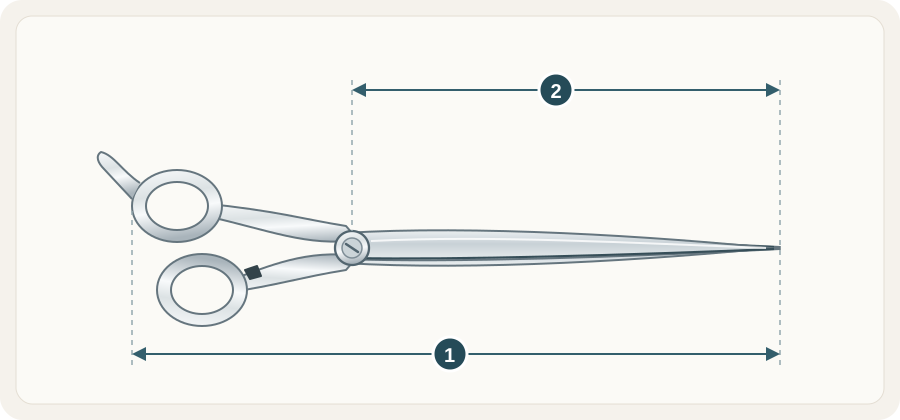
Nominal size is the marketed length of the whole tool, usually in inches. It helps you browse and match a familiar tool. It does not say how much blade you have. Treat it as a filing label, and see the definition of nominal length.
2. Blade length: the figure that is often missing
Where a maker publishes a cutting-blade measurement, it tells you more about reach than the inch label. Many listings omit it. If reach matters to your work, ask for it or look on the maker’s model page, and note which endpoints the maker measures between.
 Open illustration at full size
- Overall tool lengthCompare the maker’s stated whole-tool size. Finger-rest treatment can vary.
- Blade lengthA separate blade measurement. Check the model specification rather than converting its nominal inch label.
3. Cutting hand: construction, not grip
“Left” and “Right” describe the blade and handle build. A listing that offers both in a selector is selling two options of one model, and the selected SKU decides which you receive. Read it twice, once before adding to cart and once in the cart.
4. Handle layout: where the thumb sits
Opposing, offset and crane layouts, and fixed or swivel thumbs, are descriptions of geometry. They say nothing certain about comfort in your hand. Compare against the handle you already use; the handle comparison guide lists what each term means.
5. Edge: convex, bevelled or micro-serrated
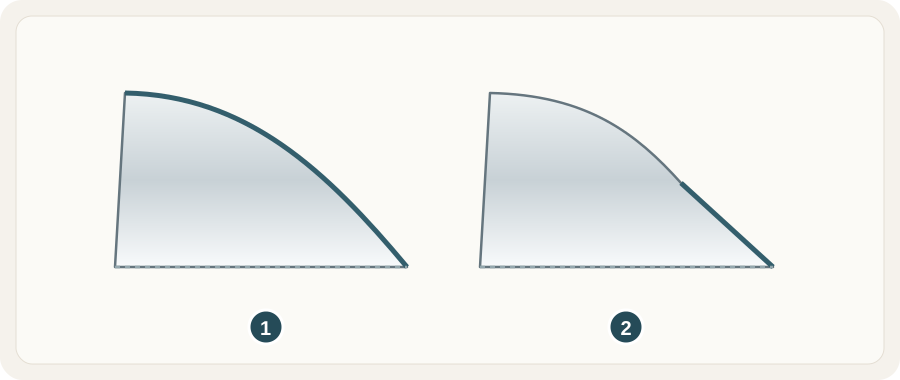
The edge line describes the surface that does the cutting. A convex edge has a curved profile approaching the cutting edge, a bevelled edge is formed with a flat bevel surface and a micro-serrated edge carries fine serrations. It is different from the blade outline, and a technician needs to know it before sharpening. The convex edge guide shows the profiles.
 Open illustration at full size
- Convex profileA curved outside approaches the cutting edge.
- Defined bevelA flat bevel approaches the cutting edge. Read the exact maker term.
6. Blade profile: sword, bamboo-leaf, straight
Profile describes the outline: a reinforced sword shape, a broad bamboo-leaf curve or a plain straight blade. It is not an edge grade and not a steel. Keep it in its own row of your comparison so that “convex” and “sword” are not treated as rivals.
7. Steel designation: a name, with limits
A named steel such as VG-10 or 440C tells you what the maker lists. It does not tell you the heat treatment, the finishing or how a model behaves in use. Read the steel library for what each grade is, and treat the name as one input to the choice, not the verdict.
8. Hardness: one property among several
Hardness is often quoted as a Rockwell C figure. It is a measured property with a stated context; it is not a score for cutting quality, comfort or value. A figure that does not change your decision can stay a footnote rather than a reason to buy.
9. Tooth count: not a removal rate
On a thinning or texturising shear, tooth count is the number of teeth. It does not tell you how much hair a closure removes: tooth width, spacing and the opposing blade matter too. Where a maker states a cut ratio, it belongs to that exact model. The cut-ratio guide explains how to read one, and same count, different thinners shows why.
10. Pivot and tension: how the blades are joined
The pivot is the joint; tension is the designed resistance of the closing blades. Screws, bearings and click-lock systems differ by model, and each has its own adjustment instructions. A listing that names the system is telling you what to look for in the care notes, not promising how smoothly it will move next year.
 Open illustration at full size
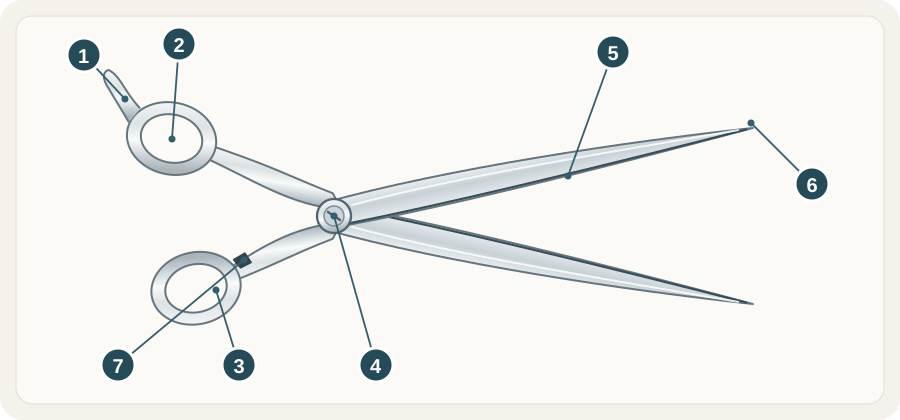
- Finger restAlso called the tang; the small extension beside the finger ring.
- Finger ringThe bow on the handle opposite the thumb ring.
- Thumb ringConnected to the blade moved by your thumb.
- PivotThe joint where the two halves turn; tension hardware varies.
- Cutting edgeThe sharpened inner border where the blades meet.
- TipsThe ends of the blades. Compare their shape on the actual model.
- BumperA small stop between the handles, sometimes called a silencer.
What a spec sheet cannot tell you
It cannot tell you how a shear feels in your hand, how it cuts the hair you work with or whether the exact unit that arrives is sound. For the last, follow the arrival checklist. For the rest, compare against your current tool on one job, and use the listing reading guide to check every selected option.
Next steps
Choose two models that name every one of the ten lines, and compare them line by line. If a field is missing, say so in your notes rather than assuming it. The Japanese shear buyer’s guide and the knowledge base carry the wider context.
Questions people ask
Which spec line matters most? It depends on the job. For reach it is the blade length, for fit the handle layout and for a toothed tool the maker’s cut ratio for that exact model.
What if the listing leaves a field out? Record it as unknown, compare the lines you do have and ask the seller or check the maker’s model page rather than assuming.
Further reading
- Scissorpedia, a reference website on scissors.
- Scissors on Wikipedia, for general background.
Scissorpedia is a fellow member of the ShearAlliance; see ShearAlliance.
A closer look at shears
Comparing two models? Send us their names or SKUs and the cutting work you have in mind.
Latest blog posts
Read all blog posts
10 Japanese Shear Myths and What Is Actually True
Ten common beliefs about Japanese shears, from blade length to steel and origin, with a plain correction and a way to check each one.

10 Mistakes to Avoid When Buying Shears Online
Ten online-buying mistakes that cost stylists time and money, from trusting the family photo to skipping the returns terms, with a fix for each.