Made in Japan, Japanese brand or Japanese steel?
Three claims that sound like one, and what each tells you about a shear.
By JapanShears EditorialUpdated
On this page
A Japanese brand, Japanese steel and a shear made in Japan are three different claims. A listing can make one without the other two. Read the wording on the exact model, and treat anything the listing does not say as a question for the maker or the seller.
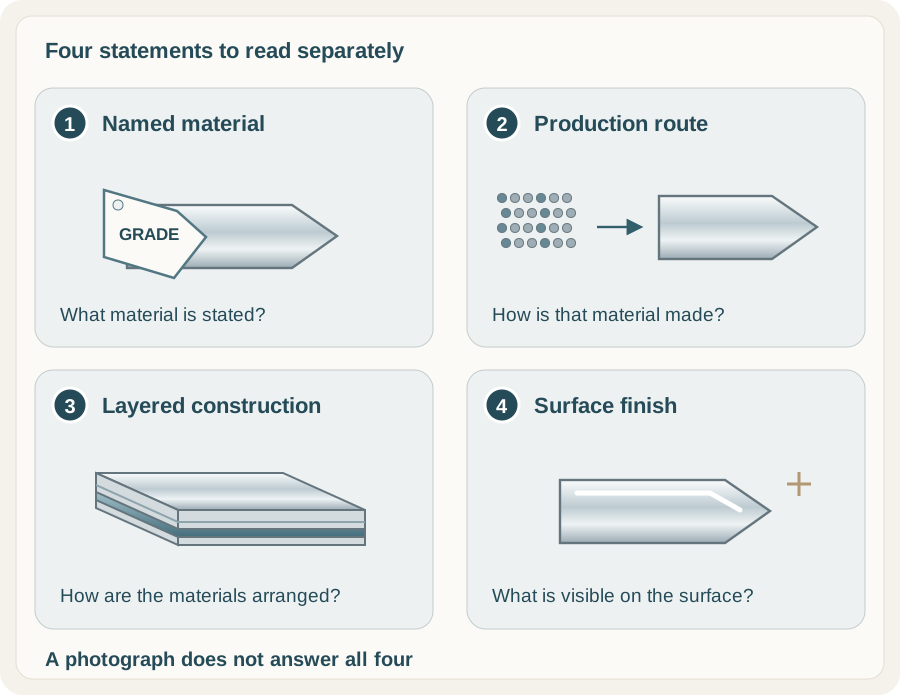 Open illustration at full size
- Named materialThe stated grade or maker alloy name describes the material.
- Production routeA powder or sintered description concerns how the material is produced.
- Layered constructionThe core and surrounding layers describe an arrangement of materials.
- Surface finishPolishing, colour or a visible pattern describes the surface; ask for construction evidence separately.
Four claims that get blended into one
| The claim | What it says | What it does not say |
|---|---|---|
| Japanese brand | The company or brand is Japanese | Where this model was made, or which steel it uses |
| Japanese steel | The maker names an alloy, often with a Japanese steel maker’s name | That the whole shear was made in Japan |
| Designed in Japan | The maker designed the model | Who made it or where |
| Made in Japan | The shear, or a stated production step, happened in Japan | Anything about the steel, the edge or whether it suits your cutting |
A fifth field sits beside these: the business address. It tells you where a company is based, not where a shear was made.
What the wording on an offer usually means
- “Japanese steel.” Ask which grade. VG-10, VG-10W, ATS-314, ZA-18 and 440C are material names. Our steel library explains them with stocked examples for several of them (none of our models lists ZA-18).
- “Forged” or “finished” in a place. Ask which production step the statement describes and where the maker records it. One step is not the whole shear.
- “Made in Japan.” Ask whether the statement is attached to this exact model and option, or to the brand in general.
- A company or workshop address. Ask whether it identifies the business, a production site or the service destination.
- An engraving or serial mark. It gives you something to record. It does not establish who made the shear or whether the seller is authorised; the authenticity checklist covers what you can check.
What we state for the brands we stock
We sell eight brands. This table records what our own brand pages and product pages say, not what a brand’s marketing says.
| Brand | Brand page and the “Country of origin” line on our product pages | Place of manufacture |
|---|---|---|
| Ichiro | Brand record: Japan. Product pages read Japan | Not stated per model on our listings |
| Juntetsu | An independent Japanese shear brand. Product pages read Japan | Not stated per model on our listings |
| Mina | An independent Japanese shear brand. Product pages read Japan | Not stated per model on our listings |
| Joewell | Brand record: Japan. Product pages read Japan | Not stated per model on our listings |
| Yasaka | Brand record: Japan. Product pages read Japan | Not stated per model on our listings |
| Kasho | Brand record: Japan. Product pages carry no origin line | Not stated per model on our listings |
| Kamisori | A Canadian brand with Japanese-inspired designs. Product pages read Canada | Some models are made in Japan; our listings do not say which |
| Feather | Brand record: Japan. Feather razors and blades are a separate product system, and their product pages carry no origin line | Not stated per model on our listings |
Read the “Country of origin” line on a product page as the brand’s country. Kamisori shows why: the line reads Canada, yet some Kamisori models are made in Japan. It is not a maker’s statement about the exact model in front of you.
“Not stated per model” means exactly that. We have not claimed a place of manufacture we cannot point to, and we would rather tell you so than imply one. Many Joewell and Kasho listings, and some Yasaka listings, link the maker’s own model page; that page is where to look for the maker’s statement about the model.
How to ask us
If place of manufacture matters to your purchase, send us the SKU of the option you are considering and the claim you want confirmed, for example “Is this model made in Japan, and where is that recorded?” We will answer from the maker’s statement, or tell you we do not have one. Keep the reply with your order record.
Where this fits in your choice
None of the three claims tells you how a shear will feel in your hand. Once the wording is clear, choose by cutting hand, reach, handle and edge. The buyer’s guide takes you through that order, and how to read a shear listing shows what each field on a listing does and does not prove.
For the Japanese and German comparison, read Japanese and German hair shears: compare the build. To see the makers side by side, start with the Japanese scissor brands shortlist.