JapanShears Editorial · Published · Updated
Japanese and German Hair Shears: Compare the Build
Compare Japanese and German shears by actual edge, hand, handle and pivot construction, with maker-specific examples rather than country stereotypes.
On this page
Compare the model’s construction
Japanese and German makers both offer several blade and handle designs. “Japanese” does not automatically mean convex, and “German” does not automatically mean bevelled. Put two actual specifications beside each other: their differences will tell you more about the choice than the country label.
A stated manufacturing origin can be useful product information. It does not supply a blade grind, cutting hand or measurement. Keep those fields separate, and use the exact model’s maker description when comparing tools from different ranges.
Three examples that break the shortcut
| Actual model | Stated construction | What the example establishes |
|---|---|---|
| Joewell FX 5.5 | Right-handed offset cutter; Standard Joewell blade | A Japanese-maker example whose named blade is flat and single bevel |
| Kasho Design Master Straight 5.5 | Right-handed straight handle; satin hollow semi-convex blades | Another construction and ring layout within Japanese shears |
| Jaguar Diamond E maker specification | Right-handed offset design; convex blades with integrated polished cutting edges | A German-maker example with a convex construction |
Joewell explains its Standard blade as flat and single bevel. KAI Europe’s Design Master reference describes that series’ semi-convex blades separately. Jaguar’s Diamond E specification identifies its own convex design. These are useful model facts; they are not a verdict on one country’s entire range.
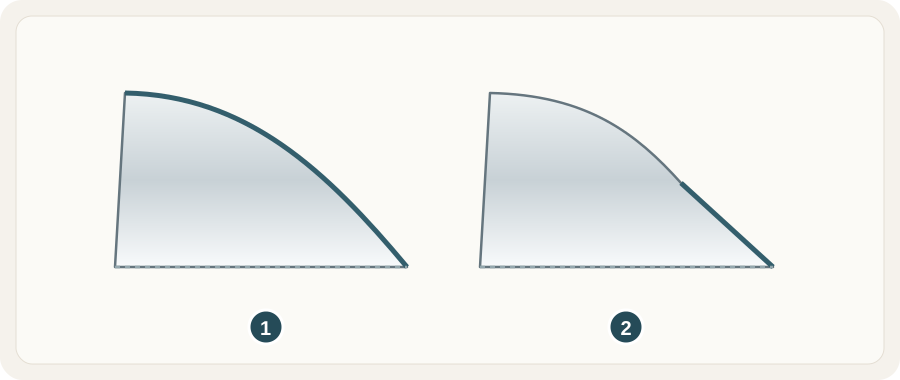 Open illustration at full size
- Convex profileA curved outside approaches the cutting edge.
- Defined bevelA flat bevel approaches the cutting edge. Read the exact maker term.
What to put side by side
| Check | Why it matters |
|---|---|
| Edge and blade line | Identify the edge and the curve along the cutting line separately; one does not establish the other. |
| Overall and blade length | Compare the maker’s nominal size and any separate blade measurement. |
| Handle layout | Ring stagger, shank angle and contours are different features. |
| Handed build | Confirm the blade and handle arrangement of the selected option. |
| Pivot and service | Identify the screw or bearing design and its care instructions. |
Our blade guide separates the edge, blade body and cutting line. The steel library explains grade names without treating hardness as a simple quality score. Compare those details after keeping the cutting hand and intended job fixed.
Hand and fit cross the country boundary
Left-handed build is a construction choice in either range. Jaguar’s left-hand explanation identifies the mirrored blade arrangement. It is the same question to establish before choosing a left-handed Japanese model: which hand is the actual tool built for? The handedness guide and left-hand shortlist help make that comparison.
Then consider ring opening, position and reach. The Design Master Straight 5.5 and Offset 5.5 show a handle-layout difference within the same series. Moving between those two does not require a country-level explanation.
Use the handle guide for offset and crane terms, and the practical fit guide for observations against a familiar tool. Brand geography cannot tell you whether a ring opening fits your finger.
Match the shear to your cutting work
For a drawing movement, compare the blade line and maker’s intended use alongside the smooth edge. For a solid line or comb work, compare the useful reach and the construction you can place against the guide. For weight adjustment, read the actual tooth design. The technique guide connects those questions to the task.
Before spending more, identify what the selected tool adds using the premium checklist. The budget guide keeps the comparison focused on useful construction and component coverage. Find another starting point in the fit gateway if the unresolved question is hand, ring layout or reach.
Keep the exact model and selected option in its service record. If a familiar tool starts pushing, catching or folding hair, set it aside and use the care and service hub before treating the change as a reason to buy from another country.
A closer look at shears
Comparing two models? Send us their names or SKUs and the cutting work you have in mind.
Latest blog posts
Read all blog posts
9 Professional Hair Scissor Stores to Compare in Australia
Compare Australian buying routes for professional hair scissors, with range differences, delivery-policy links, return conditions and a clearly labelled publisher entry.
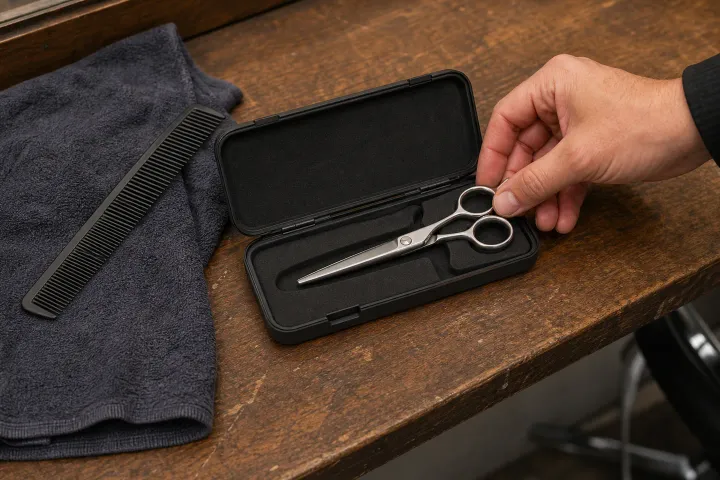
10 Scissor Cases, Wallets and Holsters to Compare
Compare ten different scissor storage layouts, from a single-tool case and paired pouch to fold wallets, larger cases and working holsters.